
Best Travel Tech Accessories: What’s Worth Packing in 2026
 Abdul WadoodLast updated

The average traveler now carries four to five electronic devices, and a dead battery at the wrong moment can derail a whole day. That single anxiety explains why the travel tech accessories market has exploded into a crowded shelf of power banks, adapters, trackers, and cables. Some of it is genuinely useful. A lot of it is plastic clutter that adds weight and solves nothing.
This guide takes a practical angle: which accessories actually earn their space, what to check before buying, and the mistakes that catch people out. It skips hype and focuses on the categories that consistently matter, from aviation battery rules to the small design details that separate a good gadget from a frustrating one.
Start With Power, Because Everything Else Depends on It
Power is the foundation of any travel tech kit. Without it, your phone is a paperweight, your earbuds are silent, and your camera is a brick. The good news is that the technology has matured, and the choices are clearer than they once were.
Power banks: capacity is only half the story
Most people shop for power banks by mAh number, which is a mistake. What matters is watt-hours (Wh) and output wattage. Watt-hours determine what you can legally fly with; output wattage determines whether your device charges quickly or crawls.
Airlines and aviation regulators generally express lithium battery limits in watt-hours, and the thresholds differ between carriers and countries. Spare power banks typically must travel in carry-on baggage rather than checked luggage. Before any flight, check the specific airline’s published policy rather than assuming a universal rule, because the numbers genuinely vary. (FAA: Lithium Batteries)
On output, look for USB Power Delivery (USB-PD), the standard that governs fast USB-C charging. A crucial detail: the charger, the cable, and the device must all support the same power profile to hit the advertised wattage. A 65W charger paired with a cheap cable can deliver far less. That mismatch is one of the most common reasons people feel let down by gear that is technically fine. (Power bank)
Travel adapters and the voltage trap
A plug adapter changes the shape of a plug. It does not change voltage. That distinction trips up more travelers than almost anything else in this category.
| Accessory | What it does | What it does not do |
|---|---|---|
| Plug adapter | Lets a plug fit a foreign socket | Convert voltage |
| Voltage converter | Steps voltage up or down | Guarantee compatibility with every device |
| Universal adapter with USB ports | Combines plug shapes with charging | Replace a proper converter for high-power appliances |
For phones, laptops, and camera chargers, most modern devices are dual-voltage and only need a plug adapter. For high-wattage appliances like hair dryers or travel kettles, a converter is the correct tool, and even then the results can be uneven. The practical rule: check the fine print on every device’s power brick before you pack.
Cables deserve more respect than they get
Cables are the least glamorous purchase in the category and the one most likely to ruin a trip. A single well-made USB-C cable with the right power rating and data speed is worth more than a tangle of freebies from hotel drawers. Carry two, not one, and pick a short braided cable for daily use plus a longer one for awkward sockets.
Charging Convenience: The Accessories That Quietly Change Your Day
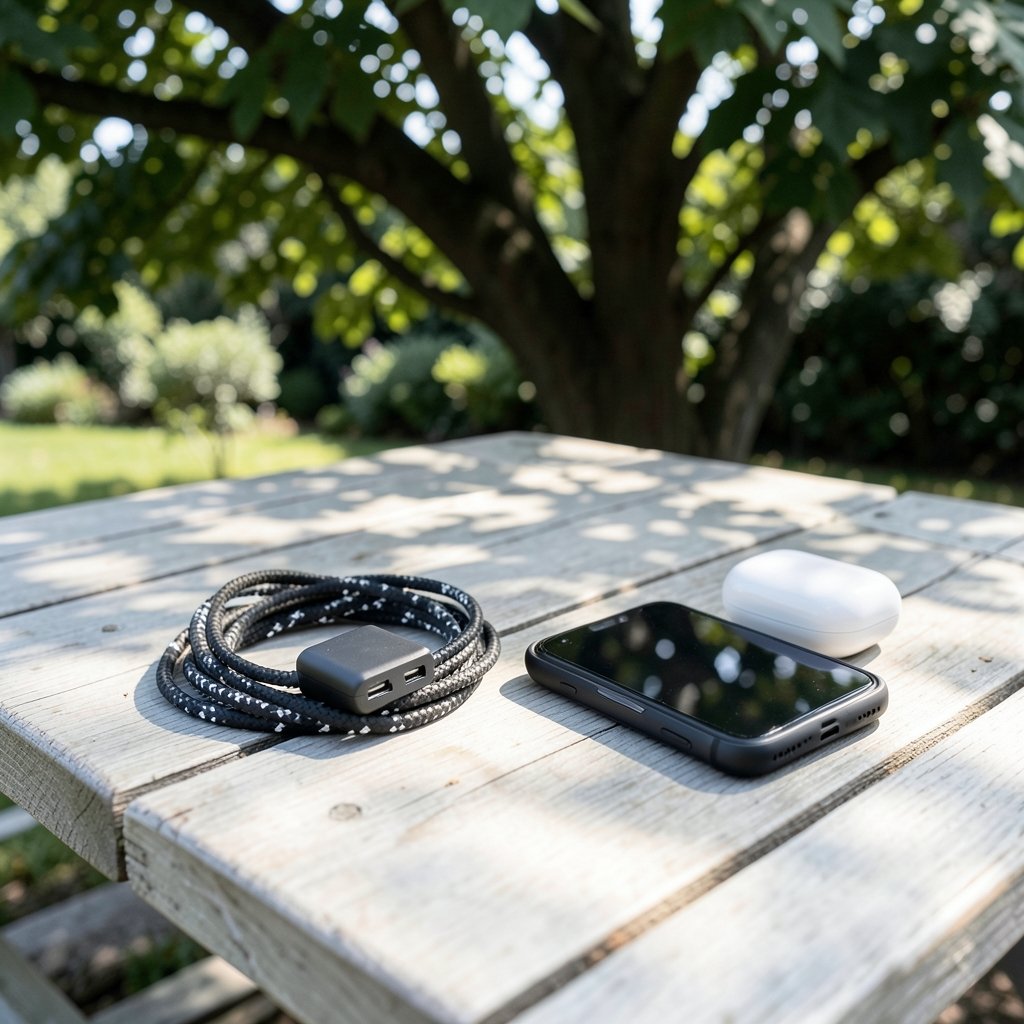
Once power is sorted, the next layer is convenience. These are the accessories that shave friction off a long travel day.
Multi-port GaN chargers
Gallium nitride chargers pack serious output into a small body. A single 65W or 100W multi-port unit can replace a laptop brick, a phone charger, and a tablet charger at once. That is a real weight and space saving. The catch is port-sharing: when you plug in several devices, the charger splits its total output, and the split is rarely even. Read the port allocation table before buying, and prioritize a charger with at least two USB-C ports and one USB-A for legacy gear.
Wireless charging and magnetic mounts
Wireless charging has settled around the Qi standard, and the newer Qi2 specification adds magnetic alignment, which keeps a phone locked in position rather than sliding around a hotel nightstand. For travel, a compact folding wireless charger that handles a phone and earbuds is a reasonable luxury. It is not necessary, and it wastes a little energy compared with a cable, but the convenience is real on a bedside table with one spare socket.
The humble power strip
A short power strip with a built-in surge protector is unglamorous and often the most useful item in the bag. Hotel rooms and airport lounges rarely have enough outlets for a family or a work group. One strip turns a single socket into four and makes you the most popular person at the gate.
Tracking and Security Gear That Actually Works
Losing a bag is a specific kind of misery. Tracking accessories have moved from novelty to close to a necessity, though the marketing outruns the reality.
Bluetooth trackers are excellent for keys, wallets, and bags within range of a phone network. Their limitation is range: they rely on nearby devices belonging to the same ecosystem to relay a location. That works well in cities and airports and poorly in remote areas. For checked luggage, a tracker gives you a location signal and, just as importantly, evidence that the bag exists and where it was last seen. Airlines’ own tracing systems have improved, but a second data point helps.
Beyond trackers, two low-tech items earn their place. A small TSA-recognized lock deters casual tampering on soft-sided bags without inviting a broken zipper. A slim RFID-blocking sleeve for cards is cheap insurance, though the real-world risk of contactless card skimming remains low compared with the risk of simply losing a wallet.
For readers who like thinking about how small design choices shape daily life, the way a well-chosen accessory quietly improves a routine is its own kind of craft, a theme explored in this look at the power of accessories in a timeless look.
Audio and Noise: The Category With the Biggest Daily Payoff
If one accessory category consistently changes the quality of a trip, it is audio. Noise-cancelling headphones turn a roaring cabin into a quiet room. The technology works best on low, steady sounds like engine drone, and less well on voices and sudden noises, which is worth knowing before you expect silence.
Three practical considerations matter more than spec sheets:
- Battery life in real use. Noise cancellation drains power faster than the marketing figure suggests. Look for at least 20 hours with cancellation on.
- Wired fallback. A 3.5mm jack or a USB-C audio option saves you on long-haul flights with seatback entertainment that has no Bluetooth.
- Fit and pressure. Clamping force matters over a ten-hour flight. If you can, try before you buy.
Earbuds are lighter and easier to sleep in, but over-ear models generally isolate better. Many travelers carry both, which is a reasonable compromise if space allows.
Laptop and Work Accessories for the Hybrid Traveler
Remote work has made the travel tech kit a mobile office. A few accessories make the difference between productive and painful.
A compact laptop stand raises the screen to eye level and does more for neck comfort than any other single item. A folding Bluetooth keyboard is worth it only if you type seriously on a tablet; otherwise the on-screen keyboard is fine. A USB-C hub with HDMI, SD card, and at least two USB-A ports covers most presentation and transfer needs, and it is far cheaper than upgrading a laptop.
The mistake here is over-packing. Every accessory adds weight and another cable to lose. A useful test: if you have not used an item on two consecutive trips, it does not belong in the bag. The same principle of stripping back to what genuinely works applies across travel planning, a theme that runs through these destination guides and travel ideas.
For travelers who care about how technology fits into daily life rather than dominating it, there is a broader conversation about designing tools that feel less intrusive, explored in this piece on technology with a more human touch.
What to Skip, and Why
A balanced guide has to name the accessories that rarely justify their space.
Solar chargers sound romantic and perform poorly in practice. Panel output is small, charging is slow, and you need direct sun for hours. A power bank is better in almost every scenario.
Multi-tool gadgets with fifteen functions usually do none of them well. A dedicated cable, a dedicated adapter, and a dedicated charger beat a Swiss-army blob.
Cheap universal adapters are a genuine hazard. Poor internal contacts arc, overheat, and fail. This is one category where paying for a reputable brand is not snobbery but safety.
Over-sized power banks beyond airline limits get confiscated at security. Check the watt-hour figure before you buy, not at the gate.
How to Build a Kit That Fits Your Actual Trip
The best travel tech accessories are the ones matched to how you travel, not to a generic checklist. A weekend city break and a two-week remote-work stint need different kits.
| Travel style | Core accessories | Optional extras |
|---|---|---|
| Weekend city break | Power bank, 2-port charger, 2 cables, tracker | Wireless charger, earbuds |
| Long-haul leisure | Power bank, multi-port GaN charger, noise-cancelling headphones, adapter | Power strip, sleep earbuds |
| Remote work trip | Laptop stand, USB-C hub, 100W charger, long cable | Folding keyboard, portable monitor |
| Family travel | Power strip, multi-port charger, trackers for each bag | Labeled cable organizers |
A simple packing method that works: lay everything out, then remove one item. The kit that survives that cut is the one you will actually carry. Cable organizers and small pouches are cheap and prevent the daily tangle that wastes minutes and patience.
One more habit worth building: test every new accessory at home before a trip. Charge the power bank fully, confirm the adapter fits your plugs, pair the headphones, and check that the hub drives your laptop. Discovering a compatibility problem in a hotel room at midnight is a avoidable frustration.
If you are also refining the non-tech side of your travel routine, small choices compound in the same way, whether that is packing lighter or thinking through grooming and care, topics covered in guides like this one on braiding hair styles, techniques and scalp health and this detailed look at what a hair transplant procedure really involves and who it suits.
Conclusion
The best travel tech accessories are not the ones with the longest feature list. They are the ones that solve a problem you actually have, survive real use, and stay within airline rules. Power comes first: a compliant power bank, a multi-port GaN charger, and two good cables cover most trips. Add noise-cancelling audio if you fly often, a tracker if you check bags, and a compact hub if you work on the road. Skip the solar panels and the fifteen-function gadgets, and test everything before you leave. Build the kit around your trip rather than a checklist, and the technology stops being something you manage and starts being something that quietly works.
Frequently Asked Questions
What size power bank can I take on a plane?
It depends on the airline and the country. Aviation regulators express limits in watt-hours, and carriers publish their own thresholds, so check your specific airline’s policy before flying. Spare power banks generally must go in carry-on baggage, not checked luggage.
Do I need a voltage converter or just a plug adapter?
Most phones, laptops, and camera chargers are dual-voltage and need only a plug adapter. High-wattage appliances like hair dryers may need a converter. Check the fine print on each device’s power brick, because a plug adapter never changes voltage.
Are noise-cancelling headphones worth it for travel?
For frequent flyers, usually yes. They work best on steady low-frequency sounds like engine drone and less well on voices. Look for at least 20 hours of battery with cancellation on, and a wired option for seatback entertainment.
What is the most overrated travel tech accessory?
Solar chargers top most lists. Panel output is small, charging is slow, and direct sun is required for hours. A power bank is more reliable in nearly every situation.
How many cables should I pack?
Carry at least two USB-C cables with the correct power rating, plus one longer cable for awkward sockets. Cables fail more often than any other accessory, and a spare costs little.
Why does my fast charger not charge my phone quickly?
Fast charging requires the charger, the cable, and the device to support the same power profile. A high-wattage charger paired with a low-rated cable delivers far less than advertised. Check all three parts of the chain.