
Patchwork Tattoos: How to Build a Collected Sleeve
 Abdul WadoodLast updated

Walk into any busy tattoo shop on a Saturday and you will see them: arms and legs covered in a dozen unrelated images, each with its own story, its own artist, and its own little pocket of skin. That is the patchwork tattoo in a nutshell. The style has quietly become one of the most requested looks in studios, especially among people who would rather collect tattoos slowly than commit to one giant design. There is no single origin story, no trademark, and no rulebook. But there is a real method to making a scattered collection look intentional, and that method is worth understanding before you start filling space. (Old school (tattoo)))
What Counts as a Patchwork Tattoo?
A patchwork tattoo is a body area covered by many small to medium tattoos placed side by side, usually with visible gaps of bare skin between them. The pieces do not share a theme, a color palette, or an artist. A cartoon strawberry might sit next to a band logo, a tiny flower, and a line of script. The collection is the point, not any single image.
This is different from a traditional sleeve, where one artist designs a connected composition that flows around the arm. Patchwork grows over years. It is often called a “collector’s sleeve” for that reason. The look is deliberately loose, a bit messy, and very personal.
The term itself is informal. It borrows from quilting, and you will not find it in academic tattoo literature or in most studio price lists. It lives in tattoo communities, on social media, and in everyday conversation between clients and artists.
Why the Style Has Become So Popular
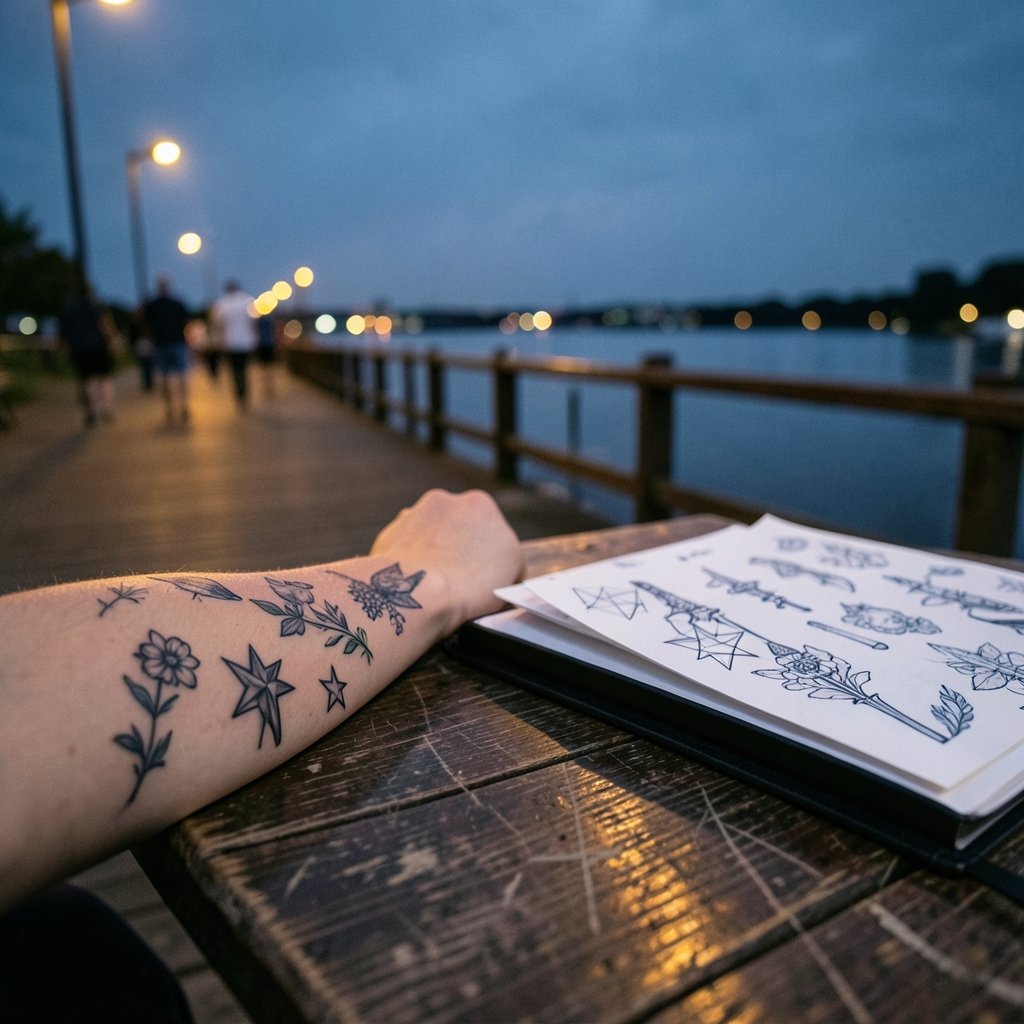
Several forces have pushed patchwork into the mainstream.
First, cost. A full custom sleeve can take 20 to 40 hours of work, and at typical studio rates that adds up fast. Small pieces bought one at a time spread the expense over months or years. Second, commitment anxiety. A single bold design is a big decision. A small tattoo you can hide under a sleeve is a much softer entry point.
Third, the culture of collecting. Tattoo flash sheets, the pre-drawn designs that shops have displayed for decades, are built for exactly this kind of buying. Walk in, pick a design, get it done. Many collectors treat flash like a souvenir habit, picking up a piece in each city they visit.
Fourth, visibility. Social media rewards dense, varied coverage. A limb packed with small, sharp images photographs well and reads clearly at a glance, which suits a visual medium built on scrolling.
How to Plan a Patchwork Sleeve That Still Looks Good
The biggest mistake people make is treating patchwork as “no planning needed.” It is true that you do not need a master design. It is not true that placement does not matter. The arms and legs that look best in photos almost always had someone thinking a few steps ahead.
Start with the anchor pieces
Choose two or three tattoos you love most and place them first, in the spots you see most often: the outer forearm, the top of the shoulder, the front of the thigh. These become anchors. Everything else fills in around them. If you start with tiny filler tattoos, you will run out of room for the pieces you actually care about.
Leave breathing room
Cramming pieces edge to edge removes the contrast that makes patchwork work. Bare skin between tattoos is a design element, not wasted space. A gap of a centimeter or two keeps each image legible. It also leaves room for future additions, which matters more than most people expect.
Vary the scale
A wall of identical small tattoos looks flat. Mix a large anchor piece with medium images and small accents. Scale contrast creates rhythm, and rhythm is what separates a good collected sleeve from a random scatter.
Keep quality consistent
This is the mistake that stings. A cheap tattoo next to a beautifully executed one drags the whole limb down. Patchwork is a long game, so budget for fewer, better pieces. If you need to stretch your money between appointments, learning basic grooming and equipment habits helps you look after the skin around your collection. A practical guide to hair clippers and how they work is a good example of the kind of everyday tool knowledge that keeps your appearance sharp while you save for the next session.
Color or Black and Grey?
This is the fork in the road that shapes everything after it.
| Approach | Strength | Watch out for |
|---|---|---|
| All black and grey | Easy to mix artists and styles; ages predictably | Can look flat without strong contrast |
| All color, loose palette | Bold and lively; reads well from a distance | Clashing palettes if you do not think ahead |
| Color with a shared rule | Cohesive without being themed | Needs discipline to follow the rule |
| Mixed, no rule | Maximum freedom | Highest risk of looking accidental |
A common middle path is a shared palette rule: every piece can be any subject, but they all use the same three or four colors. Another is a shared line weight, where every artist is asked to use a similar outline thickness. Neither rule limits what you get tattooed. Both make the collection hang together. If you want to think about color more deliberately, the same principles that govern hair color choices for your skin tone apply here: contrast and undertone decide whether a palette flatters the canvas it sits on.
Finding Artists for a Collected Sleeve
Patchwork is unusual because you are not hiring one artist for one vision. You are curating. That changes how you should shop.
Look for artists whose small work is strong alongside their large custom pieces. Many tattooers are excellent at big compositions and mediocre at tiny detail. Check healed photos as well as fresh ones. Fresh tattoos always look crisp; healed ones tell you how the line work held up.
Ask about minimum charges before you book. Many studios have a shop minimum that makes a very small tattoo poor value. If you want several tiny pieces, ask whether an artist will do a short session with multiple designs.
Do not be afraid to collect across cities. The patchwork approach is built for it. Just keep a photo log of what you have and where, so a new artist can see the surrounding work and match the feel.
Placement: Where Patchwork Works Best
The forearm, upper arm, and thigh are the classic canvases. They are flat enough to hold small images cleanly, and easy to cover when needed. The calf works well too, though the curve makes very small pieces harder to place.
Areas to approach with care:
- Hands, neck, and face. High visibility and faster fading. Many artists will not tattoo these on newer clients.
- Bony spots like the collarbone and ankle, where small tattoos can distort.
- Skin that stretches, such as the stomach, where fine detail can blur over time.
If you are building toward a fully covered limb, the practical grooming side matters as much as the ink. Short hair around a forearm or calf keeps the collection visible, and a good cut makes the whole look sharper. A guide to short hairstyles that work in practice covers the same logic of shape and proportion that applies to planning a sleeve.
What Patchwork Tattoos Cost
Costs vary widely by city and artist reputation, so treat any figure as a rough planning tool rather than a quote.
- Shop minimum: often the floor price for any tattoo, regardless of size.
- Small pieces: typically priced at or just above the minimum.
- Medium pieces: charged hourly or by the piece.
- Full coverage: the sum of many sessions over years, not a single bill.
The financial advantage of patchwork is not that it is cheap. It is that it is spread out. You pay as you go, which makes a large collection achievable on a normal budget.
Aftercare and Longevity
Patchwork sleeves live or die on aftercare, because each new tattoo sits next to healing ones. A few practical rules:
- Follow your artist’s written aftercare instructions exactly, even if they differ from what worked last time.
- Keep fresh tattoos out of direct sun. Sunscreen on healed work, none on healing work unless your artist says otherwise.
- Avoid tight straps and rough fabric over a new piece for the first couple of weeks.
- Do not scratch. Itchiness is normal; picking is how you lose ink.
- Book the next session only after the last one has fully settled, usually a few weeks.
Long term, the enemy is sun exposure and weight change, both of which soften fine detail. Black outlines age best. Very fine, delicate work looks stunning fresh and fades fastest.
Common Mistakes to Avoid
- Filling every gap too early. You will want room later.
- Letting one cheap tattoo set the tone. Quality is contagious in both directions.
- Ignoring flow. Tattoos on a curved limb should follow its lines rather than fight them.
- Skipping the photo log. Future artists need to see the neighborhood.
- Chasing trends. A collection should reflect you in ten years, not this season alone.
Conclusion
Patchwork tattoos are less a style than a method: collect deliberately, place with intention, and let the gaps do some of the work. The look rewards patience and punishes rush. Start with the pieces you love most, keep quality high, vary your scale, and give yourself room to grow. Done that way, a scattered sleeve stops looking accidental and starts looking like exactly what it is: a record of years, told in small pictures.
The same patience that governs placement also governs how you talk about the work. Patchwork invites conversation because every piece has a story, and that is part of its appeal. Expect strangers to ask about individual tattoos rather than the whole arm. Have a short answer ready for the ones that are personal, and enjoy the ones that are not. Artists appreciate clients who can describe what they want in plain terms and who understand that a small image still takes real skill to place well. Respect their minimums, show up on time, and tip as you would for any skilled trade. Those habits build relationships, and relationships are how you get priority booking when a guest artist visits or a flash day is announced.
Keep records beyond photos, too. Note the artist, the date, and the shop for each piece. In ten years, that log will be worth more than you expect, especially if you move cities or want a piece touched up. Some collectors sketch a rough map of each limb and mark where every tattoo sits, which makes planning the next addition far easier.
Finally, accept that the sleeve is never quite finished. There is always one more gap, one more idea, one more city with a shop you want to visit. That is not a flaw in the approach. It is the point. Patchwork tattoos reward the person who treats the body as a living archive, added to slowly and with care. Start small, choose well, and let the collection grow at the speed of your life rather than the speed of a trend.
That slow pace is also a safeguard. Quick decisions made to fill space often become the pieces you later want covered, and cover-ups cost more than patience ever will. Give each new tattoo a few months of living before committing to the next one; you will learn how it sits, how it ages, and whether it still feels like yours. Collectors who rush tend to stop seeing individual pieces and start seeing clutter, while those who wait keep the enthusiasm that made them start. Let each addition earn its place, and the sleeve will keep meaning something long after the trend that inspired it has passed.