
How to Wear Statement Sunglasses: 2026 Style Guide
 Abdul WadoodLast updated

Roughly 90% of visible aging happens from sun exposure, and the skin around your eyes is the thinnest on your body — which is why sunglasses are the single most worn accessory most people own. Yet statement sunglasses are a different beast entirely. A pair of oversized white frames or mirrored aviators can transform an outfit or completely hijack it. The difference between “effortless” and “costume” comes down to a handful of styling decisions most people never think about. (Sunglasses)
This guide breaks down exactly how to wear bold sunglasses in real life — proportion, color, face shape, outfit balance, and the practical mistakes that make statement frames look off. No runway fantasy required.
What Counts as Statement Sunglasses?
Not every pair of sunglasses is a statement pair. The label applies when the frames do the talking before anything else in your outfit does. Common examples include:
- Oversized frames that extend past the cheekbones
- Bold colors — cherry red, cobalt blue, milky white
- Unusual shapes — cat-eye, geometric hexagons, slim rectangles
- Heavy textures — tortoiseshell, chunky acetate, metallic hardware
- Tinted or mirrored lenses in unexpected shades
Classic black wayfarers or thin wire aviators are not statement pieces — they’re workhorses. Statement sunglasses are the ones that make a stranger look twice. That’s the point, and it’s also the risk.
The most important practical distinction: statement frames are an accessory, not a utility purchase. You likely already own a neutral pair for errands and driving. The statement pair is the one you wear when the outfit needs a focal point.
The One-Statement Rule (and Why It Works)
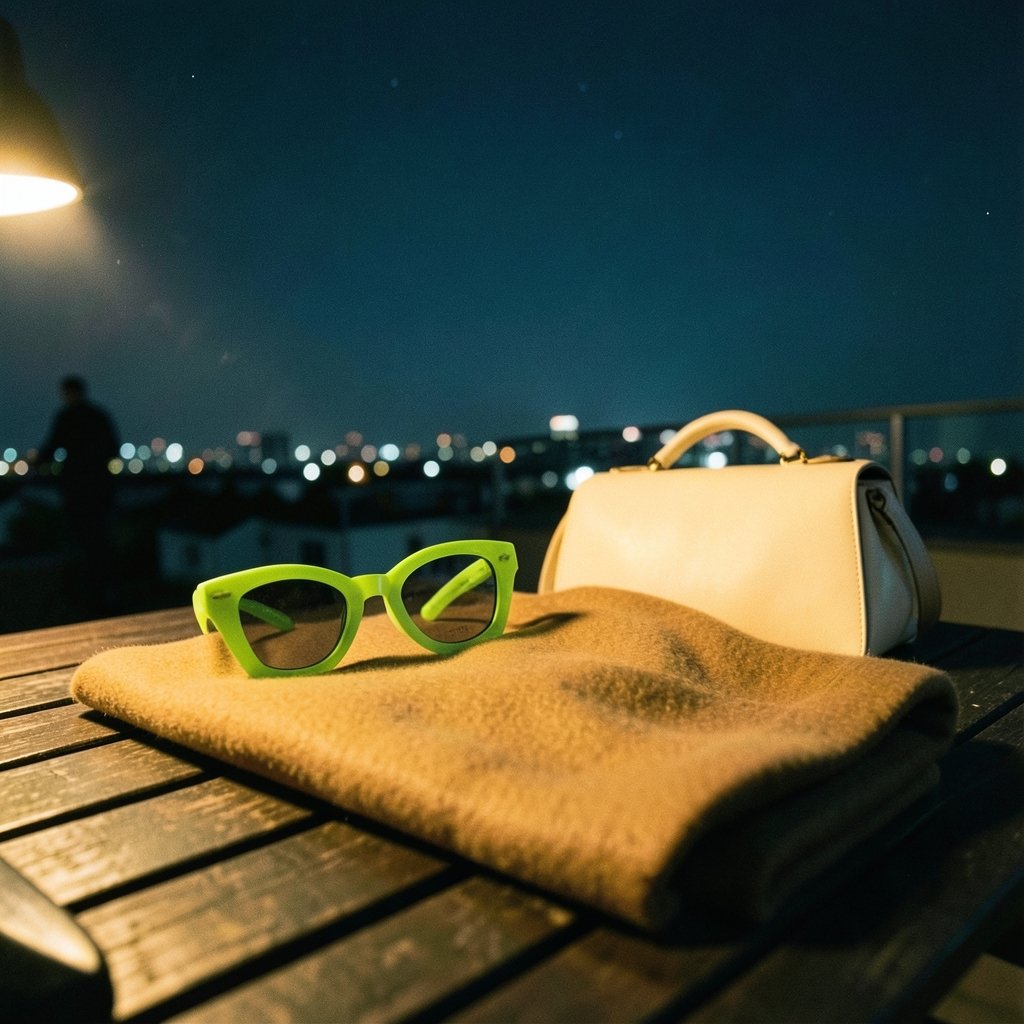
The single most reliable styling principle for bold sunglasses is this: let the frames be the only loud thing in the look. Fashion editors repeat this constantly because it works. When your sunglasses are oversized neon-green cat-eyes, adding a printed dress, chunky necklace, and statement bag creates visual noise — the eye has nowhere to land.
In practice, that means:
- Pick your statement sunglasses first.
- Build the outfit around them in neutral or tonal colors.
- Add at most one secondary accent — a bag, a lip, a shoe — that echoes a color from the frames.
- Remove everything else that competes.
This doesn’t mean dressing boringly. A monochrome outfit in a strong color — all camel, all cream, all black — with bold sunglasses reads as intentional and polished. A busy outfit with bold sunglasses reads as cluttered.
The Proportion Rule Nobody Explains Well
Oversized frames need balance. The most common styling convention is to pair big, angular sunglasses with simpler, more fitted clothing — a slim turtleneck, a tailored blazer, straight-leg jeans. The contrast between a large frame and a clean silhouette keeps the sunglasses as the focal point rather than making the whole look feel top-heavy.
The reverse also holds. Delicate or slim statement frames — think narrow rectangles or small round lenses — can handle looser, more voluminous clothing because they don’t compete for space.
A quick reference:
| Frame Style | Best Paired With | Avoid |
|---|---|---|
| Oversized / angular | Fitted tops, tailored layers, sleek hair | Bulky scarves, huge hats, ruffled collars |
| Round / retro | Relaxed tailoring, knits, soft fabrics | Sharp shoulder pads, heavy hardware |
| Slim / rectangular | Loose silhouettes, oversized shirts | Tiny necklines, fussy details |
| Colored acetate | Neutral or tonal outfits | Competing brights near the face |
Match Frames to Face Shape — Carefully
The old rule says angular frames suit rounder faces and rounded frames suit angular faces. It’s popular advice, and it’s partly useful — contrast does create balance. But treat it as a starting point, not law. Plenty of stylists argue face-shape rules are overprescribed and that frame width relative to your cheekbones matters more than geometry.
What actually works in practice:
- Frame width should roughly match your face width at the cheekbones. Too narrow looks pinched; too wide swallows the face.
- Brow line matters. Frames that sit level with or just below your eyebrows frame the face best.
- Try before you commit if the frames are oversized or unusually shaped. Photos lie; mirrors in daylight don’t.
If you’re experimenting with bold color for the first time, a shade that flatters your skin tone is a safer entry point than a shape experiment. Warm undertones tend to suit tortoiseshell, amber, and olive; cool undertones often carry black, navy, and cool reds well. This is convention, not science — but it’s a useful filter when you’re standing in a store.
Color Coordination: The Trick That Makes Bold Frames Look Deliberate
The fastest way to make statement sunglasses look styled rather than random is to repeat their color somewhere else in the outfit. A red frame with a red lip. Blue lenses with a blue bag. White frames with white sneakers. This single move — called “echoing” in styling circles — makes the whole look read as a decision rather than an accident.
Three reliable approaches:
- Tonal echo: repeat the frame color in one small accessory. Subtle, safe, always works.
- Neutral frame, bold lens: a black or tortoise frame with a colored lens is the easiest entry into statement eyewear. The frame anchors it; the lens adds the personality.
- Monochrome plus one: an all-neutral outfit with one vivid frame color. This is the highest-impact, lowest-risk formula.
If you’re building a bolder hair color story alongside your eyewear — say, a warm shade that plays with tortoiseshell frames — it helps to understand how those tones actually read in daylight. A guide to dirty blonde hair explains how warm, low-contrast shades interact with skin tone, which is the same logic that governs frame color choice.
Building Outfits Around Statement Sunglasses
Here’s where most people go wrong: they treat the sunglasses as an afterthought and then wonder why the look feels off. Reverse the order. Start with the frames, then dress to them.
For oversized frames: keep the neckline clean. Crew necks, turtlenecks, and simple collars give the frames room. Skip giant earrings — they fight the frame’s lower edge.
For colored acetate: build a tonal outfit in a color family that supports the frame. A chocolate brown frame, for example, sits beautifully against cream, camel, and espresso. If you want to understand how that shade reads in real light, this breakdown of chocolate brown hair covers how warm browns shift between indoor and outdoor lighting — the same effect that makes brown frames look different in a store versus on the street.
For mirrored or tinted lenses: let the lens color lead. Mirrored blue lenses against an all-white outfit is one of the cleanest summer formulas there is. If you’re drawn to saturated lens colors, a blue hair dye guide is a useful primer on how blue tones behave across different bases — relevant if you’re coordinating hair, frames, and lenses in the same cool palette.
For geometric or novelty shapes: treat them as jewelry. Simple earrings or none, hair pulled back or sleek, and a neckline that leaves space.
Hair, Hats, and Headwear
Statement sunglasses and big hats compete for the same real estate. If you wear both, keep the hat simple — a plain straw fedora or a clean baseball cap — and let the frames win. Hair matters too: pulled-back hair exposes the frame’s shape, while loose hair can soften an angular pair. Neither is wrong; just decide which effect you want.
The Practical Mistakes That Undo a Statement Look
These come up again and again in real life, and each one is fixable:
- Wearing statement frames with a statement outfit. The most common error. One loud element per look.
- Ignoring fit. Sunglasses that slide down the nose or pinch at the temples look bad regardless of how good the frame is. Get them adjusted.
- Skipping UV protection for style. This is the one place where style should never win. Regulators including the U.S. Food and Drug Administration treat sunglasses as protective eyewear and set labeling requirements for UV claims, and the Skin Cancer Foundation recommends UV-blocking eyewear whenever you’re outdoors. Bold frames are fine; unprotected lenses are not.
- Buying online without checking measurements. Frame width, lens width, and bridge width are listed on most product pages. Compare them to a pair you already own.
- Over-accessorizing the face. Earrings, nose rings, bold lip, bold brows, and bold frames all at once is a lot. Pick two.
- Forgetting the rest of the outfit’s metal tones. Gold frames with silver jewelry can work, but it’s a deliberate clash, not a default.
Statement Sunglasses for Different Settings
Context changes everything. The same cherry-red cat-eye that looks sharp at a gallery opening can feel excessive at a school pickup.
Everyday and errands: stick to one bold element — colored lenses in a neutral frame, or a slightly oversized black frame. Keep the outfit simple.
Work: bold frames are usually fine in creative offices; in conservative ones, a strong shape in a neutral color is the safer play. Tortoiseshell is the universal diplomat.
Evening: this is where you go all in. Metallic frames, mirrored lenses, dramatic shapes. Pair with a monochrome outfit and minimal jewelry.
Travel and outdoors: prioritize UV protection and fit over novelty. A wrap or sport-adjacent frame with a bold lens color gives you personality without sacrificing coverage.
How to Choose Your First Statement Pair
If you’re new to bold eyewear, work through this sequence:
- Set a budget. Statement frames are a want, not a need — spend accordingly.
- Decide your risk level. Colored lens in a neutral frame is low risk. Neon oversized acetate is high risk.
- Check the UV rating. Look for a UV400 label or equivalent protection claim.
- Measure against a pair you own. Frame width is the number that matters most.
- Try them with three outfits you already wear. If they don’t work with at least three, they’ll sit in a drawer.
- Get them adjusted. A five-minute adjustment at an optician transforms fit.
The three-outfit test is the one most people skip, and it’s the one that saves the most money. A pair that only works with one specific dress is a costume, not an accessory.
Conclusion
Statement sunglasses reward a little restraint. The formula isn’t complicated: pick frames you genuinely love, let them be the loudest thing in the look, echo their color once somewhere else, and make sure the lenses actually protect your eyes. Proportion and fit do the quiet work; color and shape do the talking. Get those four things right and bold frames stop feeling like a risk and start feeling like the easiest part of getting dressed. The best pair isn’t the boldest one on the shelf — it’s the one you reach for without thinking, again and again, because it makes every outfit a little sharper.
Frequently Asked Questions
What are statement sunglasses?
Statement sunglasses are frames designed to be the focal point of an outfit — oversized shapes, bold colors, unusual geometry, heavy textures, or tinted and mirrored lenses. They’re distinguished from neutral, everyday sunglasses by their visual impact rather than their function. Most people own one neutral pair for daily wear and one or two statement pairs for when the outfit calls for a focal point.
Can I wear statement sunglasses with a busy outfit?
It’s possible but risky. The reliable rule is one statement per look. If your outfit already has a bold print, strong color blocking, or heavy jewelry, choose a simpler frame. If you want to wear the bold frames, simplify everything else — neutral colors, clean lines, minimal accessories. This keeps the eye from having to choose where to look.
Do statement sunglasses actually protect my eyes?
Only if the lenses carry proper UV protection. Bold frames with cheap, uncoated lenses can be worse than no sunglasses at all, because dark lenses cause your pupils to dilate while letting UV through. Look for a UV400 label or an equivalent protection claim, and buy from sellers who state the rating clearly. Style and protection are not mutually exclusive — you just have to check.
What face shape suits oversized sunglasses?
Oversized frames tend to flatter most faces when the width roughly matches the cheekbones and the top of the frame sits near the brow line. The old advice about angular frames for round faces and round frames for angular faces is a useful starting point but not a rule. Fit — width, bridge, temple comfort — matters more than geometric matching.
How do I stop bold sunglasses from looking like a costume?
Three things: simplify the rest of the outfit, repeat the frame color once in a small accessory, and make sure the frames fit properly. Costume energy usually comes from too many competing elements or poor fit. A bold frame against a clean, tonal outfit with one color echo reads as styled; the same frame against a busy outfit with sliding fit reads as dress-up.
Are expensive statement sunglasses worth it?
Sometimes. Price buys better lens quality, sturdier hinges, and more comfortable fit — all of which matter for daily wear. But statement frames are inherently trend-driven, and trends move fast. A mid-priced pair with verified UV protection and a good fit will serve you better than a luxury pair you’re afraid to wear. Spend on protection and fit first, branding last.