
Sleeve Tattoos for Men: Costs, Pain & Design Guide
 Abdul WadoodLast updated

Roughly one in three American adults under 40 has at least one tattoo, according to Pew Research Center, and a growing share of those are large-scale pieces. The sleeve, once a badge of maritime and biker subcultures, has quietly become one of the most requested formats in Western tattoo shops. That shift matters, because a sleeve is not simply a bigger tattoo. It is a multi-year project with a budget, a pain curve, a healing schedule, and real-world consequences at work. (Tattoo)
This guide covers what a man actually needs to know before committing: what counts as a sleeve, what it costs, how much it hurts, how long it takes, and where the practical landmines are.
What Counts as a Sleeve Tattoo?
Terminology in the tattoo world is loose, but most artists use a few standard labels:
| Term | Coverage | Typical Sessions |
|---|---|---|
| Quarter sleeve | Shoulder to mid-upper arm | 1–2 |
| Half sleeve (upper) | Shoulder to elbow | 2–4 |
| Half sleeve (lower) | Elbow to wrist | 2–4 |
| Three-quarter sleeve | Shoulder to mid-forearm | 4–6 |
| Full sleeve | Shoulder to wrist | 6–12+ |
A full sleeve covers the entire arm from the shoulder cap to the wrist. Many artists treat it as a single composition rather than a stack of unrelated images, which is why planning matters more than most first-timers expect. A half sleeve stops at the elbow, and it is by far the most common entry point for men who want visible coverage they can still hide under a short-sleeve shirt.
There is also the patchwork sleeve: a collection of separate pieces, often collected over years, filling the arm gradually. It looks deliberately chaotic, and it is cheaper to build slowly, but it requires more discipline to keep the spacing balanced.
A Short History of Arm Coverage
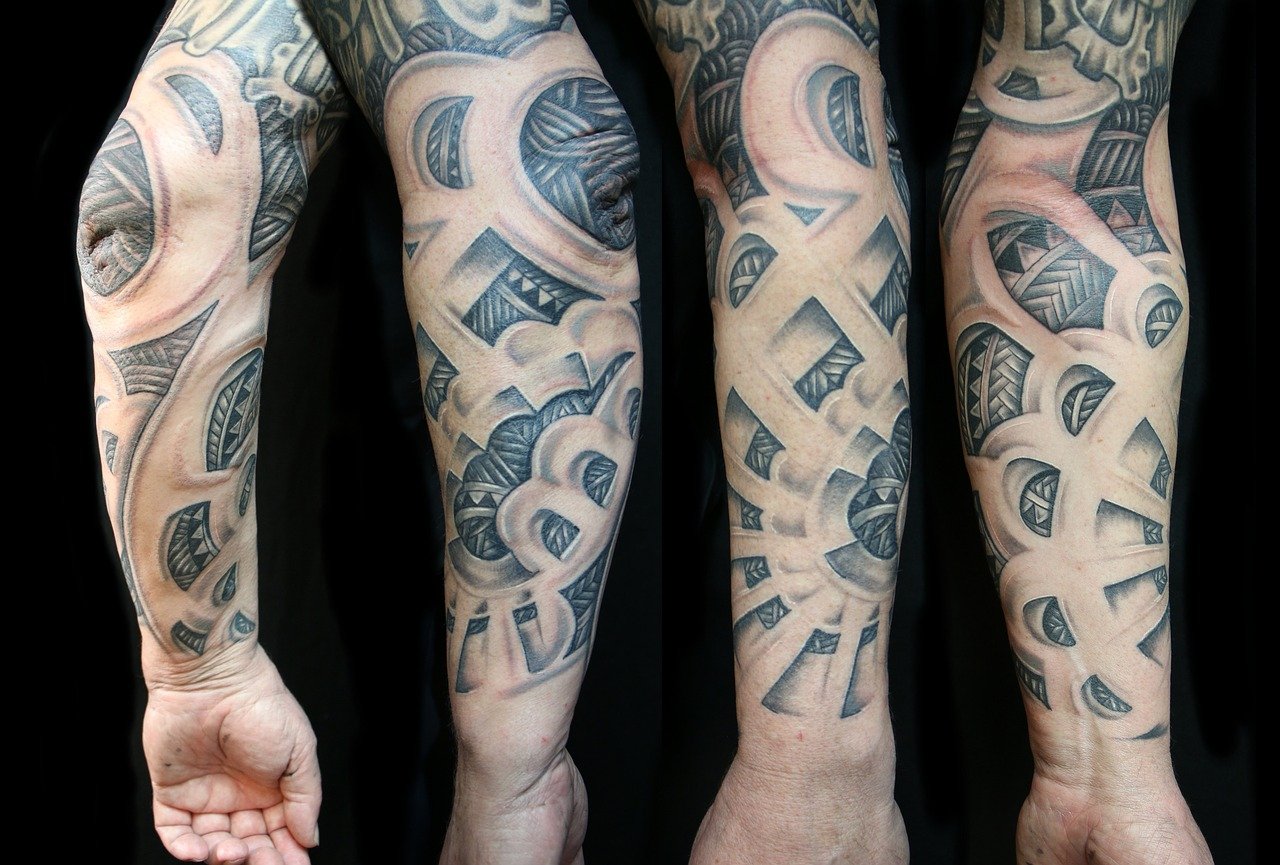
Full-arm tattooing is not a modern invention. Japanese irezumi developed elaborate full-body and full-arm compositions during the Edo period, and Polynesian and other Pacific cultures practiced extensive arm and body tattooing long before any Western “sleeve” trend existed. What changed in the late twentieth century was visibility. Sleeves moved from sailors, soldiers, and motorcycle clubs into mainstream fashion, and by the 1990s and 2000s they had become common enough that artists began specializing in large-scale, single-concept arm work.
The practical takeaway from that history: sleeves have always carried meaning, whether ritual, tribal, occupational, or personal. Men who treat the sleeve as pure decoration often end up unhappy with it a decade later. Men who treat it as a narrative tend to still like it.
What a Sleeve Actually Costs
Price varies enormously by city, artist reputation, and complexity. In the United States, most reputable shops charge $150 to $300 per hour, and a full sleeve typically runs 20 to 40 hours of chair time. That puts a realistic full-sleeve range at $3,000 to $12,000, with high-demand artists in major cities often exceeding that.
There are ways to reduce cost without wrecking quality:
- Book a lower-demand artist at a strong shop. Many shops have apprentices or newer artists whose rates are 40 to 60 percent lower, with supervision available.
- Choose black and grey over full color. Color work adds hours, and more hours mean more money.
- Build in stages. A patchwork approach spreads the cost over years, though the total usually ends up higher than a single planned composition.
- Ask about day rates. Some artists quote a flat day rate for long sessions, which can save money on large pieces.
What does not work in practice: haggling hard with a good artist, or chasing the cheapest quote online. Cover-ups and reworks of bad sleeves cost far more than doing it right the first time.
How Much Does It Hurt?
Honest answer: it depends on the spot. The pain scale across the arm is fairly consistent from person to person:
- Outer upper arm and shoulder: mild, the easiest part
- Outer forearm: mild to moderate
- Inner forearm: moderate, more sensitive
- Elbow and elbow ditch: sharp, often the worst single point
- Inner bicep and armpit edge: high, thin skin and nerve-dense
- Wrist and hand: high, especially near the bone
Most men describe a full sleeve as tolerable but exhausting rather than unbearable. The real challenge is duration. A four-hour session on the inner bicep is a test of patience more than pain threshold. Eating properly beforehand, staying hydrated, and avoiding alcohol for 24 hours before the appointment all make a measurable difference. So does booking shorter sessions. Two three-hour sessions usually beat one six-hour marathon for both pain and healing quality.
Planning a Design That Ages Well
This is where most regrets originate. A few principles that hold up over time:
Design for the whole arm, not the first session. Good artists sketch the full composition first, then break it into sessions. If your artist starts without a plan for the wrist and shoulder, ask why.
Leave negative space. Skin gaps give a sleeve breathing room and make it read clearly from a distance. Arms packed edge to edge with detail turn into a dark blur after a few years.
Think about the elbow and wrist. These areas distort and fade faster than flat surfaces. Simple, bold shapes survive there. Fine line work does not.
Consider the fade. Tattoos soften over decades. Bold outlines and strong contrast age far better than delicate shading.
Skip trends. Whatever style is flooding social media right now will look dated in fifteen years. Classic Japanese, traditional American, blackwork, and geometric styles have all proven their staying power. Pick a style you would have liked ten years ago, not one you discovered last month.
For men building a sleeve as part of a broader personal brand or creative project, Voozon Media covers visual identity and design thinking that translates well to planning a long-term composition.
The Workplace Question
This is the practical issue that derails more sleeve plans than pain or money. Many employers still maintain dress codes requiring tattoos to be covered, and policies vary widely by industry and region. Healthcare, hospitality, finance, and public-facing roles tend to be stricter; trades, tech, and creative fields tend to be more relaxed.
Before booking a full sleeve, do three things:
- Read your employee handbook, specifically the appearance or dress code section.
- Look at what senior colleagues do. Visible tattoos on managers are a stronger signal than any written policy.
- Decide on your stop line. Many men choose a half sleeve that ends above the elbow precisely so a standard short-sleeve shirt covers it entirely.
A lower half sleeve to the wrist is far harder to conceal in summer than an upper half sleeve. That single decision affects your wardrobe for the next thirty years.
Health, Safety, and Ink Regulation
In the United States, tattoo ink is regulated as a cosmetic, and the U.S. Food and Drug Administration has issued warnings about ink-related infections and unverified ingredients in some pigments. The practical implications for anyone planning a sleeve:
- Choose a licensed shop. Licensing rules vary by state, but a legitimate shop will show credentials without hesitation.
- Ask about ink brands. Reputable artists know exactly what they use and are not defensive about the question.
- Watch the hygiene routine. Fresh needles, fresh gloves, sealed ink caps, and a clean station are non-negotiable.
- Know the healing timeline. Surface healing takes two to three weeks; deeper layers take two to three months. Sun exposure during that window damages the work permanently.
Healing and Aftercare That Actually Works
Most aftercare failures come from doing too much, not too little. What works in practice:
- Keep the initial bandage on for the period your artist specifies, usually a few hours to a day.
- Wash gently with fragrance-free soap and lukewarm water, twice daily.
- Apply a thin layer of recommended ointment. Thin is the operative word; smothering a fresh tattoo causes problems.
- Avoid swimming pools, hot tubs, and direct sun for at least two weeks.
- Do not pick or scratch. Flaking is normal; peeling chunks off is not.
What does not work: plastic wrap left on for days, alcohol-based lotions, and the belief that a tattoo is “healed” because it stopped hurting.
Removal and Regret
Laser removal is the standard method, and it is slow. A full sleeve typically requires six to twelve sessions spaced weeks apart, and complete removal is not guaranteed, particularly with certain colors. Partial fading is more common, often as preparation for a cover-up. Cost per session runs into the hundreds of dollars, which means removing a full sleeve can easily exceed what it cost to put on.
The lesson is unglamorous but true: the cheapest way to fix a bad sleeve is to plan it properly the first time.
Conclusion
A sleeve tattoo for men is a serious commitment measured in years, thousands of dollars, and a fair amount of discomfort. It is also one of the most satisfying forms of self-expression available, provided it is planned rather than improvised. Get the design sketched for the whole arm, budget for 20 to 40 hours of chair time, respect the healing process, and check your workplace policy before the needle touches skin. Do those four things and the odds of regret drop sharply. Skip them, and you join the long line of men paying for laser sessions they never expected.
How much does a full sleeve tattoo cost?
Most reputable shops charge $150 to $300 per hour, and a full sleeve takes 20 to 40 hours. That puts the realistic range at $3,000 to $12,000, with in-demand artists in major cities often charging more. Half sleeves typically land between $1,200 and $4,000.
How long does it take to complete a sleeve?
A full sleeve usually requires six to twelve sessions spread over six months to two years. The timeline depends on session length, healing speed, and how quickly you can book follow-up appointments with a busy artist. Rushing the schedule usually hurts the final result.
Which part of a sleeve tattoo hurts the most?
The elbow, the inner bicep, the armpit edge, and the wrist are consistently reported as the most painful areas. The outer upper arm and outer forearm are the easiest. Most men find the duration of a long session more challenging than the peak pain itself.
Can you get a sleeve tattoo if you have a physical job?
Yes, but plan around healing. Fresh tattoos need to stay clean and avoid friction, so heavy lifting, dirty environments, and tight equipment straps can cause problems during the first two weeks. Many men schedule sessions before a few days off work. (Tattoos: Understand risks and precautions)
Will a sleeve tattoo affect your career?
It can, depending on the industry. Many employers still require tattoos to be covered, and policies vary widely. A half sleeve ending above the elbow is easy to conceal under a short-sleeve shirt, while a full sleeve to the wrist is much harder to hide in warm weather.
How do you choose the right artist for a sleeve?
Choose an artist whose existing portfolio matches the style you want rather than someone with good reviews alone. Ask to see healed work as well as fresh photos. Confirm they sketch a full-arm plan before the first session, and check that the shop is licensed and uses sealed, fresh supplies.