
Matching Tattoos for Couples: 2026 Design Guide
 Abdul WadoodLast updated

Roughly one in four American adults now has at least one tattoo, and a growing share of those are shared designs between partners. Walk into any busy studio on a Saturday and you’ll see the same scene: two people holding hands, comparing sketches, deciding whether to go with the full heart or split it down the middle. Matching tattoos for couples have moved well past the old anchor-and-heart cliché. They’re now a genuine design decision, a small act of commitment, and, for some couples, a decision they later rethink. This guide covers what actually works, what tends to go wrong, and how to pick a design you’ll still be happy with in ten years.
Why Couples Choose Matching Ink
The appeal is easy to understand. A tattoo is permanent, visible, and personal. Sharing one with a partner turns a private relationship into something you can literally point to. Couples often mark anniversaries, weddings, the birth of a child, or simply a moment when the relationship felt solid.
There’s also a practical side. Tattoos are expensive, and getting them together turns a solo errand into a shared experience. Many studios even offer a small discount for two bookings in one session, though you should never let a discount drive the decision.
The less romantic reason matters too: matching tattoos are a low-stakes way to test compatibility on a big decision. You have to agree on a design, a placement, an artist, and a budget. Couples who can’t survive that conversation probably shouldn’t be booking back-to-back sessions.
Matching vs. Complementary: Know the Difference
Most people say “matching” when they actually mean one of two things. It’s worth separating them before you start sketching.
| Type | What It Looks Like | Best For |
|---|---|---|
| Identical matching | The exact same design, same size, same placement on both people | Couples who want an obvious, visible pair |
| Complementary pairing | Two halves of one design, or two related designs that only make sense together | Couples who want subtlety and individual pieces |
| Thematic matching | Different designs sharing a style, color palette, or motif | Couples with different tastes |
| Hidden matching | Small designs in covered spots, invisible to everyone else | Private couples, professional settings |
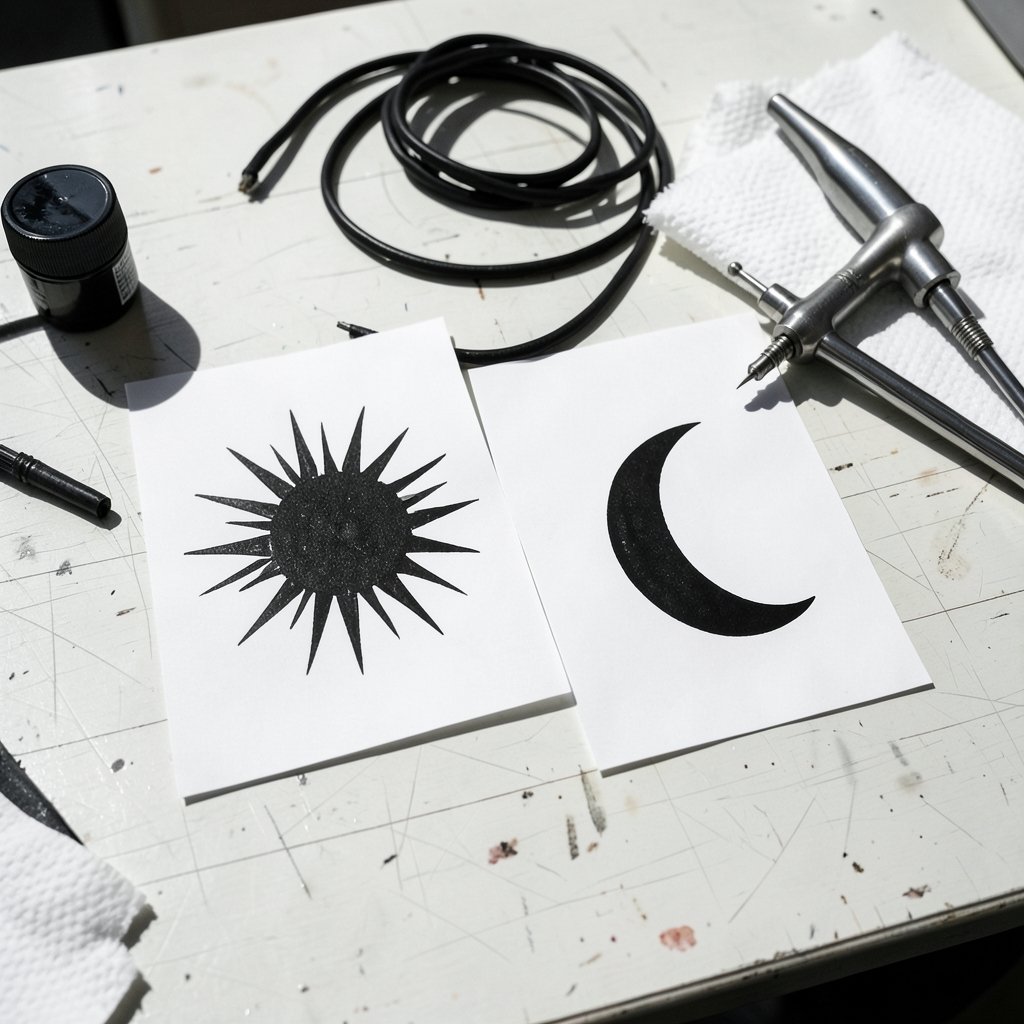
Complementary designs tend to age better as individual tattoos. A half-heart on its own can look odd, but a sun on one partner and a moon on the other works fine as a standalone piece if the relationship ever changes. That’s a practical design advantage, separate from any sentimental value.
Choosing a Design That Actually Lasts
The most common mistake is choosing something that only means something right now. Trendy designs date fast. So do in-jokes that lose their punch after a few years.
Practical rules that hold up:
- Wait three months. Sit with the idea. If you still love it after ninety days, it’s probably not a passing mood.
- Avoid names and dates as the primary element. Lettering is the least forgiving tattoo category. It blurs faster than linework, and it’s the single hardest thing to cover up later.
- Pick a style, not merely an image. Fine-line, traditional, blackwork, and watercolor all age differently. Fine-line pieces can fade and blur within a few years, especially on hands and feet.
- Agree on size before you agree on the design. A design that looks great at two inches may look cluttered at six.
- Consider placement symmetry. Matching designs on the same body part read as a pair. Matching designs on different body parts often just look like two unrelated tattoos.
A useful test: sketch the design, then imagine it on your skin in fifteen years, at a heavier weight, with sun exposure behind it. If that image still works, you’re on solid ground.
What It Costs and What to Ask the Artist
Pricing varies enormously by city, artist reputation, and size. A small matching pair might run a few hundred dollars total; larger custom work runs into the thousands. Most artists charge by the hour or by the piece, and a good artist will quote you before booking.
Questions worth asking before you commit:
- Have you tattooed this style before? Ask to see healed photos as well as fresh ones.
- How will this design age in this placement?
- Can you show me the stencil before we start?
- What’s your touch-up policy?
Fresh tattoo photos are misleading. Lines look crisp because the skin is still swollen and the ink is at the surface. Always ask for healed work. Any experienced artist has it.
The Regret Question, Handled Honestly
This is the part most articles skip. Some couples do regret matching tattoos. The reasons are usually predictable: the relationship ended, the design was rushed, or one partner felt pressured into it.
Tattoo removal is possible but it’s not trivial. Laser removal typically requires multiple sessions spread over months, costs more than the original tattoo in most cases, and works better on some ink colors than others. Black and dark inks respond best; greens and yellows are notoriously stubborn. Cover-ups are another option, but they require a larger, darker design than the original, which limits your choices.
The honest takeaway: treat a matching tattoo like any other permanent decision, not like a romantic gesture with an undo button. If you’re not fully certain, get something small and easily covered. A two-inch design on your ribcage is a very different risk than a forearm sleeve.
There’s also a middle path more couples should consider: matching tattoos on a date, not on a whim. Book the session for an anniversary or a specific milestone. It gives the tattoo a built-in story and forces a natural waiting period.
Placement, Pain, and Practicality
Pain varies by location far more than by design. Fleshy areas like the upper arm, thigh, and calf are generally easier. Ribs, spine, feet, hands, and the inside of the elbow are rougher. If one partner is tattoo-naive, don’t book their first piece somewhere painful just to match a placement.
Visibility matters too. Hand, neck, and face tattoos still carry professional consequences in many fields, and some employers have policies against visible ink. If either partner works in a conservative environment, a hidden placement solves the problem without killing the idea.
Aftercare is where couples can genuinely help each other. Fresh tattoos need washing, moisturizing, and protection from sun and friction for the first couple of weeks. Two people going through aftercare together usually do it better than one, simply because there’s someone to remind them.
How to Handle Disagreement
The most common friction point isn’t the design. It’s the degree of commitment. One partner wants something bold and visible; the other wants something small and private. Both positions are reasonable.
A workable compromise: pick a small, meaningful design and put it somewhere covered. You get the shared experience and the private meaning without either person feeling overexposed. If one partner is genuinely unsure, the right answer is to wait. A tattoo postponed is a decision preserved; a tattoo rushed is a decision locked in. (Tattoo)
Never let a partner pressure you into ink. A tattoo given as a concession tends to become a source of resentment, and it’s a permanent reminder of a bad conversation.
Conclusion
Matching tattoos for couples work best when they’re treated as a design decision first and a romantic gesture second. Choose a style that ages well, keep the size modest if you’re uncertain, ask to see healed work, and give yourselves a real waiting period. The couples who end up happiest with their matching ink are rarely the ones who booked spontaneously. They’re the ones who talked it through, picked something they’d each want even alone, and walked out of the studio with a piece they’d choose again.
Frequently Asked Questions
How much do matching tattoos usually cost?
Costs depend on size, artist, and city. Small matching pairs often run a few hundred dollars total, while larger custom pieces cost considerably more. Most artists quote by the hour or by the piece, and a reputable studio will give you a price before you book. Never choose a design based on a discount alone.
Do matching tattoos have to be identical?
No. Identical designs are only one option. Complementary pairings, where two designs complete each other, and thematic matches, where partners share a style or motif, are both common. Complementary designs have a practical edge: each piece still works as a standalone tattoo. (Relationships)
Are matching tattoos a bad idea?
They’re a bad idea when they’re rushed, when one partner feels pressured, or when the design is a passing trend. They’re a reasonable idea when both people genuinely want the piece, the design has staying power, and the placement is sensible for their careers and lifestyles. The risk isn’t the tattoo itself. It’s the speed of the decision.
Which placements work best for couples?
Upper arm, forearm, thigh, calf, and ribcage are popular because they’re easy to cover and age reasonably well. Hands, fingers, and feet fade faster and are harder to touch up. If either partner needs to keep ink hidden at work, choose a covered placement and skip the visible-symmetry idea entirely.
Can a matching tattoo be removed or covered up?
Yes, but plan for it to be harder than the original. Laser removal usually takes multiple sessions over several months and often costs more than the tattoo did. Cover-ups require a larger, darker design, which limits your options. Small designs in easily covered spots are far more forgiving if you ever change your mind.
How long should couples wait before getting matching tattoos?
Three months is a reasonable minimum. It’s long enough for the novelty to wear off and for both partners to confirm they still want it. Booking the session around a specific date, like an anniversary, builds in a natural waiting period and gives the tattoo a story worth telling.
One more point worth adding: not every couple needs to get inked on the same day. Some of the strongest matching tattoos happen when one partner goes first and the other follows weeks or months later, once they’ve seen the healed result and lived with the idea a little longer. It removes the pressure of a shared appointment and gives the second person an honest preview of what they’re signing up for.
And if you decide against it entirely, that’s a perfectly good outcome too. A shared experience, a piece of jewelry, or a trip you take together can mark a relationship just as meaningfully, without any of the permanence or the cost. The point of a matching tattoo was never the ink itself. It’s the decision you make together, deliberately, with your eyes open. Get that part right, and the rest tends to follow.
One more consideration: budget for the touch-up as well as the session. Many artists offer a free or discounted touch-up within the first few months, but that courtesy varies, and it’s worth confirming in writing before you book. A slightly higher hourly rate from an artist with a clear touch-up policy often costs less overall than a cheaper session followed by paid corrections.
Finally, photograph everything. Take clear, well-lit photos of the fresh work and again at the one-month and one-year marks. Healed photos are the most useful thing you can hand a future artist, and they’re also the honest record of how your design is actually aging. If it’s holding up well, you’ll know. If it isn’t, you’ll catch it early, while a touch-up is still simple.