
Hair Stores Near Me: Find the Right Shop in 2026
 Abdul WadoodLast updated

You typed “hair stores near me” into your phone, and now you’re staring at a map dotted with pins. A beauty supply chain, a wig shop, a salon that also sells bundles, a pharmacy aisle that technically counts. Which one actually has what you need?
That question is harder than it looks, because “hair store” is a loose label. It can mean a big-box beauty retailer, a neighborhood beauty supply shop, or a salon counter that sells extensions on the side. Knowing how to sort them quickly saves gas, money, and a wasted Saturday.
What “Hair Stores Near Me” Actually Returns
Search engines treat “near me” queries as location-dependent. They resolve results using your device location or IP address, so two people in the same city can get different lists. There is no single national answer to the query, and anyone who claims otherwise is guessing.
That matters for a practical reason. The results you see reflect your neighborhood, not the best shops in your metro area. If you want a full picture, widen your search radius or try a few different phrasings, because the platforms behind the results categorize stores differently.
Google Maps and Google Business Profile listings are the most common way people find local hair stores. Listings bundle hours, reviews, photos, and directions in one place. They’re also user-edited and can go stale, so a listing that says “open now” isn’t a guarantee.
Yelp runs separate categories for hair salons and beauty supply stores. Those category definitions don’t match Google’s exactly, which is why the same shop can appear under one label on one platform and a different label on another. Store counts shift between sources and dates for this reason alone.
The Three Types of Hair Store You’ll Encounter
Before you drive anywhere, figure out which category you actually need. The three below cover most of what shows up in local results, and they serve very different purposes.
| Store type | What it sells | Best for | Watch out for |
|---|---|---|---|
| Beauty supply retail | Wigs, braiding hair, extensions, relaxers, styling tools, care products | Bundles, braiding hair, hard-to-find products | Inconsistent hours, cash-only policies at some independents |
| Chain beauty retailer | Branded haircare, tools, some salon services | Name-brand products, returns, loyalty programs | Limited wig and extension selection |
| Salon with retail counter | Professional products, sometimes extensions | Advice from a stylist, color-matched pieces | Higher prices, stock tied to what the salon uses |
Independent beauty supply stores are a distinct retail category in many U.S. urban areas. Many are Black-owned and specialize in wigs, braiding hair, and extensions. This segment has real cultural and economic weight, and it’s often the only place in a neighborhood where you can buy specific textures, tools, or braiding hair in the quantities you need.
Chain retailers such as Sally Beauty and Ulta Beauty operate their own store-locator pages. Those are the closest thing to a primary source for confirmed locations, because the companies control the data. Third-party directories are secondary and tend to lag behind relocations and closures.
Salons that sell retail are the wildcard. They’re great for advice and color matching, but their shelves carry what the stylists use. If you need a specific brand or a particular length and texture of bundle, call ahead. (Hairdresser)
How to Vet a Hair Store Before You Go
The fastest way to waste an afternoon is to trust a listing without checking it. A few habits fix that, and they take about three minutes total.
- Call the store. Not text, not DM. A phone call confirms hours, stock, and whether they carry the specific item you want. Independent shops often answer quickly because they know stock questions are their bread and butter.
- Check the most recent reviews, not the rating. A 4.2-star shop with ten reviews from last month tells you more than a 4.8-star shop whose newest review is two years old. Read the one-star reviews specifically. They reveal patterns: rude service, expired products, no returns.
- Look at user photos. Review photos show actual shelves and actual inventory. If every photo is a storefront sign, you’ve learned nothing.
- Confirm the address on a second source. Cross-check the chain’s own locator against the map listing. When they disagree, trust the company’s page.
- Ask about return policy before paying. Beauty supply returns are often restricted, especially on hair extensions and wigs. Some shops allow exchanges only, and some allow nothing once the package is opened.
A practical tip that saves real money: for human hair bundles and wigs, ask whether the hair is returnable and whether it has been processed. Unopened, unprocessed hair is easier to exchange if the texture is wrong. Once it’s been washed, cut, or installed, you own it.
Another habit worth building: bring a photo of the finished look you want, rather than only a product name. Staff at independent beauty supply shops are often skilled at reverse-engineering a photo into a shopping list of bundles, closures, and tools. That expertise is the main reason to shop in person instead of online.
Common Mistakes People Make
Most disappointing hair store trips trace back to the same handful of errors. None of them are exotic, and all of them are avoidable.
Assuming all beauty supply stores are the same. They aren’t. One shop may be deep in wigs and almost empty on braiding hair; the next may be the reverse. Inventory reflects the neighborhood’s demand, so a store two miles away can carry a completely different mix.
Trusting “open now” on a map without checking. Holiday hours, family emergencies, and relocations all break listings. A quick call eliminates the risk entirely.
Ignoring the definition problem. If you search for a hair store and get a salon, that’s not a bad result, it’s a category mismatch. Decide whether you need products or a service, then search accordingly.
Skipping the price comparison. Prices for the same bundle or braiding hair can vary widely within a few blocks. Buying from the first shop you walk into is convenient and usually more expensive.
Overlooking small-business resources. If you’re considering opening your own shop, the U.S. Small Business Administration publishes guidance on licensing, permits, and retail operations. Retail classification questions are better answered through the U.S. Census Bureau, whose NAICS system separates beauty supply retail from salon services. That distinction matters for anyone trying to understand why store counts differ so much between platforms.
What Actually Works in Practice
The shoppers who consistently find good hair stores tend to follow the same playbook. It’s not complicated, but it is deliberate.
They start with the company locator pages for chains, because those are authoritative for confirmed locations and hours. Then they use map listings for independent shops, treating them as leads rather than facts. They call before driving. They read recent reviews for patterns. And they build a short list of two or three trusted shops rather than hunting fresh every time.
There’s a community angle too. In many cities, the best information about which beauty supply shop has the braiding hair you want comes from other customers, not from any directory. Stylists, braiders, and regulars know which shops restock reliably and which ones run out. Asking in a local forum or a stylist’s chair often beats any search result.
For broader retail and consumer-protection context, the Federal Trade Commission publishes guidance on return policies and misleading advertising, which is useful when a shop’s posted policy doesn’t match what you were told at the counter.
If you’re researching how local businesses present themselves online, or you run a shop and want your listing to show up correctly, resources like Voozon Media cover digital visibility and local search topics. Accurate hours, real photos, and current contact details are the three things that most affect whether a store gets found, and they’re also the three things most often neglected.
Hours, Availability, and the Snapshot Problem
Any list of hair stores is a snapshot, and snapshots expire. Store hours change with seasons and holidays. Shops relocate. Chains open and close locations as part of routine portfolio management, and their store counts shift from quarter to quarter. (Barbers, Hairstylists, and Cosmetologists)
That’s why a “verified as of” date matters more than a comprehensive list. If you’re reading a directory of local hair stores, check when it was last updated. If there’s no date, assume it’s older than it looks.
The same caution applies to review counts and ratings. A shop with hundreds of reviews accumulated over eight years may have changed ownership twice in that time. Recent reviews describe the current store; old ones describe a business that may no longer exist in any meaningful sense.
Chain Locator vs. Third-Party Directory
Both tools have a place, and knowing which to trust for what saves time.
| Question | Best source | Why |
|---|---|---|
| Is this chain location open? | Company store locator | Company-controlled, updated for closures |
| What are today’s hours? | Phone call | Listings lag on holiday and temporary changes |
| Does it carry a specific product? | Phone call or store page | Inventory varies by location |
| What’s the neighborhood reputation? | Recent reviews and user photos | Shows current service and stock |
| How do platforms categorize it? | Each platform’s own category page | Definitions differ between platforms |
The takeaway is simple. Use directories to generate candidates. Use primary sources and phone calls to confirm them. Never let a map pin be your only evidence.
Conclusion
Finding hair stores near you isn’t hard. Finding the right one takes a little discipline. Search results are location-dependent, platforms categorize stores differently, and listings go stale, so the query is only the first step.
The reliable approach is to decide whether you need products or a service, use chain locators and map listings to build a short list, call ahead to confirm stock and hours, and read recent reviews for patterns rather than ratings. Build a small set of trusted shops over time, and lean on stylists and other customers for the kind of inventory knowledge no directory captures.
Do that, and “hair stores near me” stops being a gamble. It becomes a short list of places you already know will have what you need.
Frequently Asked Questions
Why do different search engines show different hair stores near me?
Search engines resolve “near me” queries using your device location or IP address, so results vary by city and even by neighborhood. Platforms also define categories differently, which changes which stores appear under a hair-related search. There’s no single national list.
Are independent beauty supply stores the same as chain beauty retailers?
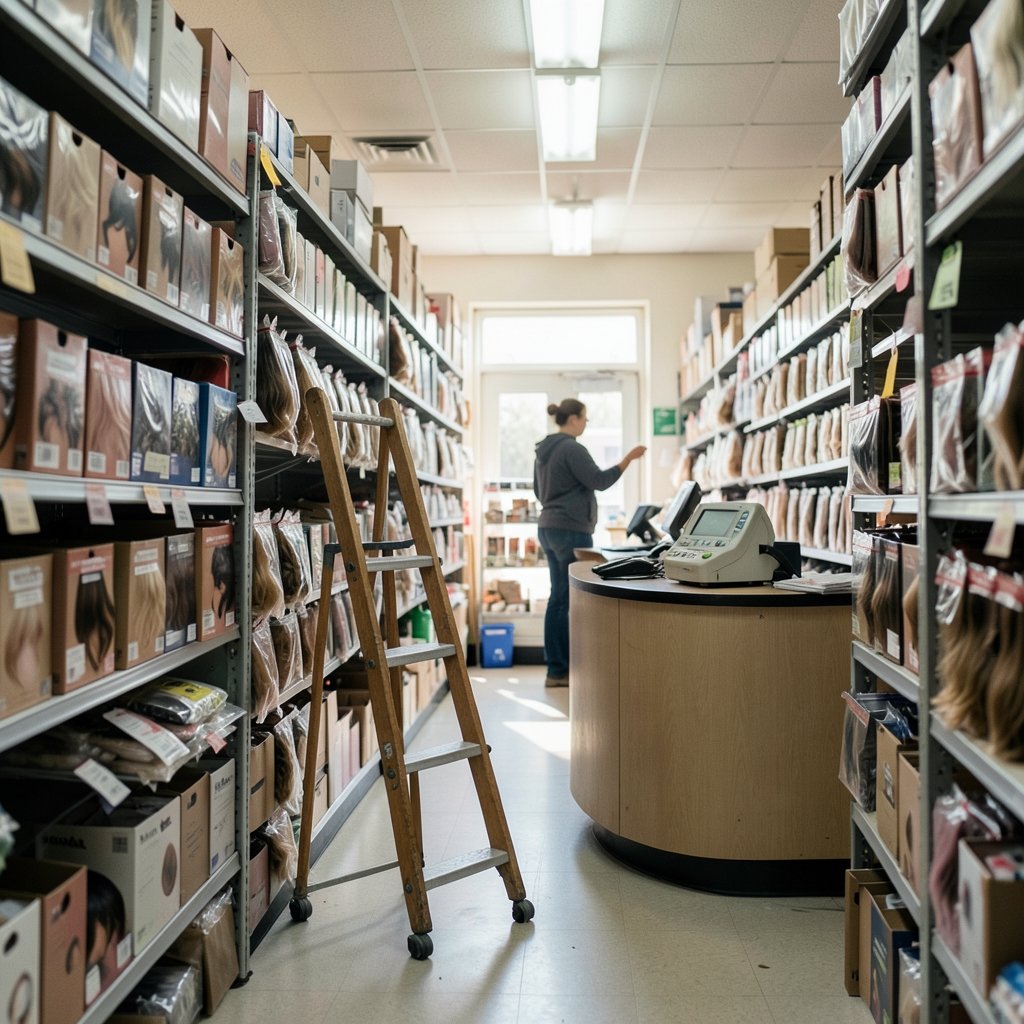
No. Independent beauty supply stores often specialize in wigs, braiding hair, and extensions, and many are Black-owned neighborhood businesses. Chain retailers focus more on branded haircare, tools, and some salon services. Their inventories and return policies differ significantly.
How can I confirm a hair store is actually open?
Call the store directly. Company store-locator pages are the most reliable source for confirmed chain locations, but hours can change for holidays or temporary closures. Map listings are user-edited and can lag behind reality, so a phone call is the fastest confirmation.
What should I check before buying hair extensions or a wig?
Ask about the return policy before paying, since many shops restrict returns or exchanges on hair products once packaging is opened. Confirm whether the hair is processed, and inspect the texture and length in person. Unopened, unprocessed hair is easier to exchange if something’s wrong.
Why do store counts for hair stores differ between websites?
Platforms use different category definitions, and directory data is often user-generated and can be outdated. Industry classification systems also separate beauty supply retail from salon services. Store counts shift with openings, closures, and relocations, so any number is a snapshot of a specific date.
Is it better to shop in person or search online first?
Search online to build a short list, then shop in person for anything involving texture, color matching, or fit. Staff at independent beauty supply shops are often skilled at turning a photo into a specific shopping list of bundles, closures, and tools, which is hard to replicate online.