
Funny Tattoos: Joke Ink Ideas & Tips for 2026
 Abdul WadoodLast updated

A tattoo is permanent, expensive, and often painful, yet a growing number of people walk into a studio and ask for a cartoon hot dog riding a skateboard. That contradiction is the whole point. Funny tattoos turn a serious commitment into a conversation starter, and they do it on purpose.
The appeal is easy to understand once you look at how tattoo culture has shifted. Ink is no longer reserved for sailors, bikers, or rebellion. It has become a mainstream form of self-expression, and self-expression includes humor. A silly tattoo says something specific about its owner: I don’t take myself too seriously. That message can be more powerful than any skull or rose.
This guide covers what makes funny tattoos work, where the trend came from, which designs hold up over time, and the practical mistakes that turn a great joke into a regret.
What Counts as a Funny Tattoo?
There is no official category for humor in tattoo research, and surveys rarely separate “joke ink” from other styles. That means anyone quoting a precise statistic about funny tattoo prevalence is probably guessing. What can be said with confidence is that humor has become a visible strand of modern tattoo culture, sitting alongside traditional, realism, and fine-line styles. (Tattoo)
A funny tattoo generally falls into one of a few buckets:
- Absurdist images with no punchline, like a pigeon in sunglasses or a banana holding a knife
- Visual puns, where the joke only lands when you look closely
- Deadpan text, such as a single word in serious typography that undercuts itself
- Cute-but-wrong mashups, like a kitten in a business suit
- Self-aware classics, including the intentional misspelling or the deliberately bad drawing
The common thread is tone. A funny tattoo is designed to produce a small, involuntary laugh rather than admiration or awe. It is meant to be a little ridiculous.
A Short History of Joke Ink
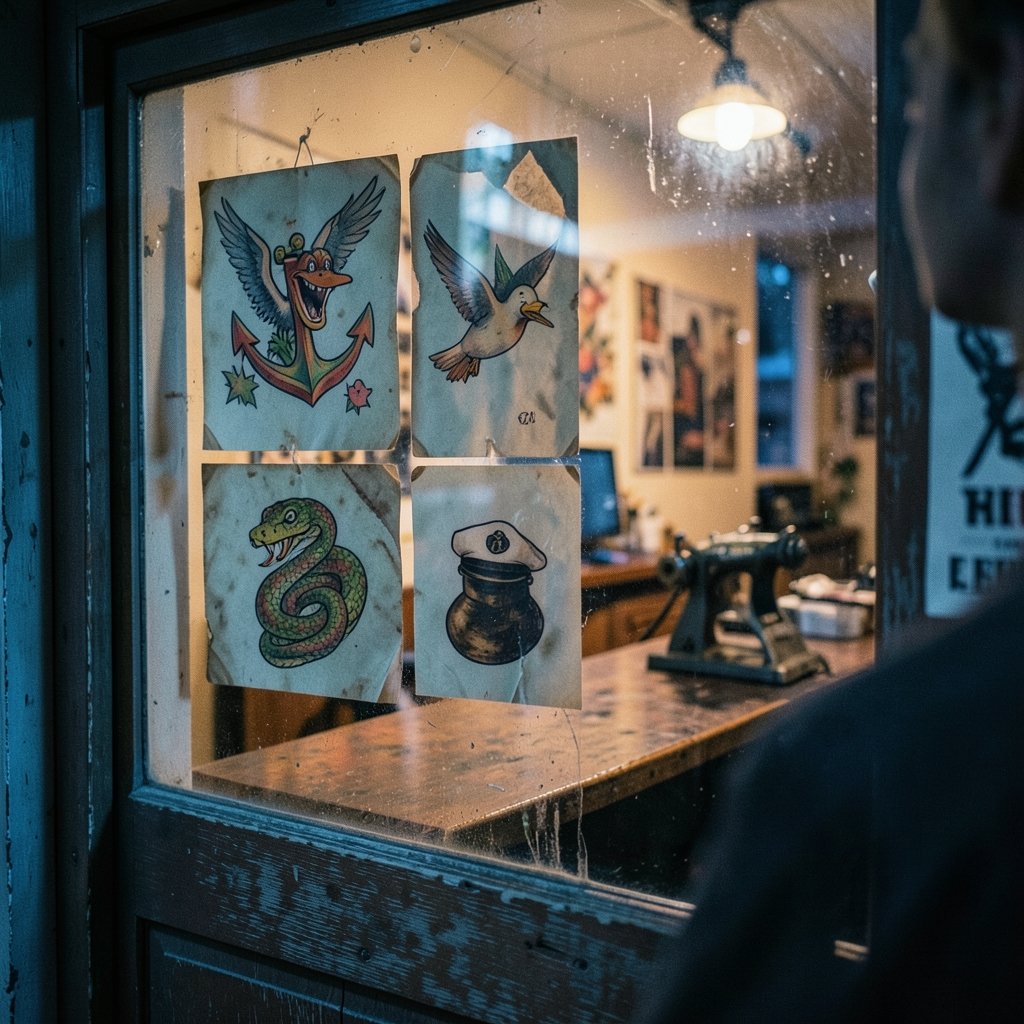
Permanent body art has carried humor for longer than most people assume. Tattooing has appeared across cultures for thousands of years, from Polynesian traditions to ancient Egyptian practice, and not all of it was ceremonial or solemn. Soldiers and sailors have long collected comic or crude designs as souvenirs and inside jokes.
What changed recently is scale and visibility. Social media turned tattoos into shareable content. A clever, silly design photographed well can reach more people in a day than a whole shop’s clientele in a year. That feedback loop pushed studios to experiment with humor, and it pushed clients to ask for designs that photograph as a joke.
The result is a style that borrows from illustration, cartooning, and internet culture more than from tattoo tradition. Many artists now specialize in it, and a good one will tell you the same thing: funny is harder than it looks.
Why People Choose Funny Tattoos
Ask ten people with joke ink why they did it, and you will hear variations on a few themes.
Humor as a coping tool
A tattoo appointment involves needles, discomfort, and a decision you cannot undo. Making that decision funny lowers the stakes. For people anxious about permanence, a silly design feels easier to commit to than a serious portrait.
A built-in icebreaker
A visible funny tattoo does social work for free. Strangers comment on it. It fills silence. For people who find small talk difficult, that is a genuine practical benefit.
Reclaiming the body
Some people get joke tattoos after illness, grief, or a hard season. Choosing something absurd is a way of asserting that the body can also be a place for lightness. That motivation shows up often in first-hand accounts from tattooed adults, and it is one of the most consistent reasons people give for going silly rather than sentimental.
The long game
There is a particular pleasure in knowing the joke will still be there in forty years. A funny tattoo ages differently from a trendy one. It becomes a story about who you were, delivered deadpan.
What Actually Works in Practice
Experience from studios and long-tattooed clients points to a handful of design principles that separate a joke that lasts from one that fades into embarrassment.
| Principle | What it looks like | Why it matters |
|---|---|---|
| Readable at a glance | Bold outline, limited detail | Small, busy designs blur into mush within a few years |
| Joke works without context | No inside reference needed | Inside jokes lose their audience when friendships change |
| Good placement | Thigh, forearm, calf, ribs | Visible enough to be fun, hideable enough for work |
| Artist buy-in | Artist laughs, then improves it | Enthusiastic artists draw better jokes |
| Room to age | Simple shapes, strong contrast | Skin changes; clean lines survive it |
Two practical tips come up again and again. First, sit with the idea for at least a month. If it still makes you smile after thirty days, it will probably still make you smile after ten years. Second, take the drawing seriously even when the subject is silly. A badly executed funny tattoo stops being funny fast, because the joke depends on the image being clean enough to read.
A common mistake is going too small. People assume a small joke is a safe joke, then discover that fine detail and tiny text blur together. Another frequent error is choosing a design that only works as a photograph, such as a joke that depends on a caption nobody will read from a distance.
The Regret Question
Tattoo regret is real, and it is well documented in dermatology and public health literature. Removal services exist for a reason, and demand for laser treatment has grown as tattooing has become more common.
Funny tattoos are not automatically safer than serious ones. A joke can wear thin. A meme can die. A reference that felt hilarious at twenty-two can feel exhausting at forty.
What reduces risk is not seriousness but specificity. Tattoos that express something true about the wearer tend to hold up, even when the surface is absurd. A person who has always been the family clown will still enjoy a whoopee-cushion tattoo decades later, because it is accurate. A person who got a viral meme because it was viral that month is borrowing someone else’s joke, and borrowed jokes expire.
The other protective factor is placement. Hidden or semi-hidden spots give you control over when the joke is on display. That single decision prevents most workplace awkwardness and most second thoughts.
Choosing an Artist for Comic Work
Not every tattooer enjoys drawing jokes. Some build careers on realism, script, or traditional flash and will do a funny design without much enthusiasm. The results usually show.
Look for artists whose portfolios include illustration, cartoons, or bold linework. Check whether their healed work, beyond fresh photos, still reads clearly. Ask directly whether they enjoy comic designs. Most will tell you the truth.
Bring references, but bring your version of the joke. A good artist will redraw it to fit your body, your skin tone, and the way the design will age. Expect them to push back on tiny text, thin lines, and overly detailed backgrounds. That pushback is a good sign.
Finally, discuss size honestly. A joke tattoo that is slightly bigger than you planned will almost always look better than one squeezed into a space too small for it. Skin is not paper, and ink spreads over time.
Humor, Culture, and Knowing the Line
Funny is subjective, and tattoos are public. A joke that lands with your friends might read as offensive to a stranger, an employer, or a family member. This is worth thinking through before the needle comes out, not after.
Broadly, the safest humor punches at yourself, at absurdity, or at nothing in particular. The riskiest humor targets groups, relies on shock, or depends on the viewer sharing a very specific worldview. Since a tattoo has no off switch, the audience is everyone who ever sees it.
There is also a craft question here. The best funny tattoos tend to be quietly strange rather than loudly provocative. A tiny, perfectly rendered shrimp on a tricycle is funnier than a giant slogan designed to offend, and it will still be funny when the provocation has worn off. Subtlety is what gives a joke legs.
Conclusion
Funny tattoos are not a loophole around commitment. They are a different way of making one. Instead of marking a solemn moment, they mark a disposition: the choice to be the person who laughs. Done well, with clean linework, honest placement, and an artist who enjoys the joke, they age into something better than a punchline. They become a small, permanent record of not taking yourself too seriously. Done badly, or borrowed from a trend that has already moved on, they become a lesson. The difference comes down to whether the joke is genuinely yours, and whether you gave it enough time to prove it.
Frequently Asked Questions
Are funny tattoos a bad idea for a first tattoo?
Not inherently, but placement matters more than subject. A first tattoo in a highly visible spot leaves no room to change your mind about visibility. Many artists recommend a thigh, calf, or upper arm for a first joke tattoo so the design can be enjoyed privately while you get used to having ink.
How much should a small funny tattoo cost?
Pricing varies widely by city, artist reputation, and shop minimums. Most studios set a minimum charge that applies even to tiny designs, and well-known artists charge hourly or per piece at higher rates. The practical advice is to budget for the artist you actually want rather than shopping purely on price, since a cheap, poorly executed joke is the most expensive outcome.
Will a funny tattoo still be funny in ten years?
It depends on whether the joke is yours. Tattoos tied to your own personality, family role, or sense of humor tend to hold up. Tattoos tied to a specific viral moment, meme cycle, or internet trend often do not, because the cultural context that made them funny disappears. (A Brief History of Tattoos)
Can text-based joke tattoos work?
Yes, but text is the least forgiving element in tattooing. Small lettering blurs and spreads as skin ages, so artists usually recommend short phrases, larger sizing, and clean sans-serif fonts. A single word executed boldly will outlast a long sentence every time.
Where should a funny tattoo go if I need to hide it for work?
Common choices include the upper thigh, ribs, shoulder blade, upper back, and areas covered by a standard sleeve. Visibility rules vary by industry and country, so check your own workplace expectations rather than assuming. Semi-hidden placements give you the option to show the joke on your own terms.
Do tattoo artists get annoyed by joke requests?
Most do not, provided the request is clear and the client respects their design judgment. Artists tend to enjoy projects that let them draw something playful. What does frustrate them is a client who insists on a size or level of detail that will not age well, or who treats a custom drawing as a copy-paste job.
The through-line is simple: a funny tattoo is a commitment to a version of yourself that finds things funny. That version can survive job changes and haircuts and entire decades, as long as the joke was never rented from the internet in the first place. If you are on the fence, wait a month, sketch it twice, and ask an artist you trust whether it will still read cleanly in ten years. If the answer is yes and you are still grinning, book the appointment. The best ones are the jokes you get to keep telling without ever opening your mouth.