
Finger Tattoos for Men: What to Expect & How They Age
 Abdul WadoodLast updated

Finger tattoos have quietly become one of the most requested placements in men’s tattoo studios, and the reason is simple: they are visible in almost every social situation, from a handshake to a phone screen. Yet the same placement that makes them striking also makes them demanding. The skin on the fingers is thin, constantly flexed, and exposed to soap, sun, and friction all day long. That combination is why two men can get the same design on the same day and end up with very different results six months later. (Tattoo)
This guide covers what actually works on fingers, what tends to fail, how to prepare, and how to judge whether a finger tattoo fits your life rather than just your Instagram feed.
Why Finger Tattoos Age Faster Than Almost Any Other Placement
The skin on the sides and tops of the fingers is among the thinnest on the body, and it sits directly over bone and tendon with very little fat cushioning beneath it. When a needle deposits ink into that shallow layer, the body’s immune system treats the pigment as a foreign object and gradually breaks it down. On thicker areas like the upper arm or thigh, that process takes years. On fingers, it can be visible within months.
Add the daily grind: handwashing dozens of times a day, gripping steering wheels, lifting weights, typing, cooking, and exposure to cleaning products. Each of these accelerates ink loss and can blur fine lines. Blowout, the soft halo of ink that spreads beyond the intended line, is also more common here because the dermal layer is so shallow that a needle can easily overshoot.
Practical takeaway: expect a finger tattoo to look its sharpest at around two to four weeks after healing, then gradually soften. That is not a sign of a bad artist. It is the nature of the placement.
Design Choices That Survive on Fingers
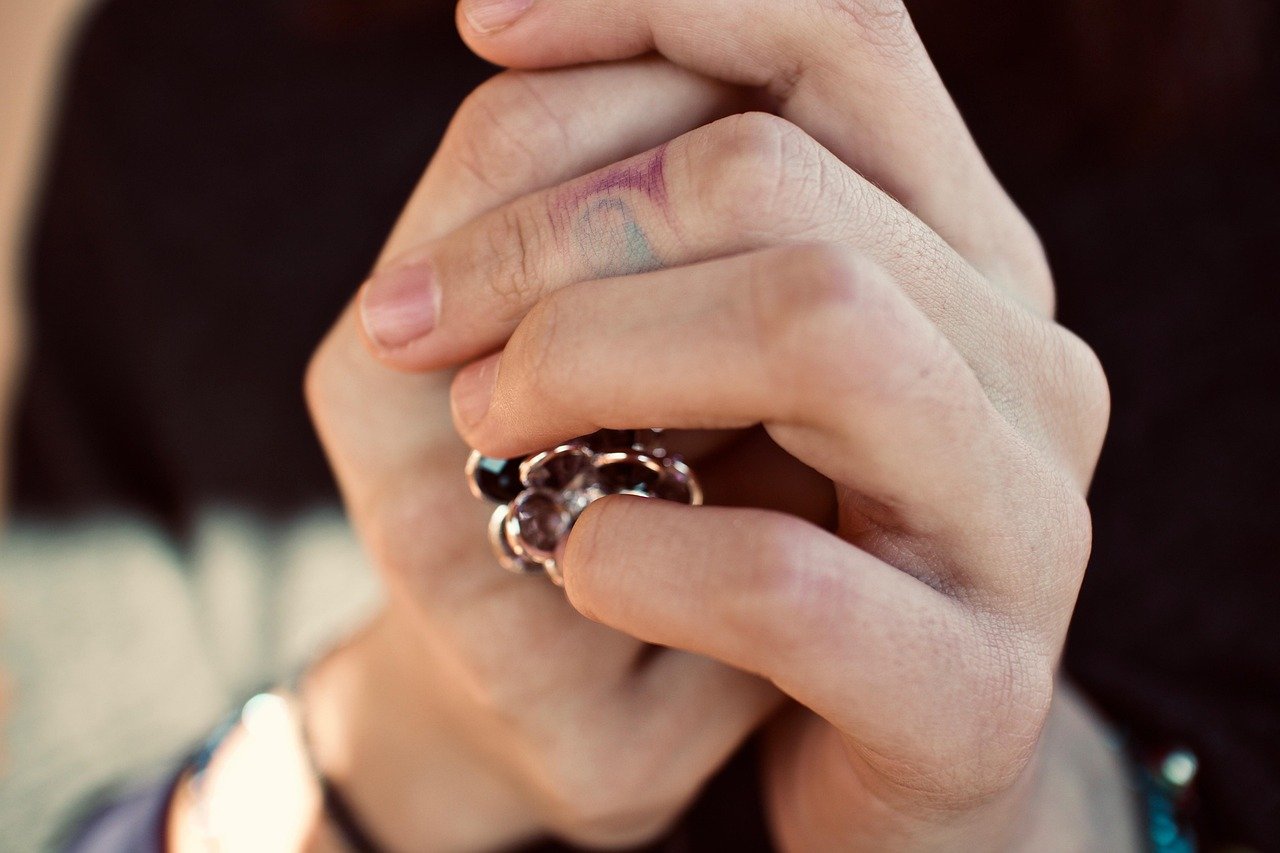
The single biggest predictor of long-term satisfaction is design simplicity. A detailed portrait or a delicate script quote will lose definition fast. Bold, high-contrast work holds up far better.
| Design type | How it holds up | Best for |
|---|---|---|
| Bold single letters or initials | Excellent | First-timers, minimal style |
| Simple geometric lines, dots, arrows | Very good | Clean, modern look |
| Solid black bands or rings | Excellent | Wedding or commitment rings |
| Small symbols (cross, anchor, rune) | Good if bold | Symbolic personal meaning |
| Fine script or thin lettering | Poor to fair | Best avoided on fingers |
| Detailed realism or portraits | Poor | Not recommended |
| Color work | Fair | Fades and shifts hue fastest |
A useful rule that experienced artists repeat: if a design would not read clearly from across a room when drawn in marker on your finger, it will not read clearly as a healed tattoo either. Scale matters more here than anywhere else on the body.
Placement: Top, Side, or Inside the Finger
Where on the finger the ink goes changes both the look and the durability. The top of the finger, between the knuckle and the nail, is the most visible and also the most exposed to sun and friction. The side of the finger is slightly more protected and often ages better. The inner finger, facing the palm, is the most sheltered of all but also the least visible, which defeats the purpose for many men.
Knuckle-adjacent placements and designs that cross a joint are riskier. Ink over a crease gets pushed and pulled every time the finger bends, and lines tend to break up there first. If a design must cross a joint, thicker lines and generous spacing give it the best chance.
Pain, Session Length, and What the Appointment Feels Like
Finger tattoos are widely described as more painful than arm or back work, largely because there is so little tissue between skin and bone. The sensation is often described as sharp and vibrating rather than dull. The good news is that sessions are short. Most single-finger designs take fifteen to forty-five minutes, so even a nervous first-timer is finished quickly.
A few practical points that make the appointment smoother:
- Eat a proper meal an hour or two before, and stay hydrated.
- Avoid alcohol for twenty-four hours beforehand; it thins the blood and affects ink retention.
- Skip caffeine right before the session if you are prone to flinching.
- Bring reference images, but trust the artist to simplify them for the placement.
- Ask directly whether the artist has healed photos of finger work as well as fresh photos.
That last point is the most important and the most commonly skipped. Fresh tattoo photos flatter every artist. Healed photos on fingers reveal who actually understands the placement.
Healing: The Stage Where Most Finger Tattoos Are Won or Lost
Finger aftercare is unforgiving. The standard advice to keep a tattoo out of water for two weeks collides with the reality of washing your hands. The workaround is to wash normally but gently, pat dry with a clean paper towel rather than a shared cloth towel, and reapply a thin layer of ointment immediately afterward.
Common mistakes that damage healing finger tattoos include:
- Over-moisturizing. A thick layer of ointment softens the skin and pulls ink out. Thin is the goal.
- Picking or scratching. Fingers itch during healing and are impossible to ignore. Light tapping helps.
- Skipping sun protection. Ultraviolet light degrades pigment faster than anything else. A high-factor sunscreen on healed work is non-negotiable.
- Using harsh hand sanitizers constantly. Alcohol-based gels dry the skin and can dull fresh ink; use them sparingly during the first two weeks.
- Assuming it is healed at two weeks. Surface healing takes about two weeks, but the deeper layer takes a month or more.
Expect some ink loss during the first healing cycle. A touch-up at four to eight weeks is normal and often built into the price, but confirm that before booking rather than after.
Work, Culture, and the Visibility Problem
Finger tattoos are the least hideable tattoos a man can get. That is the appeal and the risk. Workplace attitudes vary enormously by industry, region, and role. Customer-facing positions in finance, law, hospitality, and some healthcare settings are more likely to have visible-tattoo policies, while creative, trades, tech, and self-employed roles are typically relaxed. (Tattoos and piercings: What to know)
Before committing, it is worth checking your employer’s written dress or appearance policy rather than guessing. If the policy is silent, look at what senior people in your organization actually do. A single bold letter on the side of a finger is easy to cover with a ring or a plaster for an interview; a full set of knuckle-to-nail designs is not.
There is also a cultural dimension. Finger tattoos carry strong associations in some communities, from religious symbolism to prison and gang iconography, and a small number of symbols carry meanings the wearer may not intend. If a design has a specific meaning you are borrowing, it is worth understanding it fully first.
Cost, Touch-Ups, and the Long-Term Budget
Finger tattoos are usually priced as small pieces, often at or near a studio’s minimum charge, so the per-square-inch cost is high even though the total is modest. The real expense is maintenance. Because fading is faster here, many men budget for a touch-up every one to three years to keep lines crisp.
The honest calculation is not “what does the tattoo cost” but “what does it cost to keep it looking the way I want.” Someone who wants crisp lines indefinitely should plan for periodic maintenance. Someone who likes the softened, weathered look can simply let it be. Both are valid; the mistake is expecting the first outcome without paying for it.
Choosing an Artist Who Actually Does Fingers
Not every talented artist is a good choice for this placement. Look for portfolios that include healed finger work, and ask specifically how the artist handles ink depth on thin skin. Artists who specialize in bold blackwork, lettering, and minimal styles tend to have the most relevant experience.
Questions worth asking during a consultation:
- Can I see healed photos of finger tattoos you did a year or more ago?
- How do you adjust needle depth for thin skin?
- What is your touch-up policy and how long does it last?
- Would you recommend simplifying my design, and why?
An artist who pushes back on an overcomplicated idea is usually doing you a favor. The best finger tattoo artists are often the ones who talk clients out of designs that will not survive.
When a Finger Tattoo Is the Wrong Choice
It is worth being honest about the cases where this placement disappoints. If the design depends on fine detail, if the wearer cannot commit to sun protection and gentle aftercare, if the workplace is genuinely restrictive, or if the person is still deciding what they want their tattoo to say, fingers are a poor first canvas. The visibility that makes them appealing also makes them permanent in a very public way.
For anyone unsure, a good middle path is to start with a single small, bold design on the side of one finger, live with it through a full healing cycle, and then decide whether to expand. That approach costs little and teaches more than any amount of research.
Conclusion
Finger tattoos for men work best when the design is bold, the expectations are realistic, and the aftercare is disciplined. The placement rewards simplicity and punishes detail. It is visible, personal, and genuinely striking, but it is also the placement most likely to soften, blur, and need maintenance. Choose a simple design, find an artist with proven healed finger work, protect the ink from the sun, and budget for a touch-up now and then. Do that, and a finger tattoo becomes a small, permanent detail that earns its place rather than a decision you spend years working around.
How long does a finger tattoo last?
Most finger tattoos remain visible for years, but they typically soften and blur within six to twelve months rather than staying crisp. Full fading is uncommon, though very fine lines can become faint. Touch-ups every one to three years keep the design sharp.
Do finger tattoos hurt more than other placements?
Yes, generally. The skin is thin and sits close to bone, so the sensation is sharper and more vibrating than on the arm or back. Sessions are short, however, often under forty-five minutes, which makes the experience manageable even for first-timers.
Will a finger tattoo blow out?
Blowout is more likely on fingers than on most other areas because the skin layer is shallow and easy to overshoot. Choosing an artist with proven healed finger work and opting for bold, simple designs reduces the risk considerably.
Can I hide a finger tattoo at work?
It depends on the design and the employer. A small mark on the side of a finger can often be covered with a ring or plaster, while designs across the top or multiple fingers are difficult to conceal. Check your employer’s written appearance policy before booking.
How much does a finger tattoo cost?
Most studios charge at or near their minimum fee for small finger pieces, so the total is usually modest even though the per-area cost is high. Ask about the touch-up policy upfront, since maintenance is part of the real cost.
Is a finger tattoo a good first tattoo?
Usually not. The placement is highly visible, fades faster than most, and demands careful aftercare. A single small, bold design on one finger is a reasonable starting point, but a full set of finger tattoos is better left until you know how your skin holds ink.