
Cross Tattoos for Men: Designs, Meanings & Advice
 Abdul WadoodLast updated
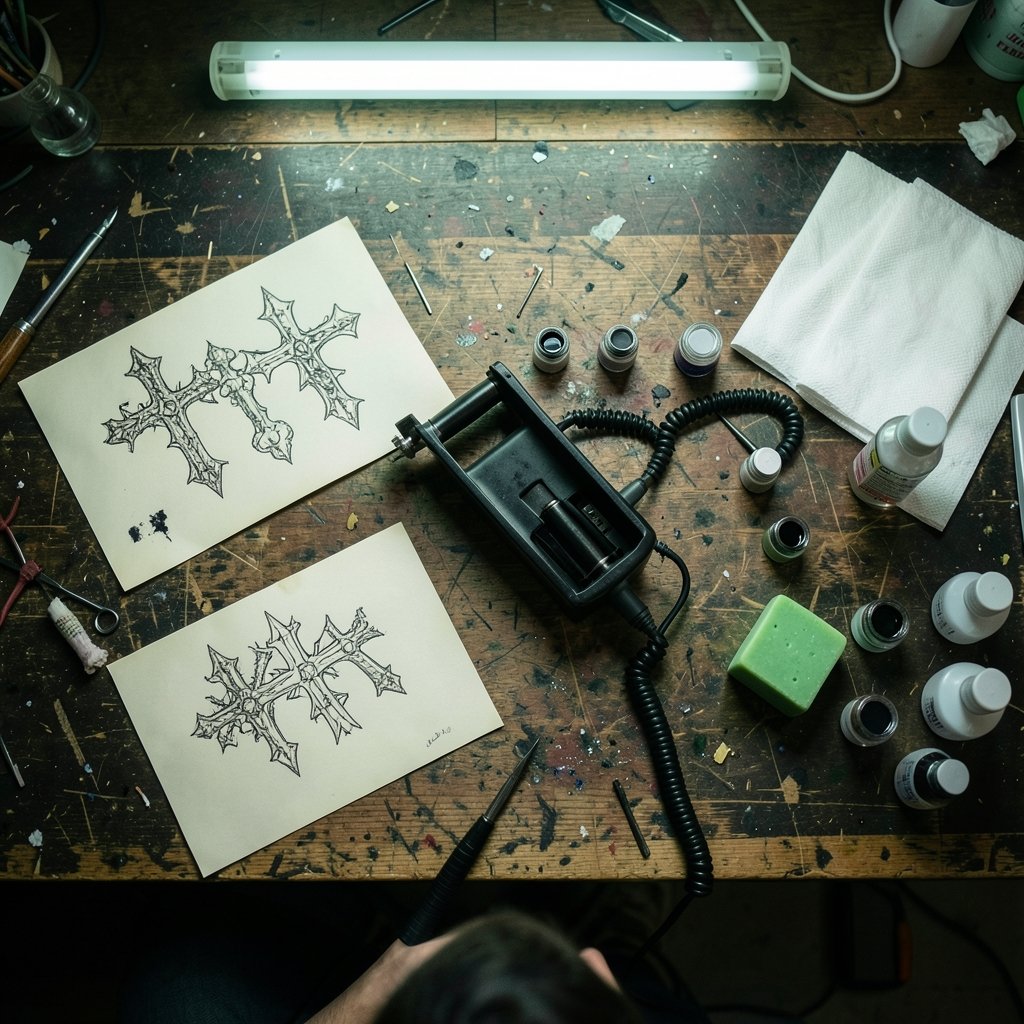
Some of the oldest tattoos ever found sit on a body pulled from an Alpine glacier. The 5,300-year-old mummy known as Ötzi carries dozens of small marks, including simple cross-like lines near his joints. Whether those marks were meant as symbols or as early pain therapy is still debated, but the takeaway holds: cross tattoos for men are not a modern fad. They are one of the oldest design instincts in body art, and they still work today because a cross can say almost anything the wearer needs it to say.
That flexibility is exactly why the design is so popular, and why so many men end up with a tattoo they regret. A cross is simple enough to draw in thirty seconds and layered enough to get wrong for a lifetime. This guide covers the history, the main styles, the practical design choices, and the mistakes that are easiest to avoid.
Why the Cross Still Works as a Men’s Tattoo
The cross is one of the most recognizable shapes in the world. It reads instantly at any size, from a two-inch wrist piece to a full back panel. That instant readability is a big part of its appeal. A tattoo that communicates at a glance tends to age better than one that needs explaining.
There is also the meaning problem, which is really a meaning advantage. A cross can stand for faith, family, sacrifice, protection, memory, or nothing more than a clean geometric form. Two men can wear the same outline for completely different reasons, and neither is wrong.
According to Wikipedia’s overview of the Christian cross, the symbol moved from a method of Roman execution to a central emblem of faith over several centuries. Crucifixion was a common Roman punishment, and the cross only became a widely used symbol in the fourth century. That history matters for design: the cross began as an instrument of shame and became a sign of hope, and many men want their tattoo to carry that reversal.
A Short History That Shapes Modern Designs

Tattooing itself is ancient. The South Tyrol Museum of Archaeology documents Ötzi’s tattoos in detail, and they are mostly short parallel lines rather than clear crosses. Popular articles often claim otherwise, so treat the “crosses on Ötzi” story with caution. The honest version is that early tattoo marks are open to interpretation, and the cross as a deliberate tattoo symbol is a much later development tied to Christian communities. (Tattoo)
What is clear is that cross variants developed separately. The Latin cross, the Celtic cross, the Orthodox cross, and the Jerusalem cross all have distinct histories and proportions. The Celtic cross’s ring is often linked to Irish stone crosses from roughly the eighth to twelfth centuries, though the popular claim that the ring is a pagan sun symbol is contested by scholars. If a man wants a Celtic cross for the pagan story, he should know that story is disputed. If he wants it for its look and its Irish roots, it is a strong choice.
The Main Cross Styles and What They Signal
Style choice does more work than most people expect. A thin outline and a heavy blackwork piece read as different personalities even when the shape is identical.
| Style | Typical Look | Common Meaning | Best Placement |
|---|---|---|---|
| Latin cross | Simple vertical and crossbar | Faith, memorial | Forearm, chest |
| Celtic cross | Cross with a ring | Heritage, eternity | Upper arm, back |
| Orthodox cross | Multiple crossbars | Tradition, devotion | Chest, shoulder blade |
| Blackwork | Solid black, bold | Strength, minimalism | Forearm, hand |
| Fine line | Thin, delicate lines | Subtlety, elegance | Wrist, inner arm |
| Realism | Shaded, detailed | Craft, personal story | Upper arm, back |
| Script-integrated | Cross built from text | Memory, names, dates | Ribs, forearm |
Latin Cross
The plain Latin cross is the most requested version. It is also the easiest to get wrong, because a simple shape has nowhere to hide sloppy linework. A slightly crooked crossbar is visible from across a room. Men who want this design should ask the artist to stencil it and check the symmetry in a mirror before the needle starts.
Celtic Cross
The ringed cross suits men who want something with more visual weight. It works well in blackwork and in knotwork detail. The main practical warning: knotwork is dense, and dense detail blurs over time. A Celtic cross with fine interlacing on a small wrist area will look like a smudge in ten years. Scale it up or simplify the knot.
Orthodox and Jerusalem Crosses
These carry specific religious identity. The Orthodox cross has multiple crossbars, and the Jerusalem cross has four small crosses around a central one. Both are meaningful and both are specific. A man who is not part of those traditions may still choose them, but he should know what they mean before a stranger asks.
Fine Line and Minimalist
Fine line crosses have surged in popularity because they look clean and modern. They also fade faster than bold work, especially on hands, wrists, and feet. Sun exposure and skin turnover hit thin lines hardest. A minimalist cross is a good choice if the wearer accepts that it may need a touch-up every few years.
Realism and Script
Realistic crosses with wood grain, stone texture, or draped cloth suit men who want a showpiece. Script-integrated crosses, where the cross is built from names or dates, are a common memorial choice. The design risk here is legibility. Text that is too small or too curly turns into a dark line within a few years.
Meaning: Faith, Memory, and Everything Between
Most men choose a cross for one of four reasons, and it helps to know which one applies before booking an appointment.
Faith. This is the most direct meaning. Some men want a visible marker of belief. Others want a private one, which is why small inner-arm placements stay popular.
Memory. A cross is a common memorial tattoo for a parent, grandparent, or friend. Dates, initials, and birth flowers often get folded into the design.
Heritage. Celtic, Orthodox, and regional cross designs connect a man to family history or culture.
Aesthetics. Some men simply like the geometry. That is a valid reason, and the tattoo does not need a deeper story to be worth having.
Religious attitudes toward tattooing vary widely. Leviticus 19:28 is often cited in Jewish and some Christian discussions of body marking, and interpretation differs across denominations. A man who wants a cross tattoo for religious reasons should think about how his own community views it. This is a personal question, not a rule.
Practical Design Advice That Actually Helps
The gap between a good cross tattoo and a bad one usually comes down to decisions made before the needle.
Start with placement, not design. Where the tattoo goes determines how much detail it can hold. Forearms and upper arms hold detail well. Ribs, hands, and feet distort and fade faster.
Size up, within reason. A common mistake is choosing a design that is too small for its detail. If a cross has script, knotwork, or shading, it needs room. Shrinking a detailed design to fit a wrist is how blurry tattoos happen.
Check symmetry on your own body. Bodies are not symmetrical. A cross that looks straight on paper can look tilted on a chest or collarbone. Ask the artist to place the stencil, then look at it in a mirror and in photos from a few angles before committing.
Decide on color early. Black and grey ages more predictably than color. Color crosses can look striking, but some pigments fade unevenly. In the European Union, restrictions on certain tattoo ink pigments took effect in January 2022 under the REACH regulation, which changed what artists can legally use. Ask your artist what they are working with.
Consider how it ages. Lines thicken, ink spreads, and skin changes over decades. Bold, simple shapes survive. Ultra-fine detail does not.
Think about visibility. A hand or neck cross is a statement that follows a man into job interviews and family dinners. There is no wrong answer, but the decision deserves honest thought rather than a spontaneous Friday afternoon.
Safety, Aftercare, and What to Expect
Tattoo safety is mostly about the studio and the aftercare, not the design.
In the United States, tattoo ink and practice fall under state and local health codes, with the FDA providing oversight of tattoo inks. In Europe, the European Chemicals Agency sets restrictions on ink substances. A reputable studio will follow local rules, use single-use needles, and be willing to talk about ink sources.
Aftercare basics that actually matter:
- Keep the fresh tattoo clean and lightly moisturized.
- Avoid soaking it in pools, baths, or the ocean for the first couple of weeks.
- Do not pick or scratch the peeling skin.
- Keep it out of direct sun while it heals, and use sunscreen once healed.
- Contact the artist or a doctor if you see spreading redness, pus, or fever.
A cross on a forearm is exposed to sun constantly. Sunscreen is not optional if the wearer wants the lines to stay crisp.
Common Mistakes Men Make With Cross Tattoos
Some errors show up again and again.
Choosing an artist by price alone. A cheap cross is still a permanent cross. Linework is the hardest skill to fake, and a simple cross exposes weak linework immediately.
Copying a design from a search result. Reference images are fine as a starting point, but a good artist will redraw the design for the wearer’s body and size. Direct copies often fit badly.
Ignoring the stencil. The stencil is the last checkpoint. If the cross looks off-center in the mirror, say so before the needle touches skin.
Overloading the meaning. A cross with a name, a date, a verse, a rose, and a banner can become cluttered. One strong idea usually beats five competing ones.
Skipping the healing plan. A tattoo is an open wound for a short time. Men who treat aftercare casually end up with patchy ink and unnecessary touch-ups.
Cross Tattoos for Men: A Design That Rewards Thought
The cross has survived for centuries because it is simple, flexible, and heavy with meaning for the people who choose it. For men, that flexibility is the appeal and the challenge. The same outline can be a statement of faith, a memorial, a nod to heritage, or a clean piece of geometry, and the design decisions around it determine whether it looks sharp in twenty years or blurry in five.
The practical path is straightforward. Pick the meaning first, then the style, then the placement, then the artist. Size the design for its detail. Check the stencil in a mirror. Follow the aftercare. None of that is glamorous, but it is what separates a tattoo a man is proud of from one he covers up.
A cross tattoo is not a trend to chase. It is a permanent mark with a long history behind it. Treated with a little patience and a good artist, it earns its place.
Frequently Asked Questions
How much does a small cross tattoo usually cost?
Pricing depends on the studio, the artist, and the size. Most shops set a minimum charge that covers small pieces, and simple crosses often fall near that minimum. Larger or detailed work is priced by the hour or by the piece. Ask for a quote during a consultation rather than guessing from online averages.
Does a cross tattoo have to be religious?
No. Plenty of men choose a cross for its shape, its symmetry, or its connection to family and memory. The symbol carries religious history, but the wearer decides what it means in his own life. Some men keep it private for that reason, placing it where clothing covers it.
Which placement is best for a first cross tattoo?
The upper arm and forearm are the most forgiving spots for a first tattoo. They hold detail well, heal predictably, and can be covered by a sleeve when needed. Hands, feet, ribs, and neck are harder to heal and harder to hide, so they are usually better saved for later work.
Do fine line cross tattoos fade faster?
Yes, generally. Thin lines and light shading break down sooner than bold blackwork, especially in areas exposed to sun. They can still look excellent, but the wearer should expect touch-ups over time and commit to sunscreen once the tattoo is fully healed.
Can a cross tattoo cover an old tattoo?
Sometimes. A cross has large solid areas that can hide darker ink, but cover-ups depend on the old tattoo’s size, color, and darkness. A consultation with an artist who specializes in cover-ups is the only reliable way to know. Some old tattoos need lightening sessions first.
How long does a small cross tattoo take to heal?
The surface usually heals in two to four weeks, while deeper layers take a few months to settle. During the first two weeks, keep it clean, moisturized, and out of pools and direct sun. Peeling and itching are normal. Spreading redness, swelling, or fever are not and should be checked by a doctor.