
Business Casual Capsule Wardrobe: Build a Small, Hardworking Closet
 Abdul WadoodLast updated

The term “capsule wardrobe” is often traced back to London boutique owner Susie Faux, who opened a shop called Wardrobe in 1975 and promoted the idea of a small, interchangeable set of clothes instead of a packed closet. Half a century later, that idea has found its natural home in the office. Business casual is famously fuzzy as a dress code, yet it is also one of the easiest styles to strip down to a tight, hardworking core.
That is the promise of a business casual capsule wardrobe: a limited set of pieces that mix freely, cover most workdays, and remove the morning guessing game. This guide explains how the system works, what to buy, what to skip, and how to keep it running for years rather than one season.
Why a Capsule Works Better Than a Full Closet
Most people do not have a clothing shortage. They have a matching problem. A closet full of individual pieces that each look good on their own can still produce very few complete outfits, because the colors, fabrics, and formality levels do not cooperate.
A capsule flips that logic. Every item is chosen partly for how it pairs with the others, so the number of possible outfits grows much faster than the number of garments. Twenty carefully chosen pieces can generate dozens of combinations. Twenty random pieces often generate three or four, plus frustration.
There is a practical bonus too. Fewer items means clearer laundry routines, easier packing for work trips, and less decision fatigue before 8 a.m. The concept overlaps heavily with the thinking behind how to build a timeless wardrobe, which favors longevity and versatility over volume.
What “Business Casual” Actually Means in Practice
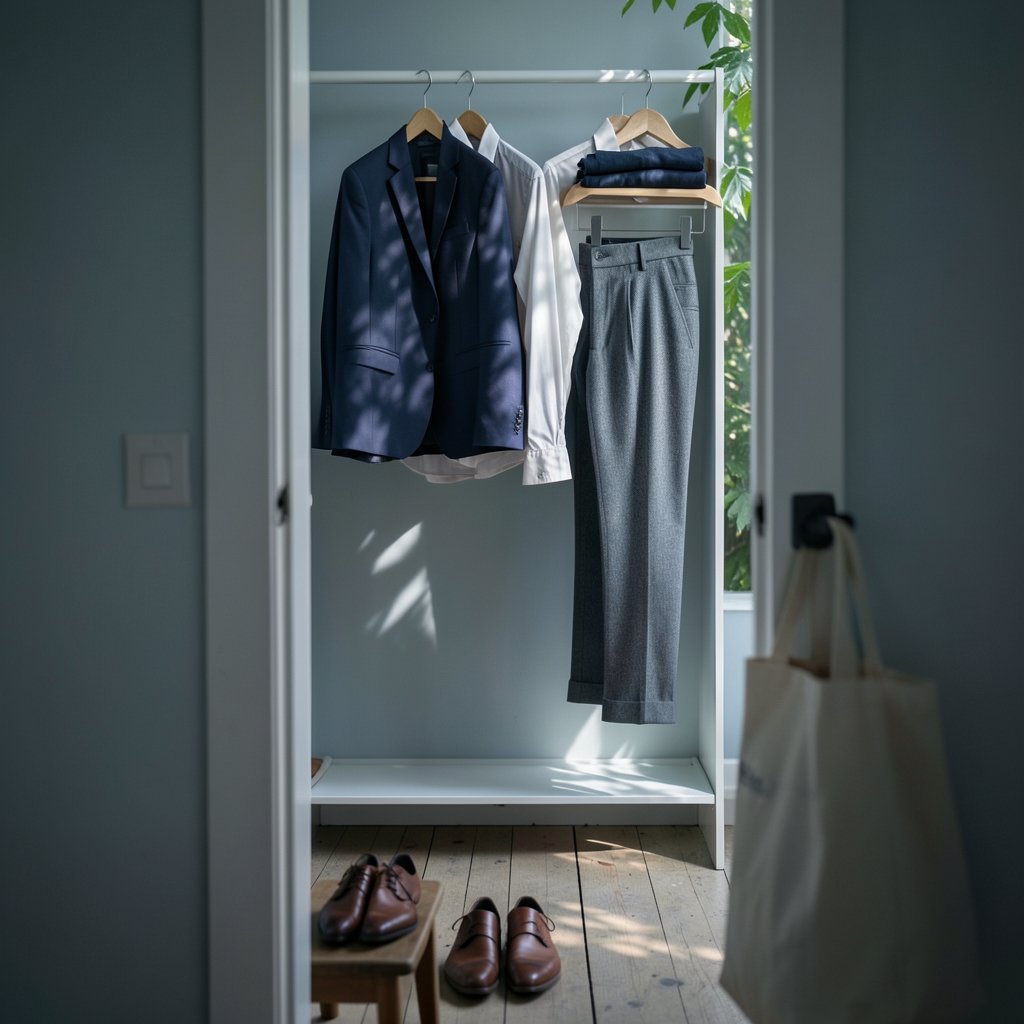
Business casual has no single official definition. Interpretations range from “wear a blazer but skip the tie” to “nice jeans are fine.” That ambiguity is the biggest trap for capsule builders, because a capsule that is too formal wastes money, and one that is too relaxed gets awkward in meetings.
The fix is to define your version before buying anything. Three questions settle most of it:
- What do the most senior people in your workplace actually wear on a normal Tuesday?
- What is the dressiest situation you regularly face, such as a client presentation or an interview?
- What is the most casual situation, such as a Friday with no meetings?
Build the capsule to the dressiest regular situation, then let the casual days borrow from it. If jeans appear in your office at all, one dark, clean pair earns its place. If they never appear, skip them and put the budget into trousers.
A Quick Formality Ladder
| Level | Typical pieces | Where it fits |
|---|---|---|
| Relaxed business casual | Knit polo, dark jeans, clean sneakers | Casual Fridays, creative offices |
| Standard business casual | Button-down, chinos or tailored trousers, loafers | Most office days, internal meetings |
| Elevated business casual | Blazer, fine-gauge knit, dress trousers, leather shoes | Client meetings, presentations |
How Many Pieces Does a Capsule Need?
Common advice puts a seasonal capsule at roughly 20 to 35 items, counting tops, bottoms, layers, shoes, and sometimes accessories. There is no authoritative standard, and the right number depends on your climate, laundry habits, and how many days you dress for work.
For a five-day office week, a workable starting point is about 24 to 28 pieces:
- 8 to 10 tops, including shirts and knits
- 4 to 5 bottoms, mixing trousers, chinos, and a skirt if relevant
- 3 to 4 layers, such as blazers, cardigans, or a fine knit
- 3 to 4 pairs of shoes
- 1 to 2 bags plus a small set of accessories
The count matters less than the ratio. Tops wear out and soil fastest, so they should be the largest group. Layers do the most visual work per item, so they should be the most versatile.
Step One: Choose a Tight Color Palette
The single most common mistake is building a capsule in six unrelated colors. It feels expressive while shopping and collapses in the closet, because too few pieces actually match.
A reliable approach is a base of two neutrals plus one accent. Navy and gray, or charcoal and camel, cover most business casual settings. The accent, whether olive, burgundy, or a soft blue, adds variety without breaking compatibility. A third neutral such as white or cream handles shirts.
Practical tip: hold a new item against three things you already own before buying. If it works with fewer than three, it is not a capsule piece. It is a standalone purchase, which is fine, but it should not count toward the capsule budget.
Step Two: Build the Core Pieces
The core is where most of the money should go, because these items get worn weekly and are judged most closely.
Tops
Start with two white or light blue button-down shirts in a fabric that survives ironing or does not need it. Add three to four fine-gauge knits in crew or V neck, which layer under blazers and read as polished without effort. Round out with two simple T-shirts or knit polos in a heavier cotton that holds its shape. Thin, floppy T-shirts undermine an otherwise sharp outfit faster than almost anything else.
Bottoms
Two pairs of tailored trousers in your base neutrals, one pair of chinos for softer days, and a skirt or a second trouser cut if you prefer variety. Fit at the waist matters more than label size. A tailor taking in a waistband costs little and transforms how a pair of trousers reads.
Layers
One structured blazer in navy or gray, one softer unstructured blazer or cardigan, and one knit that can pass as a light layer. The unstructured jacket is the unsung hero of business casual: it adds authority without the stiffness of a suit jacket.
Shoes and Bag
Loafers, derbies, or clean minimal sneakers in leather, plus one pair of low heels or dress flats if that suits you. A structured tote or briefcase in a neutral leather finishes the set. Shoes are where cheapness shows soonest, so buy the best pair you can and resole them.
Step Three: Make the Outfits Repeatable
A capsule only pays off if the combinations are obvious at 7 a.m. Two habits help.
First, establish uniforms: three or four outfit formulas you trust, such as “navy blazer, white shirt, gray trousers, loafers.” Rotating formulas feels repetitive to you and looks consistent to everyone else, which is exactly what a professional wardrobe should do.
Second, keep the capsule visually separate. If capsule pieces hang among everything else, the system quietly dissolves. A dedicated rail or section of the closet solves this in an afternoon.
Step Four: Maintain It Like a System
Capsules fail for boring reasons: a stained shirt, a worn sole, a missing button. Small maintenance tasks protect the whole investment.
- Wash knits cold and dry flat to prevent stretching.
- Rotate shoes and let them rest a day between wears.
- Keep a small repair kit and fix buttons and hems promptly.
- Review the capsule each season and replace one or two worn items rather than rebuilding.
A useful rule: buy one, retire one. It keeps the count stable and stops the capsule from slowly turning back into a closet.
Common Mistakes That Undo a Capsule
Buying trends first. A statement piece that matches nothing is a cost, not an asset. Trends belong in accessories, which are cheap to swap.
Ignoring fabric quality. Two inexpensive shirts that pill after ten washes cost more than one good shirt worn for years. Look at weight, drape, and how the fabric recovers after squeezing.
Overbuying at the start. New capsule builders often buy everything in one weekend and discover half of it does not fit their real life. Buy the core first, live with it for a month, then fill gaps.
Skipping the tailor. Off-the-rack fit is a starting point. Hemming trousers and taking in a waistband is the cheapest upgrade in menswear and womenswear alike.
Forgetting the dress code reality check. A capsule built for an imaginary office is useless. Match it to the workplace you actually walk into.
What It Costs and What It Saves
A capsule is not automatically cheaper. It redirects spending from many forgettable items toward fewer, better ones. The savings show up over time: fewer replacement purchases, fewer “nothing to wear” panic buys, and less money spent on clothes that hang unworn.
The environmental angle is real as well. Extending the active life of garments is one of the most effective ways to reduce the footprint of a wardrobe, which is a theme fashion-studies researchers return to repeatedly. Buying less and wearing longer beats buying “sustainable” labels at volume.
Adapting the Capsule to Different Workplaces
A creative studio and a law firm need different capsules, but the method is identical. Adjust the formality ladder, not the system.
| Workplace | Adjustments |
|---|---|
| Corporate office | Two blazers, more tailored trousers, leather shoes only |
| Creative or tech office | One blazer, dark jeans allowed, clean sneakers acceptable |
| Client-facing role | Extra shirt and blazer, stronger structure, neutral palette |
| Hybrid schedule | Fewer total pieces, more layers for video calls |
Hybrid workers should weight the capsule toward tops and layers, since only the upper half appears on camera and the commute days need the most durable pieces.
Conclusion
A business casual capsule wardrobe is less about restraint and more about compatibility. Choose a tight palette, buy the core in the best fabric you can afford, tailor what needs tailoring, and organize the pieces so the combinations are visible. The result is a wardrobe that answers the daily question quickly and looks deliberate without being fussy. Start with a dozen pieces, live with them for a month, and let the gaps tell you what to add next. If you want to go deeper into the philosophy behind it, the Voozon editorial team covers wardrobe strategy in more detail, and the timeless wardrobe guide is a natural next read.
Frequently Asked Questions
How many pieces should a business casual capsule wardrobe have?
Most guidance lands between 20 and 35 items per season, including shoes. For a five-day office week, around 24 to 28 pieces is a practical starting point, weighted toward tops because they wear out fastest. The exact number matters less than whether every piece matches at least three others.
Is a capsule wardrobe expensive to start?
It can be, if you buy everything at once. A better approach is to build in stages: core trousers and shirts first, then layers, then shoes. Buying fewer, better items usually costs less over three to five years than replacing cheap pieces repeatedly.
Can I include jeans in a business casual capsule?
Yes, if your workplace allows them. Choose one dark, clean, well-fitting pair without distressing and pair them with a blazer or fine knit to keep the look intentional. If jeans never appear in your office, skip them and put the budget into a second pair of trousers.
How often should I replace capsule items?
Replace when an item shows visible wear, not on a fixed schedule. Shirts and knits typically need replacing first, while blazers and shoes can last years with care. A one-in, one-out rule keeps the capsule from expanding back into a full closet.
Does a capsule wardrobe work for both men and women?
Yes. The method is gender-neutral: a tight palette, a core of tops and bottoms, a few layers, and reliable shoes. The specific pieces differ, but the logic of compatibility and repeatable outfits applies equally.
What is the biggest mistake when building a capsule?
Buying statement pieces before the basics. A bold item that matches nothing adds cost without adding outfits. Build the neutral core first, confirm it works in daily life, then add personality through accessories and one or two accent pieces.