
American Traditional Tattoos: 2026 Guide to Timeless Style
 Abdul WadoodLast updated
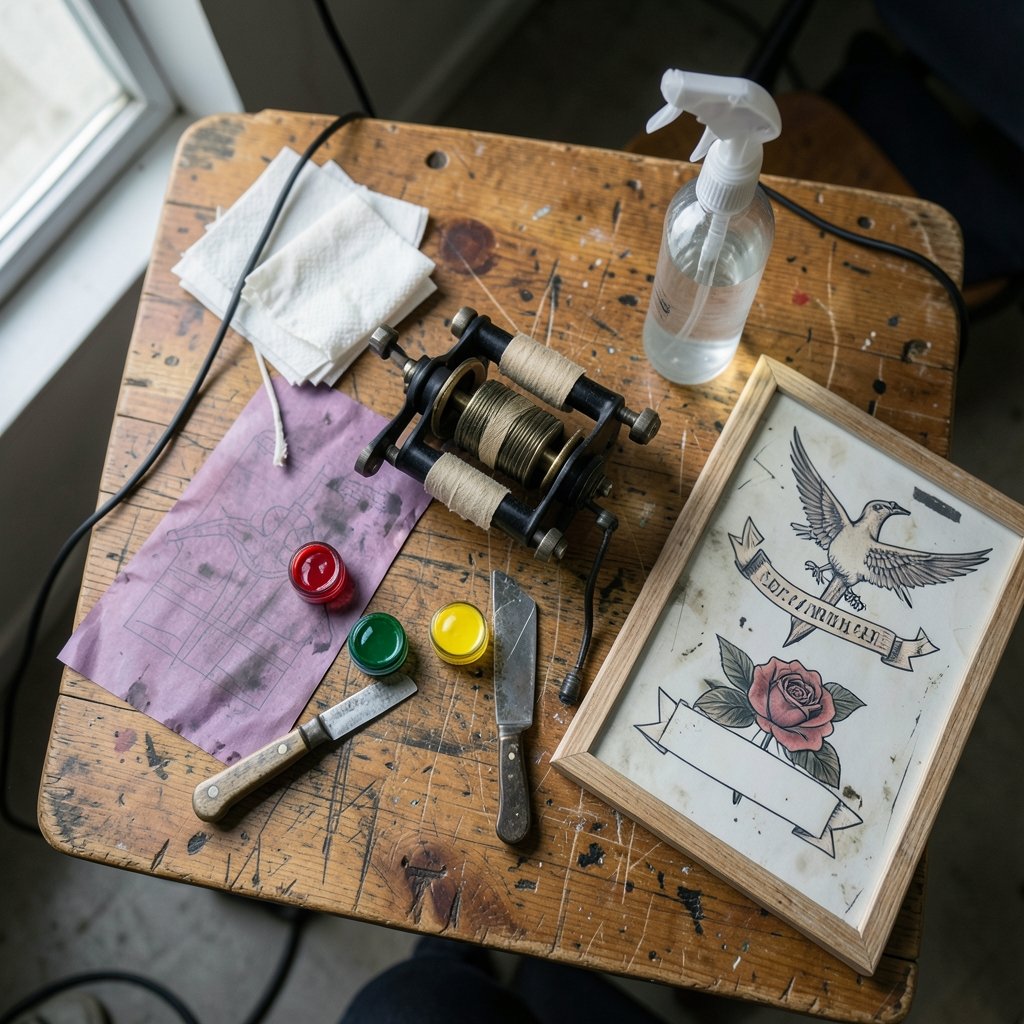
Walk into almost any tattoo shop in the world and you will find one flash sheet that looks familiar: thick black outlines, a tight palette of red, yellow, green, and blue, and motifs that could have been lifted straight off a 1940s sailor’s arm. That look is American traditional tattooing, sometimes called old school or traditional Western style. It is the rare tattoo genre that has survived a century of changing fashion without ever really going out of style. According to Wikipedia’s overview of tattooing, the practice has ancient roots across many cultures, but the American traditional branch has its own distinct rules, heroes, and visual grammar. This guide breaks down what the style actually is, how to spot it, what it costs, and how to get one that will still look sharp in thirty years.
What Makes a Tattoo “American Traditional”?
The style rests on a few non-negotiable rules. Learn them and you can spot an American traditional piece from across a room.
Bold black outlines. Traditional tattoos start with a heavy, confident line. That outline is not decoration; it is structure. It holds the color in place and keeps the design readable as skin ages and ink spreads slightly over decades.
A limited, flat color palette. Classic work sticks to red, yellow, green, blue, and black. There are no soft gradients, no airbrushed fades, no photorealism. Color is packed in solid and flat, like a screen print.
High contrast and simple shapes. Traditional designs read instantly at a distance. A swallow looks like a swallow, not a suggestion of a swallow.
Iconography with history. Anchors, daggers, roses, eagles, swallows, panthers, skulls, ships, and banners carrying short words are the standard vocabulary. Most of these images came from maritime tattoo culture, where they carried meaning: a swallow signaled homecoming, an anchor meant stability and a settled life ashore.
Longevity as a design goal. Every choice in the style serves one purpose: making the tattoo legible for a lifetime. That is why traditional work ages better than almost any other genre.
A Short History of the Old School
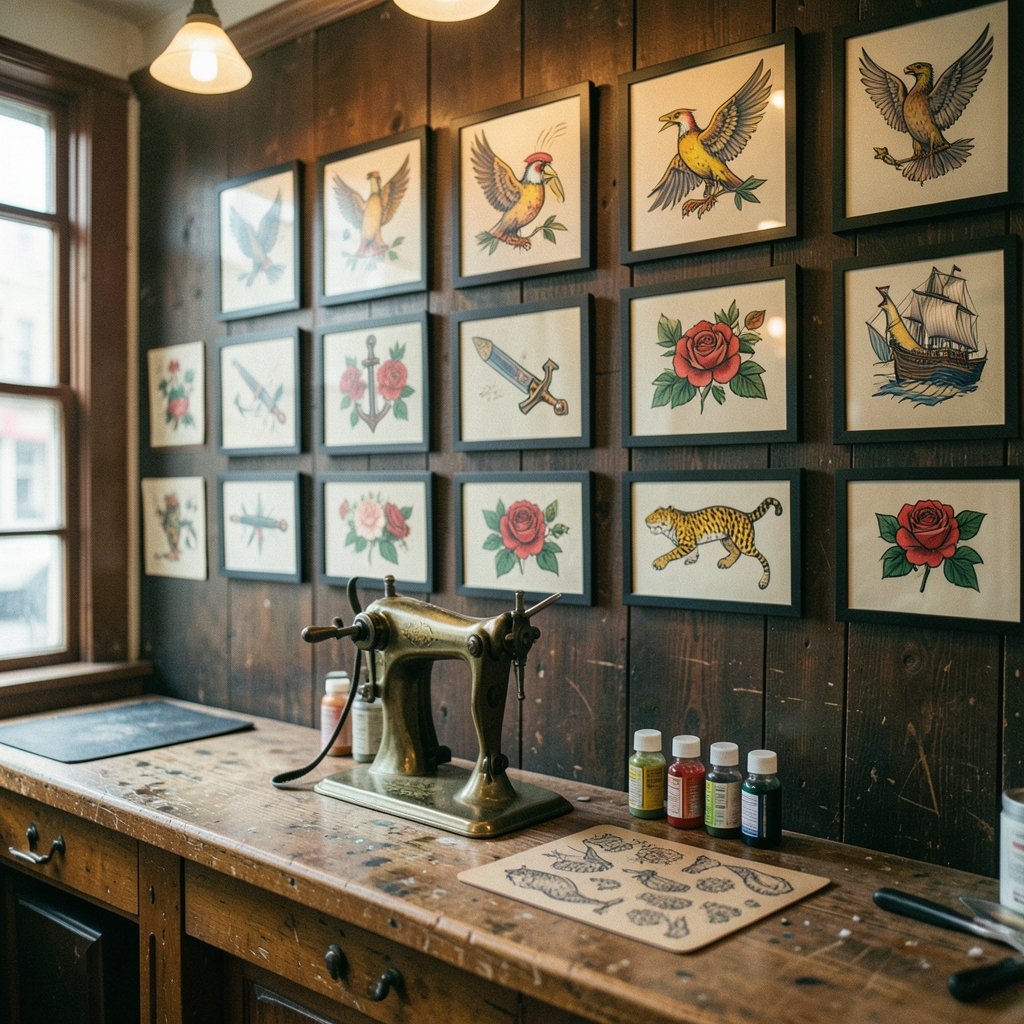
American traditional tattooing is inseparable from a handful of names. The style is generally traced to Sailor Jerry Collins, who worked in Honolulu from the 1930s until his death in 1973 and standardized much of the imagery and technique that define the look today. Earlier, August “Cap” Coleman is widely credited with helping popularize the modern tattoo machine and with codifying many of the designs that became standard shop flash in the early twentieth century.
The style spread through port cities, where sailors traded designs across oceans. British, Scandinavian, and Japanese influences all fed into the American version, which then traveled back out again. By the mid-twentieth century, traditional flash sheets were a shared visual language from San Francisco to Sydney.
The style dipped in popularity during the 1980s and 1990s, when tribal, biomechanical, and fine-line work dominated. It came roaring back in the 2000s and 2010s, partly through artists who trained in the old tradition and partly because clients started asking for work that would not blur into a gray smudge by age fifty. For broader context on how tattooing has moved in and out of mainstream culture, the Smithsonian’s collections and research pages are a useful starting point for anyone who wants to dig deeper into the cultural record.
How American Traditional Compares to Other Styles
Clients often arrive at a shop knowing they want “something classic” but unsure which style fits. The table below lays out the practical differences.
| Feature | American Traditional | Neo-Traditional | Fine Line | Realism |
|---|---|---|---|---|
| Outline | Thick, bold black | Thicker, varied line weight | Very thin, delicate | Minimal or none |
| Color | Flat, 4–5 colors | Wider palette, some shading | Often black and gray | Full gradient shading |
| Detail level | Low to moderate | Moderate to high | High but fragile | Very high |
| Aging | Excellent | Good | Poor to fair | Fair |
| Typical pain/time | Moderate, fast | Moderate, slower | Low, slow | High, very slow |
The most important row is aging. Fine line and realism can look stunning on day one, but thin lines blur and soft shading fades. Traditional work is built to fight that decay.
Choosing a Design That Will Still Work in 20 Years
The best traditional tattoos are simple, well-placed, and sized correctly. A few practical rules from working artists:
- Go bigger than you think. Small traditional tattoos lose their detail as lines thicken over time. A palm-sized piece on a forearm will outlast a coin-sized one on the wrist.
- Pick a motif with personal weight. A swallow, an anchor, or a rose is only meaningful if it means something to you. Banners with names, dates, or short phrases work well because text in traditional script stays readable.
- Respect the silhouette. Traditional designs are built around strong shapes. Do not ask an artist to cram a complex scene into a shape that cannot hold it.
- Place it where the body is stable. Forearms, upper arms, calves, and thighs hold ink well. Hands, feet, and ribs fade faster because of friction, sun, and skin turnover.
- Check the flash, then ask for a custom version. Many artists will redraw a classic design to fit your body rather than stamping a copy from the wall.
A common mistake is treating traditional work as a “cheap starter tattoo.” It is often the opposite: the style demands confident linework, and a wobbly outline is far more visible in traditional work than in busy, detailed designs. Cheap traditional tattoos look cheap precisely because the style hides nothing.
What to Expect in the Chair
Sessions for a traditional piece are usually faster than for realism or fine line, because there is less detail work and less shading. A palm-sized design might take one to two hours; a full forearm sleeve built from separate motifs can be spread across several sessions.
Pain varies by placement, but the style’s heavy outline means the first pass is the most intense part. After that, color packing is repetitive rather than sharp. Most clients describe traditional work as a steady, manageable burn rather than a spike.
Aftercare is standard: keep the wrap on as instructed, wash gently with fragrance-free soap, apply a thin layer of ointment, and keep the tattoo out of direct sun and standing water for the first two weeks. Traditional tattoos heal well, but they are not immune to bad aftercare. Picking scabs or over-moisturizing can dull the color.
Cost, Artists, and What Actually Matters
Pricing varies widely by city and artist reputation. In most Western markets, a small traditional piece starts around the shop minimum, while established traditional specialists charge premium hourly rates. The style’s simplicity does not mean it is cheap to get done well.
When choosing an artist, look for a portfolio that shows clean, consistent linework and solid color packing with no patchiness. Traditional specialists often post healed photos, which are far more useful than fresh ones. A fresh tattoo flatters everyone; a healed one tells the truth. If an artist only shows fresh work, ask directly for healed examples.
It also helps to understand how the industry sees quality and safety. The U.S. Food and Drug Administration’s page on tattoos and permanent makeup explains that ink regulation is limited and that consumers should ask questions about pigments and hygiene. That is not a reason to avoid tattoos; it is a reason to choose your shop carefully.
Common Mistakes People Make
Mistake one: chasing trends inside a classic style. Asking for a traditional design with modern fine-line details defeats the purpose. The style works because of its constraints.
Mistake two: going too small. This is the single most common regret among traditional tattoo clients. Line weight has a floor; you cannot put a bold outline on a design the size of a thumbnail.
Mistake three: ignoring sun protection. Traditional tattoos fade mostly from UV exposure. Sunscreen on healed work is the cheapest longevity insurance available.
Mistake four: copying someone else’s exact tattoo. Flash is meant to be a starting point. A good artist will adapt it.
Mistake five: rushing the placement decision. A beautiful tattoo in the wrong spot looks wrong forever. Tape a printed outline to your skin for a week before committing.
Conclusion
American traditional tattooing has lasted a century for a reason: it is honest. Bold lines, flat color, and time-tested imagery are not a limitation; they are a design system built to survive decades of skin, sun, and life. Whether you are drawn to a single small anchor or a full sleeve of swallows and roses, the style rewards patience and punishes shortcuts. Choose an artist whose healed work you trust, size the design generously, protect it from the sun, and you will end up with a tattoo that looks as good in twenty years as it did on day one. For more on tattoo culture, style comparisons, and artist features, explore voozon.media.
Frequently Asked Questions
How much does an American traditional tattoo cost?
Most shops have a minimum charge that covers small pieces, and larger work is billed hourly or by the session. Prices depend heavily on city and artist reputation. Established traditional specialists charge more, but their linework and color packing are what make the style last. Always ask for a quote based on your specific design and placement.
Does American traditional tattoo style hurt more than others?
It is often described as moderate. The heavy outline pass is the sharpest part, while color packing feels more repetitive than painful. Placement matters far more than style: ribs, hands, and feet hurt regardless of what you are getting. Traditional sessions are usually shorter than realism sessions, which many clients find easier overall.
How long does an American traditional tattoo take to heal?
Surface healing typically takes two to three weeks, with deeper skin recovery continuing for a few more. Keep the tattoo clean, moisturized lightly, and out of direct sun and soaking water. Do not pick or scratch. Traditional work heals well, but poor aftercare can still dull the color and blur the lines.
Will an American traditional tattoo fade?
All tattoos fade, but traditional work fades more gracefully than most styles. The bold outline holds the design together even as color softens. Sun exposure is the biggest factor, so daily sunscreen on healed tattoos makes a real difference. Expect the colors to settle and soften slightly over the years rather than disappear.
Can I get an American traditional tattoo in color or black and gray?
Both work, but classic traditional is color-forward, using flat red, yellow, green, and blue alongside black. Black-and-gray traditional is a legitimate variation and often ages beautifully. If you want black and gray, tell your artist up front so the design is built with contrast rather than color separation in mind.
Is American traditional a good choice for a first tattoo?
It is one of the best choices for a first tattoo, provided you size it properly. The style is readable, ages well, and does not require the long, detailed sessions that realism demands. The main risk is going too small. Pick a simple motif, place it on a stable part of the body, and let the artist guide the sizing.