
City Break Capsule Wardrobe: Pack Less, Dress Better
 Abdul WadoodLast updated
A weekend city break usually means two nights, one carry-on, and a forecast that refuses to cooperate. Yet most travelers still pack as if they were moving house. According to the United Nations World Tourism Organization, international tourist arrivals have rebounded to roughly 1.5 billion a year, and city trips make up a huge share of that traffic. Every one of those travelers faces the same quiet problem: how do you look put-together in a stylish European capital when everything you own has to fit in a bag that slides under an airplane seat?
The answer, increasingly, is a city break capsule wardrobe — a small, deliberate set of clothes where every piece works with every other piece. It is not about owning less for its own sake. It is about packing with intent so that a long weekend feels effortless rather than frantic.
What a City Break Capsule Wardrobe Actually Is
A capsule wardrobe is a tightly edited collection of garments that can be mixed and matched into many outfits. The concept is usually credited to Susie Faux, who ran a London boutique in the 1970s, and it was later popularized in fashion circles by designers who built entire collections around a handful of interchangeable pieces. The city break version simply shrinks the idea to its smallest useful form: enough clothing for two to four days of walking, eating, and sightseeing, with nothing wasted.
The difference between a capsule wardrobe and ordinary packing is intentionality. A normal suitcase holds things you like. A capsule holds things that work together. That distinction matters more on a city break than almost any other kind of trip, because you are on your feet for hours, moving between a museum, a café, and a dinner reservation, often in weather that shifts from crisp morning to warm afternoon.
The Core Principle: Interchangeability Over Volume
The math is simple and a little ruthless. If you pack five tops and three bottoms that all coordinate, you have fifteen possible combinations from eight items. If you pack five tops and three bottoms that clash, you have maybe four outfits and a lot of frustration. The goal is a wardrobe where every top works with every bottom, and one pair of shoes can carry you from breakfast to a late dinner.
How Many Pieces Do You Really Need?
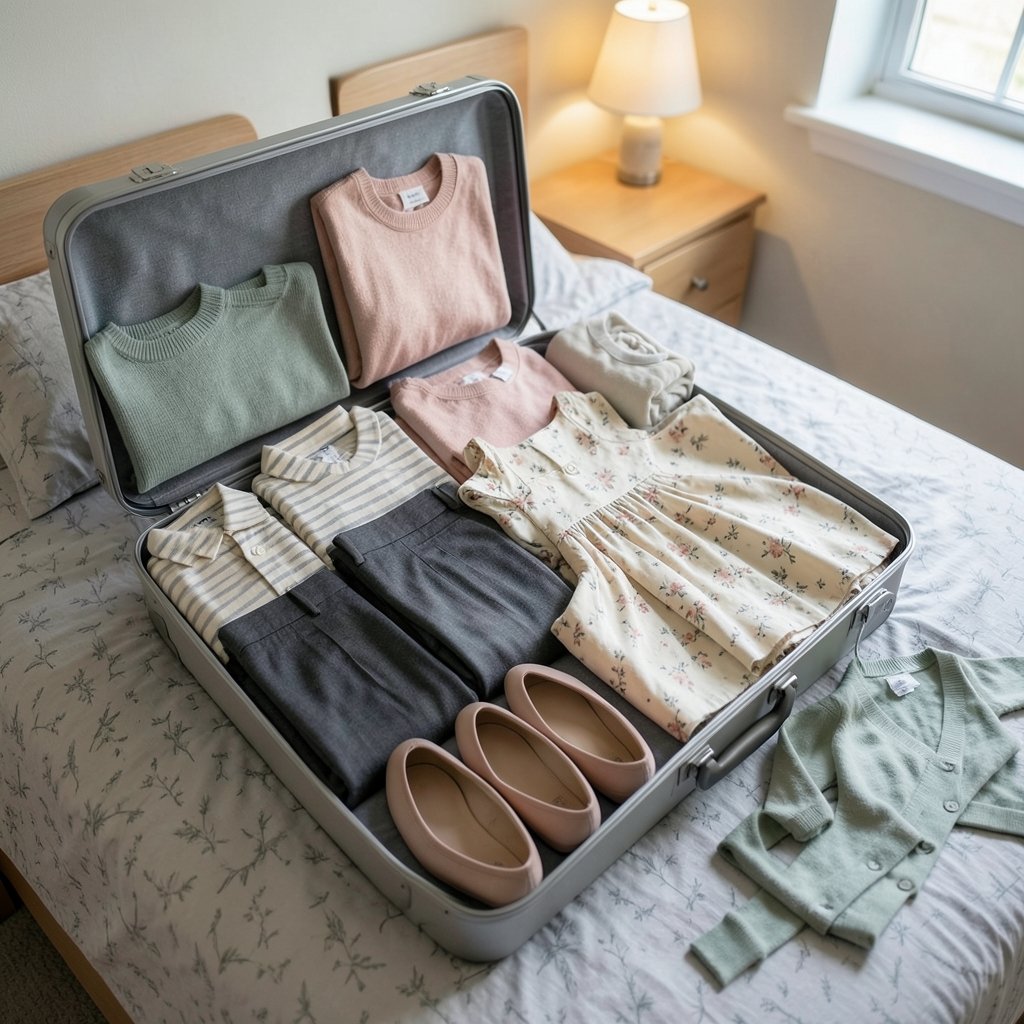
For a two-to-three-night city break, most experienced packers land on a set of roughly 10 to 14 items, not counting underwear, socks, sleepwear, and the outfit you wear on the plane or train. That range is wide on purpose: it flexes with the season and the formality of your plans.
| Trip Type | Tops | Bottoms | Outerwear | Shoes | Total Core Items |
|---|---|---|---|---|---|
| Warm-weather city break | 4 | 2 | 1 light layer | 2 (one walkable, one dressier) | 9 |
| Spring or autumn | 4 | 2 | 1 jacket | 2 | 9 |
| Winter city break | 3 (layering pieces) | 2 | 1 coat + 1 mid-layer | 1–2 | 8–9 |
| Longer trip with laundry | 5 | 3 | 1–2 | 2 | 11–12 |
The numbers matter less than the rule behind them: one in, one out. If you add a third pair of shoes, remove something else. Capsules stay small because the constraint is enforced, not because the traveler is unusually disciplined.
Choosing a Color Palette That Does the Work for You
The single most practical decision in building a city break capsule is the color palette. Pick two neutrals and one accent, then refuse to break the rule. A common and reliable formula is navy, grey, and white, with one accent color such as rust, olive, or burgundy. Everything then matches everything, and you stop thinking about outfits entirely.
This is where many people go wrong. They pack their favorite individual pieces, each lovely on its own, and discover in the hotel room that the striped shirt fights the checked trousers and the red jacket clashes with both. A capsule is a system, not a collection. The palette is the glue.
There is a sustainability angle here too. Building a small set of versatile pieces and wearing them repeatedly is the opposite of fast fashion’s churn. The same logic that makes a timeless wardrobe work at home works even harder when you are living out of a bag for three days.
The Fabrics That Survive a City Break
Fabric choice separates a capsule that looks sharp on day three from one that looks crumpled by lunch on day one. Practical packers gravitate toward materials that resist wrinkles, dry quickly, and regulate temperature.
- Merino wool for tops and mid-layers: warm when cold, breathable when warm, and famously odor-resistant, which means you can wear a piece twice.
- Cotton-blend or technical shirting that resists creasing, rather than pure crisp cotton that looks slept-in after a train ride.
- Stretch denim or technical trousers with enough give for 20,000 steps and a decent silhouette at dinner.
- A packable outer layer — a lightweight quilted jacket or a trench — that folds small and handles wind and drizzle.
Avoid heavy cottons, bulky knits, and anything that needs ironing. Hotel irons exist, but the best capsule is the one that never needs one.
Shoes: The Real Make-or-Break Decision
Ask anyone who has walked a European old town in the wrong footwear and they will tell you the truth: shoes decide whether a city break is a pleasure or a punishment. Cobblestones, tram tracks, and marble museum floors are unforgiving.
The workable formula is two pairs maximum. One is a broken-in walking shoe or sneaker with proper cushioning, ideally in a neutral color that reads as smart-casual. The second is something slightly dressier but still comfortable — a leather boot, a loafer, or a clean flat — for evenings. Wear the bulkiest pair on travel days to save space.
The most common mistake is buying new shoes for the trip. A city break is not the place to break in footwear. Blisters arrive fast and ruin everything.
Packing Lists by Season
Spring and Autumn
These are the sweet-spot seasons for city breaks, and the capsule reflects that. A trench or lightweight jacket, two long-sleeve tops, one short-sleeve layer for warm afternoons, dark jeans, one pair of tailored trousers, a scarf, and two pairs of shoes. Layers are the whole strategy: mornings are cold, afternoons are mild, evenings cool down again.
Summer
Heat changes the calculus. Lighter fabrics, more frequent washing, and a focus on breathability. Think two pairs of shorts or a skirt and shorts, three lightweight tops, a linen shirt for evenings, a sun hat, and sandals plus one walking shoe. A light cardigan or overshirt handles air-conditioned museums and chilly evenings.
Winter
Winter city breaks reward layering over bulk. A thermal base layer, a merino mid-layer, a warm coat, and a hat and gloves do more than one thick sweater. Two pairs of trousers, one pair of waterproof boots, and you are set. The capsule gets smaller in winter, not bigger, because layers do the work.
What to Leave Behind
Knowing what not to pack is half the skill. The following items almost always go unused:
- The “just in case” formal outfit that never gets worn.
- More than one bag beyond a day bag and your main luggage.
- Full-size toiletries and multiple pairs of shoes.
- Anything that only works with one specific other item.
- Bulky towels, travel pillows you will not use, and paper guidebooks replaced by a phone.
The pattern is consistent: the things people regret packing are the things packed for a hypothetical trip, not the one they are actually taking.
Packing Technique That Saves Space and Wrinkles
How you pack matters as much as what you pack. Rolling knits and casual tops saves space and reduces creasing. Folding structured pieces like shirts and trousers flat, ideally with tissue or a dry-cleaning bag between layers, keeps them sharp. Packing cubes keep the capsule organized and make repacking at the end of the trip fast.
Wear the heaviest items on travel days: the coat, the boots, the jeans. This is not a hack so much as basic physics — the weight you carry on your body is weight you do not carry in your bag.
Building the Capsule Before You Leave
The capsule should be assembled at home, ideally a week before departure, and tested. Lay every piece out and check that each top works with each bottom. Try on the combinations. Walk around the block in the shoes. This dry run catches the gaps — the missing belt, the top that only works with one pair of trousers — while there is still time to fix them.
A useful habit is to photograph each complete outfit on your phone. On the trip, decision fatigue disappears: you open the album, pick an outfit, and get on with the day.
Common Mistakes That Undo a Good Capsule
Even well-planned capsules fail for predictable reasons. Packing for the weather you hope for rather than the forecast is the classic error; check the actual forecast the day before you leave. Overpacking “options” is another. So is ignoring the dress code of a specific restaurant or event — one smart-casual outfit is usually enough, but it needs to be genuinely smart-casual.
The subtler mistake is treating the capsule as a restriction rather than a liberation. The point is not to suffer with less; it is to think less. When every piece works together, getting dressed in a hotel room takes ninety seconds and you spend the saved energy on the city instead.
Conclusion
A city break capsule wardrobe is less about fashion than about clarity. By choosing a tight color palette, favoring fabrics that travel well, limiting shoes to two sensible pairs, and packing only what works together, a traveler can move through a weekend with a single bag and zero outfit anxiety. The approach rewards planning at home so that the trip itself stays spontaneous. Whether the destination is a rainy northern capital or a sunlit Mediterranean old town, the principle holds: pack a system, not a pile. And if you want to extend the same thinking to your everyday closet, the discipline of a well-built timeless wardrobe is the natural next step.
Frequently Asked Questions
How many outfits do I need for a 3-day city break?
Three to four complete outfits is usually enough, built from around 10 to 12 core items. Because every top works with every bottom, those items create far more combinations than the outfit count suggests. Plan one smart-casual look for evenings and rotate the rest.
What is the best fabric for a city break capsule wardrobe?
Merino wool is the standout choice for tops and mid-layers because it regulates temperature and resists odor, so it can be worn more than once. For trousers, stretch denim or technical fabrics offer comfort and shape retention. Avoid heavy cotton and anything that needs ironing.
Can I do a city break with only carry-on luggage?
Yes, and most experienced travelers do. A 10-to-14-item capsule fits comfortably in a standard carry-on, especially if you wear the bulkiest shoes and coat on travel days. Packing cubes and rolling soft items help maximize space.
How do I choose a color palette for a travel capsule?
Pick two neutral base colors and one accent, then make sure every piece fits that scheme. Navy, grey, and white with a single accent like olive or burgundy is a reliable formula. The test is simple: every top should work with every bottom.
What shoes should I pack for a city break?
Two pairs at most: a broken-in, cushioned walking shoe or sneaker, and one slightly dressier but still comfortable option for evenings. Never bring brand-new shoes. Cobblestones and long walking days will expose any weakness immediately.
Is a capsule wardrobe worth it for a short trip?
For a two- or three-night trip, the payoff is mostly in reduced decision-making and lighter luggage rather than in saving money. Travelers who plan a capsule report spending less time unpacking and re-planning outfits, and more time enjoying the destination.