
Geometric Tattoos: Styles, Meanings & Booking Tips 2026
 Abdul WadoodLast updated
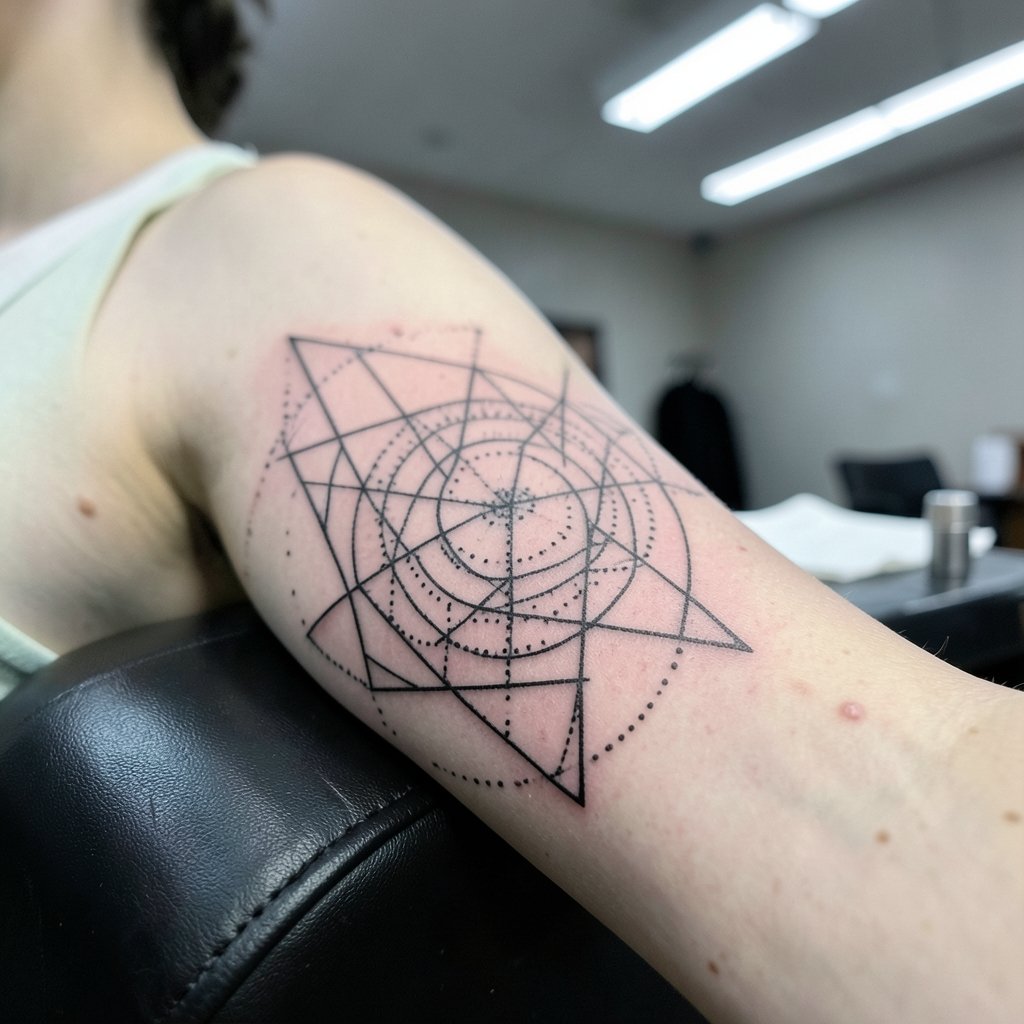
Geometric tattoos have moved from niche to mainstream fast. Search interest in clean lines, dotwork patterns, and sacred-geometry designs keeps climbing, and walk into almost any studio today and you’ll see flash sheets built around triangles, circles, and interlocking grids. Yet the style is often misunderstood. Some people assume it’s purely modern. Others think any tattoo with a straight line counts. Neither is quite right.
This guide breaks down what geometric tattooing actually is, where it comes from, how to choose a design that will age well, and the practical mistakes that trip up first-timers. It’s written for anyone weighing up a geometric piece, and for the curious who just want to understand the craft.
What Counts as a Geometric Tattoo?
A geometric tattoo uses mathematical shapes as its primary visual language: triangles, hexagons, circles, lines, grids, and dots arranged with deliberate precision. The design is not decorative background filler. The geometry is the subject.
That definition sounds simple, but the category is broad. It stretches from a single minimalist triangle on a wrist to a full sleeve of interlocking polyhedra. Several sub-styles sit underneath the umbrella:
| Sub-style | What it looks like | Typical placement |
|---|---|---|
| Minimalist geometric | One or two simple shapes, thin lines | Wrist, finger, ankle, behind the ear |
| Dotwork geometric | Patterns built from thousands of dots | Forearm, back, thigh |
| Sacred geometry | Overlapping circles, spirals, mandala-like forms | Chest, spine, shoulder |
| Blackwork geometric | Bold solid-black shapes and negative space | Sleeves, legs, large panels |
| Ornamental geometric | Symmetrical linework echoing jewelry or lace | Sternum, hands, neck |
The through-line is precision. A geometric piece lives or dies on straight lines staying straight and circles staying round. That’s why artists who specialize in this style often use stencils, rulers, and even compasses during the drawing phase.
A Short, Honest History

Here’s where a lot of online content gets sloppy. It’s tempting to claim geometric tattooing has one tidy ancient origin. The truth is messier and more interesting.
Geometry has appeared in body marking across many cultures for centuries. Indigenous traditions in Polynesia, parts of Africa, and the Americas have long used repeating patterns, symmetry, and abstract forms in tattooing and scarification. These traditions carry deep cultural and spiritual meaning, and they developed independently of each other. For an overview of how tattooing has functioned across societies, the Wikipedia entry on tattooing is a reasonable starting point, though it barely scratches the surface of any single tradition.
What’s often called “geometric tattoo” today, however, is largely a contemporary Western style. It grew out of the broader tattoo revival of the late twentieth century, alongside blackwork, dotwork, and minimalist tattooing. Artists began treating the skin as a canvas for abstract composition rather than imagery. Sacred geometry, popularized through New Age and design culture, gave the style a philosophical hook. (Tattoo)
So the honest framing is this: geometry as a design principle is ancient and global, but “geometric tattoo” as a named modern style is recent. Anyone telling you otherwise is probably selling something.
Why People Choose Geometric Designs
Ask ten people with geometric ink why they picked it and you’ll get ten answers. A few themes come up again and again.
It’s timeless in a way imagery isn’t. A portrait of a celebrity or a cartoon character can feel dated in a decade. A well-composed arrangement of circles and lines rarely does. The style leans on proportion rather than trend.
It suits people who want meaning without literalism. Many wearers attach personal significance to specific shapes. A triangle can represent change. A circle can stand for continuity. An unbroken line can mean endurance. The design doesn’t shout its meaning, which appeals to people who want something private rather than explanatory.
It works beautifully with the body. Good geometric artists design for the placement, following the natural lines of a shoulder, the curve of a calf, the taper of a forearm. A pattern that flows with anatomy looks intentional. One slapped on without thought looks like a sticker.
The best geometric tattoos aren’t just mathematically correct. They’re anatomically correct.
How to Choose a Design That Ages Well
This is where practical experience matters more than theory. Geometric tattoos are unforgiving. A slightly wobbly line in a floral piece can hide in the shading. A wobbly line in a geometric piece has nowhere to go.
A few things that genuinely make a difference:
- Keep line weights consistent. Mixed line weights can look great, but only when the artist controls them deliberately. Random variation reads as error.
- Think about scale relative to skin. Fine, dense dotwork looks stunning fresh. Over years, dots can blur together, especially on areas that stretch or see sun. Larger spacing holds up better.
- Avoid ultra-fine lines in high-friction zones. Hands, fingers, and feet shed ink faster. Delicate geometry there often needs touch-ups.
- Design for the body’s curves. A flat grid drawn on paper will distort when wrapped around a bicep. Good artists preview the stencil on the actual limb.
- Leave negative space. Skin gaps are part of the composition in blackwork and geometric pieces. Crowding shapes together muddies the design.
A common mistake is choosing a design from a screen without considering how it will sit on a three-dimensional body. Another is picking an artist purely on price. Geometric work rewards specialists, and specialists charge accordingly.
Finding the Right Artist
Not every tattooer is comfortable with geometry. The skill set overlaps with fine-line, blackwork, and dotwork, but it isn’t identical.
When vetting an artist, look for portfolios heavy on straight lines, symmetry, and clean circles. Zoom in on photos. Are the edges crisp? Do parallel lines stay parallel? Ask specifically whether they enjoy geometric work, because enthusiasm shows in results.
Also ask about their process. Some artists draw freehand directly on the skin for organic flow. For strict geometry, most prefer a carefully measured stencil. Neither approach is wrong, but you should know which you’re getting.
For broader context on what to expect from the tattooing process itself, including aftercare, Voozon Media covers practical lifestyle and culture topics that complement what you’ll hear in the studio.
Pain, Placement, and Realistic Expectations
Geometric tattoos aren’t inherently more painful than other styles, but placement drives everything. Bony areas, ribs, spine, and anywhere with thin skin tend to hurt more. Fleshy areas like the outer forearm or thigh are gentler.
Sessions vary wildly. A small minimalist piece might take thirty minutes. A full geometric sleeve can span multiple sittings and many hours. Expect larger, denser designs to cost more and require patience.
Healing follows the same rules as any tattoo: keep it clean, moisturized, and out of direct sun. But geometric pieces have one extra vulnerability. Sun exposure fades and blurs fine lines faster than bold ones. If your design relies on delicate detail, sunscreen isn’t optional. It’s maintenance.
The Cultural Conversation Worth Having
Geometric tattooing borrows visual language from traditions that aren’t always credited. Sacred geometry draws on mathematical and spiritual concepts from multiple cultures. Polynesian and other Indigenous patterns have been appropriated commercially for decades.
This doesn’t mean geometric tattoos are off-limits. It means being thoughtful. If a design references a specific cultural motif, understand where it comes from and whether it’s appropriate to wear. Many artists will happily explain the origins of patterns they use, and the good ones will steer clients away from designs that cross a line.
Respect isn’t a constraint on creativity. It’s part of doing the craft well.
Conclusion
Geometric tattoos reward planning. The style’s appeal is obvious: clean, modern, and built to last in a way trendier designs often aren’t. But that cleanliness is exactly what makes it demanding. Straight lines stay straight only when the artist is skilled and the placement is sensible. Fine detail stays crisp only when the wearer protects it.
If there’s a single takeaway, it’s this: treat geometric ink as a design project, not an impulse purchase. Study portfolios, ask questions, think about scale and sun, and choose an artist who genuinely loves the style. Do that, and you’ll end up with something that looks as sharp in ten years as it did on day one.
Frequently Asked Questions
How much does a geometric tattoo cost?
Pricing depends on size, detail, and artist reputation. Small minimalist pieces often start at a studio’s minimum rate, while large blackwork or dotwork projects can run into many sessions and significant cost. Specialist geometric artists typically charge more because the work is slow and precision-heavy. Always ask for an estimate before booking.
Do geometric tattoos hurt more than other styles?
Not inherently. Pain depends on placement and session length, not style. However, geometric designs sometimes involve dense dotwork or repeated passes over the same area to keep lines crisp, which can make a session feel longer. Bony areas and the ribs remain the toughest spots regardless of design.
How long do fine-line geometric tattoos last?
Fine lines can blur over time, especially on areas exposed to sun or subject to friction. Bold geometric work holds up best. Delicate dotwork and ultra-thin lines may need touch-ups after a few years. Consistent sunscreen use is the single biggest factor in keeping fine detail sharp.
Can geometric tattoos be covered up or removed later?
Cover-ups are harder with geometric work because clean lines and negative space leave little room to hide old ink. Removal is possible but often requires multiple sessions. Because of this, it’s worth being certain about the design and placement before committing, especially for large pieces.
Is sacred geometry culturally appropriative?
It depends on the specific symbols and their origins. Some geometric forms are universal mathematical concepts. Others are tied to living spiritual or cultural traditions. The respectful approach is to research any motif with cultural roots and ask your artist directly about its source before including it.
What should I look for in a geometric tattoo artist’s portfolio?
Focus on precision. Zoom into photos and check whether parallel lines stay parallel, circles look round, and edges are clean. Look for healed photos when possible, since fresh tattoos always look sharper. Ask whether the artist specializes in geometric, blackwork, or dotwork styles, and confirm they use measured stencils for strict designs.
## A Final Word on Aftercare
The first two weeks decide much of how a geometric piece settles. Follow your artist’s written instructions exactly, wash gently with fragrance-free soap, and resist the urge to pick or scratch as the skin flakes. Once healed, the routine is simple: moisturize daily and apply broad-spectrum sunscreen whenever the tattoo sees daylight. Photograph the piece in consistent lighting every few months; it’s the easiest way to notice subtle blurring before it becomes obvious.
## Where the Style Might Go Next
Geometric tattooing continues to evolve. Artists are experimenting with layered linework, subtle color accents within strict forms, and designs that interact with scar tissue or older pieces. Digital stencil tools have made complex symmetry more achievable, though the hand still does the real work. What won’t change is the underlying demand: people want marks that feel considered, personal, and durable. Geometry delivers that when it’s done with care.
## The Bottom Line
Geometric tattoos are neither a fad nor a secret ancient code. They’re a modern style with deep roots in global pattern-making, and they reward the same things all good tattooing does: research, patience, a skilled hand, and honest aftercare. Choose deliberately, protect your investment, and the result will speak for itself for decades.