
Viking Tattoos: History, Symbols & Modern Style Guide 2026
 Abdul WadoodLast updated

Here’s a fact that surprises almost everyone: there is no written or archaeological evidence that describes a Viking-age tattoo practice. None. The Norse sagas and Eddas, as they survive in medieval manuscripts from roughly the 13th century onward, never mention tattooing. So when a design is sold as an “authentic Viking tattoo,” it is standing on much thinner historical ground than the marketing suggests.
That doesn’t make the style meaningless. It makes it more interesting. Viking tattoos are a modern cultural phenomenon built from fragments: contested travel accounts, picture stones, metalwork, and a heavy dose of 19th-century romantic nationalism. Understanding which parts are old and which parts are invented changes how you choose a design, place it, and talk about it.
The One Historical Account Everyone Cites (and Why It’s Contested)
The closest thing to contemporary evidence comes from Ahmad ibn Fadlan, an Arab traveler who wrote an account of Rus’ traders on the Volga around 921–922 CE. In some translations, he describes men covered in dark green designs from their fingernails to their necks. This passage is the single most-quoted piece of “evidence” for Viking tattooing, and it is genuinely debated. The Arabic wording is ambiguous, and scholars disagree on whether it describes tattoos, body paint, or something else entirely. The Rus’ were also not identical to the Scandinavians usually meant by “Viking.”
There’s a second problem: “Viking” is a modern label for Scandinavian peoples of roughly the late 8th to 11th centuries, conventionally dated c. 793–1066 CE. There was no single uniform culture, let alone a single uniform tattoo style. Any claim about “the Viking tattoo tradition” flattens several centuries and a whole region into one aesthetic.
And a third: skin rarely survives in the archaeological record. Absence of evidence is not proof of absence. Whether tattooing was practiced at all in Viking-age Scandinavia is genuinely unresolved, and honest sources say so.
Why So Many “Viking” Symbols Aren’t Viking at All
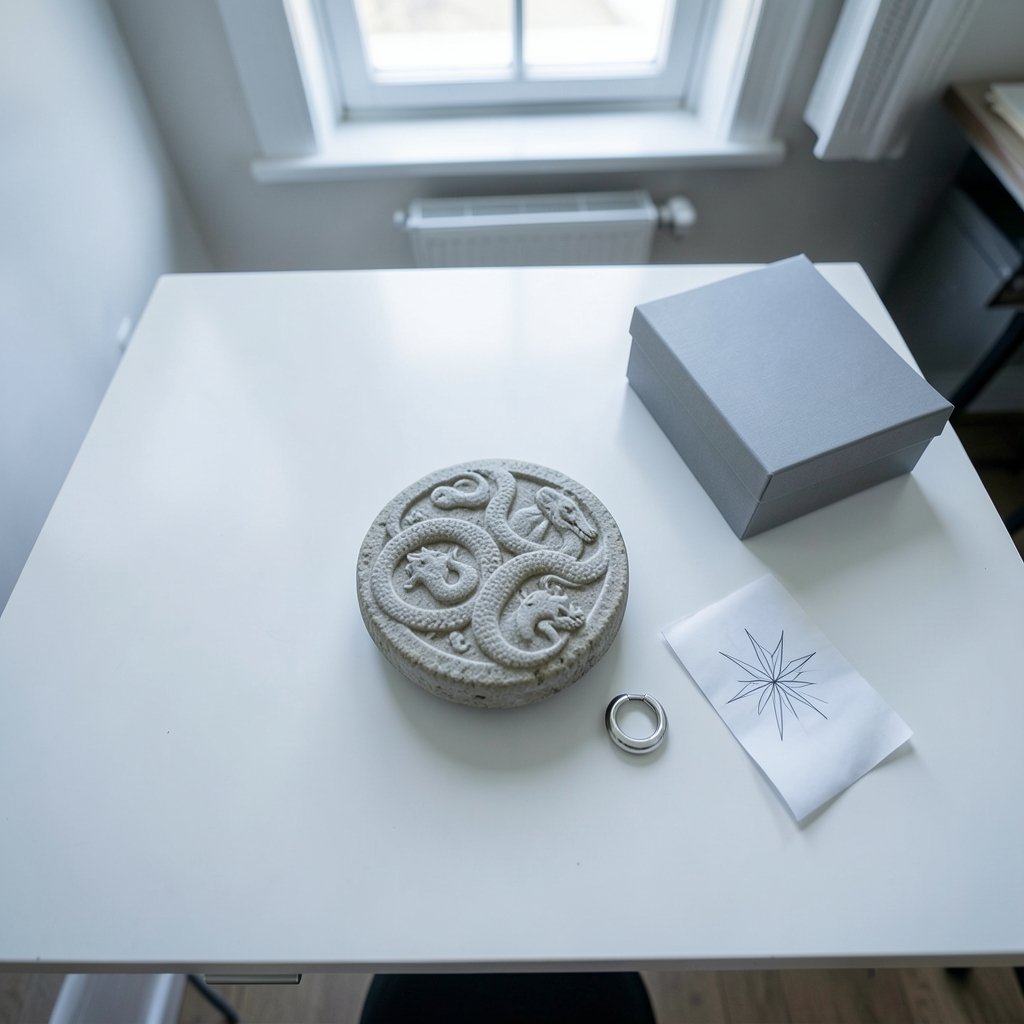
This is where most buyers get burned. A large share of popular Norse-style motifs postdate the Viking Age by centuries.
| Symbol | Commonly Sold As | Actual Origin |
|---|---|---|
| Vegvísir (“wayfinder”) | Viking compass | Icelandic grimoire, Huld Manuscript, compiled 1860 |
| Runic “spell” formulas | Viking magic | Often 17th–19th century Icelandic collections |
| Urnes-style knotwork | Viking design | 12th-century carvings, after the Viking Age |
| Horned helmet imagery | Viking warrior | 19th-century Romantic opera costume |
| Gotland picture-stone figures | Viking tattoo art | 8th–11th century carvings, but not tattoos |
The vegvísir is the clearest example. It appears in the Huld Manuscript, compiled in Iceland in 1860, which is roughly eight centuries after the Viking Age ended. It is widely mislabeled as Viking. That doesn’t make it a bad tattoo. It makes it a 19th-century Icelandic symbol, and you should know that before someone tells you it’s ancient.
What is genuinely old: Viking-age picture stones and metalwork, especially the Gotland picture stones and the Urnes style. These give you real period imagery, just not real period tattoos. For broader context on how the Viking Age is dated and studied, the Viking Age overview on Wikipedia is a reasonable starting point, and the National Museum of Denmark holds major collections of period objects.
What Actually Works in Practice
If you want a Norse-inspired tattoo that holds up, the practical approach is to separate motif from claim. Choose the imagery because you like it, and be accurate about where it comes from. That combination ages well; the “ancient Viking symbol” story usually doesn’t.
Practical tips that make a real difference:
- Ask your artist for the source object, not the Pinterest board. A good Norse-style artist can name the stone, brooch, or carving a pattern comes from. If they can’t, the design is probably a modern invention.
- Bring reference photos of actual period metalwork. Museum catalogue images of brooches and buckle fittings translate beautifully into bands and forearms because they were designed to wrap around curved surfaces.
- Decide on the story before the stencil. If you’re getting a vegvísir, know it’s an 1860s Icelandic charm. That’s a fine story. “It’s a Viking compass” is a story that will get corrected by someone at a party.
- Scale matters more than detail. Knotwork needs room. Tiny, dense interlace turns into a dark smudge within a few years.
- Skip the runic “spell” unless you can read it. Several popular runic strings circulating online are modern constructions, and a few are simply nonsense in Old Norse.
Common mistakes worth naming: treating a single contested 10th-century travel account as proof of a continent-wide tradition; assuming every rune means what a tattoo flash sheet says it means; and commissioning a large back piece from an artist who has never studied interlace construction. Interlace is a discipline. Bad interlace looks like spaghetti.
For readers building a broader visual identity around this aesthetic, Voozon Media covers design and culture topics that pair well with this kind of research-first approach.
Style, Placement, and Modern Execution
Modern Viking tattoos break into a few recognizable families, and each behaves differently on skin.
Interlace and knotwork is the workhorse. It’s continuous, rhythmic, and wraps limbs naturally. It suits forearms, calves, and shoulders. Expect to pay for the artist’s time, because good interlace is slow.
Blackwork and dotwork interpretations take period motifs and render them with modern contrast. This is where most contemporary Norse work lives, and it’s the most forgiving for first-timers.
Figurative pieces draw on picture-stone silhouettes: ships, riders, and stylized animals. These read well at medium size and are easier to keep legible than dense knotwork.
Runic bands are popular and portable, but they invite the “what does it say?” question, so get the translation verified by someone who actually reads runes before it goes on permanently.
Placement advice that holds up: forearms and calves tolerate detail; ribs and feet hurt more and blur faster; hands and fingers fade quickly regardless of skill. If a design depends on fine lines, ask the artist how it will look in ten years. The honest answer is usually “simpler.”
The Cultural Responsibility Question
Norse imagery has been adopted by extremist groups in some countries, and a few symbols carry that baggage whether you intend it or not. This is worth a two-minute check before you commit. Most Norse motifs are entirely benign, but a small number have been co-opted, and wearing one unknowingly can send a signal you never meant to send.
The practical fix is straightforward: know the symbol’s history, know its modern associations, and if a design’s primary contemporary use is political rather than cultural, pick something else. There are thousands of period motifs. You don’t need the handful with a problem.
The Southern Poverty Law Center tracks extremist symbolism and is a useful, sober reference if you want to check a specific design. It’s a five-minute search that prevents a permanent mistake.
Design Checklist Before You Book
| Question | Why It Matters |
|---|---|
| Can my artist name the source object? | Separates period motifs from modern inventions |
| Is the symbol pre- or post-1066? | Tells you whether “Viking” is accurate |
| Does the runic text translate? | Prevents permanent nonsense |
| How will this look in 10 years? | Fine detail fades; bold shapes hold |
| Does this symbol have extremist associations? | Avoids unintended signals |
Run that list once and most bad decisions disappear before the deposit.
Conclusion
Viking tattoos are a modern art form built on real fragments. The honest version of the story is more compelling than the myth: a contested 10th-century travel account, a rich body of period metalwork and picture stones, and a set of popular symbols that turn out to be 19th-century Icelandic charms. You can build a stunning Norse-inspired tattoo on that foundation. What you can’t do is claim it’s historically documented, because it isn’t, and the people who know the material will notice.
Choose the motif for its beauty, verify its origin, ask your artist hard questions, and check the modern associations. Do those four things and you’ll end up with a piece you can explain confidently for the rest of your life.
FAQ
Did Vikings actually have tattoos?
Nobody knows for certain. There is no written or archaeological evidence describing a Viking-age tattoo practice, and skin rarely survives in the archaeological record. The most-cited source, Ahmad ibn Fadlan’s account of Rus’ traders from around 921–922 CE, is debated by scholars and may not describe tattoos at all. Treat the question as genuinely open. (Vikings)
Is the vegvísir a real Viking symbol?
No. The vegvísir appears in the Huld Manuscript, compiled in Iceland in 1860, which is roughly eight centuries after the Viking Age ended. It’s a genuine Icelandic symbol, just not an ancient Norse one. It’s widely mislabeled, which is why the confusion persists.
What symbols are actually from the Viking Age?
Viking-age picture stones, especially the Gotland stones, and period metalwork in styles like Borre, Jelling, Mammen, and Ringerike give you authentic imagery. Urnes style is close but dates to the 12th century, after the Viking Age. None of these are tattoos; they’re carvings and objects you can adapt.
How much should a Norse-style tattoo cost?
Pricing varies enormously by region and artist, so any single number would be misleading. What’s reliable: interlace and knotwork take longer than they look, so expect to pay for the artist’s hours rather than a flat design fee. Dense, well-constructed knotwork is skilled labor, and cheap interlace usually looks like cheap interlace.
Do runic tattoos mean anything?
They can, but only if the runes are correctly transcribed and translated. Many popular runic strings sold as “spells” are modern constructions, and some are simply nonsense in Old Norse. Have any runic text verified by someone who reads runes before it becomes permanent.
Are Viking tattoos offensive?
Most Norse motifs are benign. A small number have been co-opted by extremist groups in some countries, so it’s worth checking a specific symbol’s modern associations before committing. Organizations that track extremist symbolism can confirm quickly. Knowing the history protects you from an unintended signal.
One last thing on the runes themselves: the Elder Futhark (24 characters) predates the Viking Age, while the Younger Futhark (16 characters) is the alphabet actually used during it. If historical accuracy matters to you, that distinction is worth raising with your artist before the stencil is cut.
A note on healing and aftercare, since it’s where good work most often goes wrong: follow your artist’s instructions exactly, keep the fresh piece out of direct sun, and don’t pick at scabbing. Bold blackwork and dotwork age gracefully; fine-line detail needs sun protection for life if you want it to stay crisp.
On artists: look for a portfolio that shows healed work alongside fresh tattoos. Interlace and dotwork look dramatically different after a year, and healed photos are the only honest preview you’ll get.
Finally, on meaning: you don’t need a mystical backstory to justify a beautiful tattoo. “I liked the Borre-style gripping beast and my artist adapted it from a museum photograph” is a complete and respectable answer. The myth is optional; the craft is not.
On the runes themselves: the Elder Futhark (24 characters) predates the Viking Age, while the Younger Futhark (16 characters) is the alphabet actually used during it. If historical accuracy matters to you, that distinction is worth raising with your artist before the stencil is cut.
A note on healing and aftercare, since it’s where good work most often goes wrong: follow your artist’s instructions exactly, keep the fresh piece out of direct sun, and don’t pick at scabbing. Bold blackwork and dotwork age gracefully; fine-line detail needs sun protection for life if you want it to stay crisp.
On artists: look for a portfolio that shows healed work alongside fresh tattoos. Interlace and dotwork look dramatically different after a year, and healed photos are the only honest preview you’ll get.
Finally, on meaning: you don’t need a mystical backstory to justify a beautiful tattoo. “I liked the Borre-style gripping beast and my artist adapted it from a museum photograph” is a complete and respectable answer. The myth is optional; the craft is not.