
What Is Métiers d’Art? French Craft Professions Explained
 Abdul WadoodLast updated

Quick Answer: What is metiers d art?
Métiers d’art is a French term for craft professions that fuse traditional technical know-how with artistic creation, covering everything from glassblowing and leatherwork to embroidery and fine metalwork. In everyday use, the phrase appears in two main contexts: France’s official register of skilled craft trades, and the luxury fashion world, where it describes the specialist ateliers that supply embroidery, feathers, and pleating to major houses.
The two meanings overlap but are not identical. The official French framing is broad and policy-driven, tied to state recognition and training. The fashion framing is narrower and commercial, referring to a handful of highly specialized workshops. A related but different concept is intangible cultural heritage, which UNESCO safeguards at the international level rather than through a national trade list.
Before relying on any single definition, check the source’s scope, the country or institution behind it, whether it covers training and certification, how it distinguishes craft from industrial production, and which industries it includes.
A Statistic That Explains the Whole Field
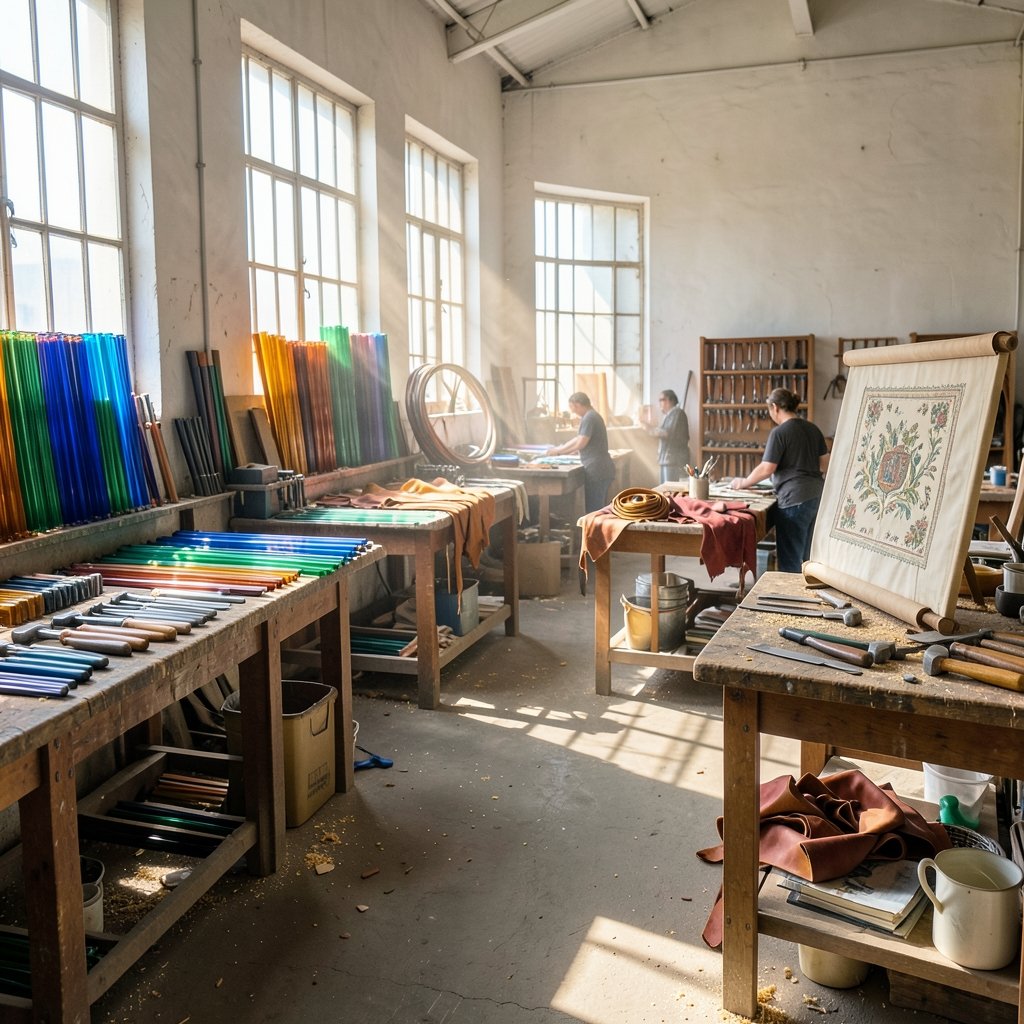
Here is a number worth sitting with: the French Ministry of Culture has cited a list of roughly 281 métiers d’art professions in recent official materials. That figure alone tells you this is not a niche hobby category. It is a sprawling, state-catalogued ecosystem of skilled trades, each with its own tools, training paths, and vocabulary.
And yet most English speakers encounter the phrase through fashion headlines, not government documents. That gap is exactly where confusion breeds. The same three words describe a glassmaker in a small provincial workshop and a feather specialist embroidering for a Paris runway show. Both are legitimate. They are just different slices of the same pie.
Where the Term Comes From and Why It Matters
The phrase translates loosely as “art professions” or “craft trades,” but the translation loses the tension built into the French original. Métier implies a trade you train for, with rules and repetition. Art implies creative judgment. Métiers d’art sit precisely at that intersection, which is why they resist easy sorting into either “manufacturing” or “fine art.” (Inside the Art of Modern Fragrance)
In France, the concept gained institutional weight in the late twentieth century, backed by the Ministry of Culture and organizations such as the Institut National des Métiers d’Art (INMA). State support took several forms: official recognition, dedicated training programs, and honors for craftspeople at the top of the trade.
Two recognition structures are worth knowing. The title Maître d’art is a state honor awarded to craftspeople who commit to passing on their knowledge. Separately, the Entreprise du Patrimoine Vivant (EPV) label recognizes companies that hold rare, living heritage skills. Both signal that France treats craft knowledge as something to be protected as well as marketed.
Internationally, the policy frame most often invoked is UNESCO’s 2003 Convention for the Safeguarding of the Intangible Cultural Heritage. That convention treats craft know-how as heritage in its own right. It is a useful reference point because it explains why governments invest in skills that markets alone might not sustain.
How the Term Splits Into Two Meanings
The cleanest way to understand métiers d’art is to separate the two arenas where it lives.
| Dimension | Official French usage | Fashion and luxury usage |
|---|---|---|
| Scope | Broad list of ~281 craft professions | Narrow set of specialist ateliers |
| Authority | Ministry of Culture, INMA | Luxury houses and their suppliers |
| Purpose | Recognition, training, heritage protection | Production of high-end goods and shows |
| Typical trades | Glass, stone, wood, metal, leather, textiles | Embroidery, feathers, pleating, lace, buttons |
| Public visibility | Low, policy-facing | High, media-facing |
In the official sense, métiers d’art is a labor and culture category. In the fashion sense, it is a supply chain. The confusion arises because luxury journalism often drops the translation entirely, leaving readers to infer that métiers d’art means “expensive embroidery.” It does not. It means craft professions, of which embroidery is one.
What Counts as a Métier d’Art in Practice
The official scope varies by source, which is one of the field’s genuine ambiguities. Still, the core categories are consistent across most descriptions:
- Glass and ceramics — blowing, casting, glazing, and kiln work
- Metal — forging, engraving, gilding, and fine jewelry work
- Leather — cutting, stitching, and finishing for goods and saddlery
- Textiles — weaving, embroidery, lace, pleating, and dyeing
- Wood — cabinetmaking, marquetry, and carving
- Stone — masonry, sculpture, and restoration
- Feathers and flowers — the niche ateliers that supply couture
What unites these trades is not the material but the method: small-scale, high-skill, and dependent on hand judgment that machines cannot fully replicate. A useful test is whether the work requires years of supervised training to execute correctly. If it does, it likely sits inside the métiers d’art family.
The Fashion Connection: Chanel and the Atelier Economy
No brand is more associated with the fashion usage than Chanel. Beginning in the 1980s and continuing through the 2000s, the house acquired several specialist ateliers, bringing embroidery, feathers, pleating, and other crafts in-house rather than relying on external suppliers. This was a strategic move as much as a romantic one: it secured rare skills and made them exclusive.
Chanel’s Métiers d’Art collection and show take their name directly from these ateliers. The show is typically staged annually, often in December, in a chosen city, and it functions as a showcase for craft-intensive pieces rather than seasonal ready-to-wear. The first edition is commonly dated to 2002, though dates in fashion history are worth verifying against primary sources.
The broader lesson is economic. When a luxury house buys an atelier, it converts a craft tradition into a protected asset. That can preserve skills that might otherwise vanish. It can also concentrate them under a single corporate roof, which raises fair questions about access, pricing, and who gets trained next.
Why This Matters Beyond Fashion
It would be easy to file métiers d’art under luxury trivia. That would miss the point. These trades sit inside a much wider conversation about how contemporary culture values making alongside designing. The same tension shows up across creative fields, where the visible idea often overshadows the invisible craft behind it. A fresh perspective on contemporary art is hard to form without noticing how much of it depends on skilled fabrication.
There is a practical dimension too. Craft knowledge is transmitted person to person, usually over years. When an experienced craftsperson retires without an apprentice, the loss is permanent. That is why state recognition schemes and heritage labels exist: they create incentives for transmission that a purely commercial market tends to underweight.
For anyone following design and craft trends, the métiers d’art story is a useful lens. It explains why certain techniques command premiums, why luxury houses invest in suppliers, and why “handmade” has become such a contested marketing word. (Art, Design & Modern Trends)
Common Mistakes People Make
A few misunderstandings come up again and again.
Treating the term as a single fixed definition. It is not. Official French usage and fashion usage differ in scope, and English-language sources rarely flag the switch. Always ask which framing a writer is using.
Assuming métiers d’art means “old.” Many of these trades are deeply contemporary. Artisans work with modern materials, digital design tools, and new markets. Tradition here refers to technique, not nostalgia.
Confusing the term with a job title. It is a category, not a role. Nobody is “a métiers d’art.” They are an embroiderer, a gilder, a pleater.
Overlooking the training pipeline. Apprenticeships and dedicated schools are the backbone of the field. Without them, the label becomes decorative.
Reading luxury marketing as documentation. Brand storytelling about craft is often accurate in spirit and loose in detail. Verify specific claims about dates, acquisitions, and techniques against institutional sources.
What Actually Works: Practical Guidance
For readers trying to engage with the field seriously, a few approaches hold up.
Start with the official framing before the commercial one. Understanding the broad category makes it much easier to spot when a brand is using the term narrowly. From there, follow the institutions: ministry publications, national craft bodies, and heritage labeling schemes tend to be more precise than press releases. (Vogue)
If you are buying, look for specificity. A product description that names the technique and the atelier is more informative than one that simply says “artisanal.” If you are studying or writing, cite the institutional definition and note the fashion usage separately rather than blending them.
And if you are considering the craft as a career, treat training as the entry gate. The trades reward patience, and the transmission model means finding a mentor or a recognized program matters more than any certificate’s branding.
How to Compare Sources on Métiers d’Art
Because definitions vary, a quick comparison habit pays off. When you encounter the term, check four things: who published the source, whether it is describing the official list or the fashion ateliers, whether it gives a date for any figures, and whether it distinguishes craft professions from industrial production. Sources that do all four are usually reliable. Sources that use the phrase as a mood word are usually not.
This matters more than it sounds. The official count of professions has shifted across editions, so a number quoted without a date is close to meaningless. Likewise, founding dates for institutions and recognition schemes are frequently misstated in secondary coverage. Primary sources settle these questions quickly.
Conclusion
Métiers d’art is best understood as a bridge term. On one side sits France’s institutional commitment to classifying, training, and protecting skilled craft professions, a project with real policy weight behind it. On the other sits the luxury fashion economy, where a small number of specialist ateliers supply the world’s most visible houses and lend their name to an annual Chanel show.
The two meanings are not in conflict. They simply answer different questions. One asks what a society values enough to catalogue and teach. The other asks what a market values enough to acquire and protect. Holding both in view gives a far clearer picture than either alone, and it makes the phrase considerably more interesting than a translation would suggest.
Frequently Asked Questions
Is métiers d’art the same as artisanat?
Not exactly. Artisanat is the broader French term for craft and small-scale artisanal production. Métiers d’art is a narrower subset emphasizing artistic creation alongside technical skill. All métiers d’art are artisanal in character, but not all artisanat qualifies as métiers d’art.
Why is the term usually left untranslated in English?
Because no single English phrase captures both halves of it. “Craft professions” misses the artistic component; “art professions” misses the trade training. Luxury and design journalism generally keep the French to avoid flattening the meaning, sometimes glossing it as “artisanal crafts” or “craft métiers.”
How many métiers d’art professions are there officially?
French official materials have cited a figure of roughly 281 professions in recent editions. The number has changed across editions, so any count should be checked against the date of the source. Treat specific figures as versioned rather than permanent.
What is the difference between Maître d’art and EPV?
Maître d’art is a state honor awarded to individual craftspeople, with an emphasis on transmitting knowledge to successors. EPV, the Entreprise du Patrimoine Vivant label, recognizes companies that hold rare living-heritage skills. One honors a person; the other recognizes a business.
Did Chanel invent the fashion usage of the term?
No. The phrase predates Chanel’s use of it as a collection name. What Chanel did was popularize the fashion-world meaning by acquiring specialist ateliers and naming an annual show after them, which pushed the term into global media coverage.
Can métiers d’art skills be learned today?
Yes, though the path is usually apprenticeship-based and long. Training typically runs through dedicated schools, workshop apprenticeships, and craftsperson-to-student transmission. State recognition schemes exist partly to keep that pipeline funded and visible, since commercial demand alone does not always sustain it.