
Tattoos Near Me: How to Vet a Studio Before You Go
 Abdul WadoodLast updated
A “near me” search feels simple: type four words, get a map full of pins, pick the closest one. But proximity tells you almost nothing about whether a studio is clean, licensed, or any good. In the United States, tattoo and piercing shops are regulated at the state and local level rather than by a single federal licensing body, which means the rules, inspection records, and age limits change the moment you cross a state line. The shop two blocks away and the shop twenty minutes away can operate under wildly different standards of oversight.
That gap is exactly where bad decisions happen. This guide walks through how to search, what to check, and which red flags should make you walk out before anyone opens a needle.
Why “Near Me” Results Are Not a Safety Ranking
Google’s local results are shaped by proximity, prominence, and relevance. They are personalized and they are not an audit. A studio can rank first because it has a well-optimized profile and hundreds of reviews, not because a health inspector gave it a perfect score.
The same logic applies to any local service search. If you have ever searched for a hair salon near you and noticed the top map pins were not the best-reviewed places in town, you already understand the mechanic. The map rewards signals, not skill. (Find Hair Salons Near Me: 2026 Guide to Smart Searching)
So treat the map as a starting list, not a shortlist. Your real research starts after you have five or six candidate studios.
The First Filter: Licensing and Inspection Records

Before you look at portfolios, look at paperwork. Most states require studios to hold a license or permit, and many local health departments publish inspection results online. These records are primary sources. A studio’s own website is marketing; an inspection report is evidence.
A practical routine:
- Search your state health department’s site for tattoo establishment requirements and any public inspection database.
- Look up each candidate studio by its legal business name, not its Instagram handle.
- Check for repeat violations around sterilization, handwashing, or equipment storage.
- Confirm the studio’s license is current, not expired or pending.
If a studio cannot tell you its license number when asked, that is your answer. Reputable shops keep that information handy because inspectors and customers both ask for it.
What Federal Rules Actually Cover
There is no national tattoo licensing law, but federal rules still apply to studios with employees. The Bloodborne Pathogens Standard from the Occupational Safety and Health Administration, codified at 29 CFR 1910.1030 and effective since 1992, requires an exposure control plan, personal protective equipment, and an offer of hepatitis B vaccination. You can read the standard directly through OSHA’s Bloodborne Pathogens materials. (Tattoo)
This matters to you as a customer because a studio that follows the standard will have visible habits: gloves changed between tasks, sharps containers mounted at eye level, surfaces wrapped in barrier film. A studio that ignores it usually shows it in the small moments.
Reading a Portfolio Without Getting Fooled
Every studio posts its best work. The question is whether that work matches what you want and whether it will still look good in five years.
Look for healed photos in addition to fresh ones. Fresh tattoos look sharp because the skin is still swollen and the ink is at peak saturation. Healed work shows how the artist handles line weight, packing color, and skin tone. Ask directly: “Do you have healed shots of this style?” Artists who document their work over time usually have them.
Match the style as well as the artist. Fine-line script, blackwork geometric, traditional American, realism, and neo-traditional all demand different muscle memory. A brilliant realism artist may be a mediocre choice for delicate lettering. Search by style plus your city rather than by “tattoos near me” alone, and your results improve right away.
Check whether the portfolio is consistent. A page of outstanding pieces mixed with shaky linework suggests the good ones came from a guest artist or were heavily edited.
Questions to Ask Before You Book
A phone call or a walk-in conversation tells you more than an hour of scrolling. Ask these plainly:
- What is your license or permit number, and who inspects you?
- Do you use single-use needles and pre-sterilized cartridges? (The answer should be an unhesitating yes.)
- How do you mix ink, and do you pour into single-use caps?
- What is your minimum age policy, and what ID do you require?
- What is your deposit and cancellation policy?
- Can I see the station before we start?
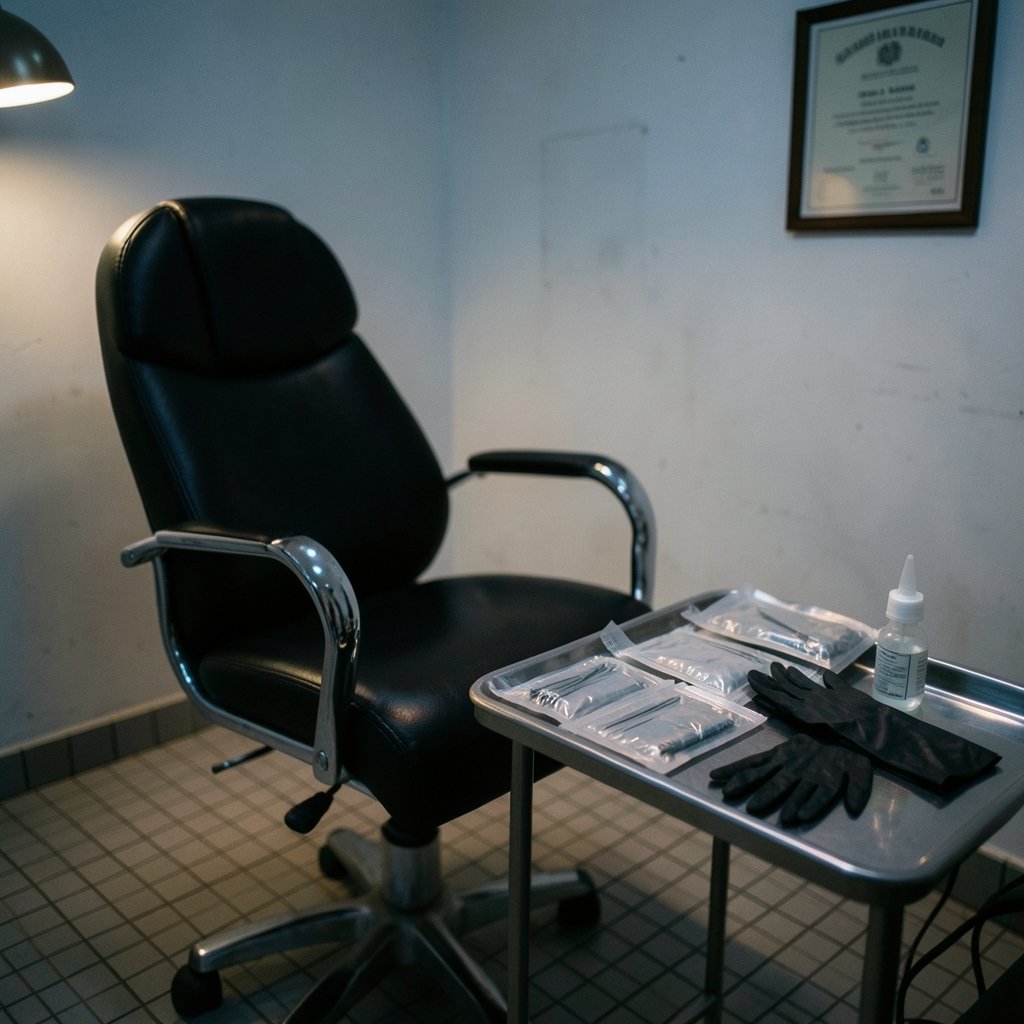
The last one is underrated. A quick look at the setup tells you whether the autoclave is real, whether the room has a sink, and whether the surfaces look maintained.
Age and ID Rules Vary More Than People Expect
Many states set the minimum age at 18, and some allow minors with parental consent. A few are stricter. Because this is set locally, do not assume the shop next door to your office follows the same rule as one across the river. Call ahead, and bring government-issued photo ID even if you are well past the threshold. Studios that follow the rules ask every time.
Cleanliness: What Actually Matters in the Chair
You do not need to be an infection control specialist to spot problems. You need to know where to look.
| What to check | Good sign | Warning sign |
|---|---|---|
| Needles and cartridges | Sealed, opened in front of you | Pre-opened or reused |
| Gloves | Changed between tasks and clients | Same pair through the whole session |
| Ink | Poured into single-use caps | Shared bottles dipped into repeatedly |
| Surfaces | Wrapped in barrier film, replaced | Wiped with a rag between clients |
| Sharps | Rigid container, not overfilled | Needles in a trash can or cup |
| Handwashing | Sink in the work area | No sink, or gloves over unwashed hands |
The CDC has published guidance on preventing infections linked to tattooing and piercing, emphasizing sterile equipment and single-use needles. You can find the current material through the CDC’s body art and infection prevention resources. If a studio’s practices contradict the basics, no portfolio is worth the risk. Bloodborne infections, MRSA, and localized skin infections are all documented outcomes of poor technique, and they are preventable.
The Ink Itself
The FDA regulates tattoo inks as cosmetics and has issued safety communications about contaminated ink batches and adverse events. Ink regulation has been debated and some states impose their own rules on top. Ask what brand the studio uses and whether they keep batch records. A shop that tracks its ink is a shop that thinks about liability.
Price, Deposits, and the Math of Cheap Tattoos
Tattoo pricing is usually hourly, half-day, or by the piece. Rates vary widely by city, artist experience, and complexity. A very low price is not automatically a scam, but it is a signal to ask why.
Things that legitimately lower cost: simple designs, small size, an apprentice under supervision, and flash from a pre-drawn sheet. Things that should raise your eyebrows: a shop that will not quote a range, a deposit with no written policy, and pressure to start the same day without a consultation.
Expect to pay a deposit to hold the appointment. Ask whether it applies to the final price and under what conditions it is refundable. Get the answer in writing, even if it is a text message.
Reviews: Useful, But Not Audited
Star ratings are not verified. Consumer review platforms have faced litigation over review filtering and fake reviews, and enforcement is inconsistent. Read the three-star reviews first. They tend to be specific and calm, while one-star and five-star reviews are often emotional.
Look for patterns in the negative reviews. One complaint about a rude receptionist is noise. Three complaints about a healed tattoo blowing out, or about a shop being hard to reach after a problem, is a pattern.
Practical Tips That Save People Real Trouble
Book a consultation. Fifteen minutes in the chair with no needle in sight lets you judge the space, the artist’s manner, and whether they listen. Artists who sketch on your ideas in real time are usually the ones who will adjust mid-session when your skin does something unexpected.
Eat and hydrate before the appointment. Most people who faint in a tattoo chair skipped a meal. It is the most common avoidable problem in the industry.
Do not drink beforehand. Alcohol thins the blood and increases bleeding. Many studios will turn you away, and you lose the deposit.
Plan for healing beyond the session. The tattoo is done in two hours; the healing takes two to four weeks. Follow the studio’s aftercare instructions, keep it out of pools and direct sun, and do not pick at scabs. If you are also booking beauty appointments around the same time, schedule them apart. Searching for a hair salon near you calls for the same practical reasoning: timing and aftercare matter as much as the appointment itself.
Ask about touch-ups. Most artists offer one free touch-up within a set window. Confirm it before you pay.
Photograph the station if you feel uneasy. It is not rude, and it documents the setup if something goes wrong later.
When to Walk Out
You are allowed to leave. Deposits are not worth an infection. Walk out if you see a needle opened before you sat down, if the artist dismisses a cleanliness question, if there is no sink in the work area, if the shop cannot produce a license, or if anyone pressures you to go bigger or faster than you wanted. Trust the instinct that made you ask the question in the first place.
The same instinct applies across personal services. People who learn to find a haircut near them without settling for the closest option tend to apply the same filter to every appointment that involves their body. It is a habit, and it pays off. (Laser Hair Removal Near Me: Choose a Clinic That Works)
Conclusion
Searching “tattoos near me” is the easy part. The work is in the twenty minutes after: checking a license, pulling an inspection record, reading the three-star reviews, and asking the questions that feel slightly awkward. Regulation in the United States is fragmented, review platforms are unaudited, and map rankings reward optimization rather than hygiene. None of that means you cannot find an excellent studio close to home. It means the map is a starting point and your own checklist is the real filter. Pick the shop that answers every question without flinching, and the tattoo will be the least interesting thing you remember about the day.
Frequently Asked Questions
Are tattoo studios required to be licensed in the US?
There is no single federal tattoo license. Regulation happens at the state and local level, and requirements vary widely. Most states require a license or permit and many local health departments inspect studios and publish results. Always verify the studio’s current license with your local health authority rather than relying on the shop’s own claims.
How can I check a studio’s inspection record?
Search your state or county health department website for tattoo establishment rules and any public inspection database. Look up the studio by its legal business name, confirm the license is current, and check for repeat violations involving sterilization, handwashing, or equipment storage.
What should I look for in a clean tattoo studio?
Sealed needles opened in front of you, gloves changed between tasks, ink poured into single-use caps, barrier film on surfaces, a sharps container that is not overfilled, and a sink in the work area. Federal bloodborne pathogen rules require studios with employees to maintain an exposure control plan and offer hepatitis B vaccination, and those habits are usually visible. (Hepatitis C)
Do I need an appointment, or can I walk in?
Both exist. Many studios take walk-ins for smaller pieces and flash designs, while custom work usually requires a consultation and a booked session. A consultation is worth the trip even if you plan to book later, because it lets you see the space and judge how the artist handles your ideas.
How much should I expect to pay?
Pricing varies by city, artist experience, size, and complexity, and most studios quote hourly, half-day, or per-piece rates. Expect a deposit to hold your appointment. Ask whether it applies to the final price and when it is refundable, and get the answer in writing.
What is the minimum age for a tattoo?
It depends on where you are. Many states set the minimum at 18, and some allow minors with parental consent, while others are stricter. Because rules are set locally, call the studio directly and bring government-issued photo ID regardless of your age.