
RC Drift Cars: How Scale Sliding Works & What to Buy
 Abdul WadoodLast updated

A 1/10-scale RC drift car can hold a 45-degree slide at walking pace, and that is exactly why the hobby has exploded. Full-size drifting burns tires at $200 a set and requires a track. RC drifting costs a fraction of that, fits in a parking garage, and rewards technique over horsepower. The result is a fast-growing niche where a $150 entry kit and a $1,500 competition build share the same basic physics.
What separates an RC drift car from a regular RC car
Any hobby-grade RC car can slide on a dusty floor. A purpose-built drift car is designed to slide predictably. Three things do the work: steering angle, a countersteer drivetrain, and tires that break traction on purpose.
Steering angle matters more than most beginners expect. Drift chassis ship with steering knuckles that allow 45 to 60 degrees of lock, versus 25 to 30 degrees on a touring car. Without that extra throw, the car cannot hold a slide and spins instead.
Countersteer gearing is the second pillar. In a countersteer setup, the front and rear wheels spin at different rates, usually with the rear overdriven by 1.5x to 2.5x. This makes the rear break loose under throttle while the front keeps grip, mimicking how a real rear-drive drift car behaves.
Tires are the cheapest and most consequential upgrade. Hard compound rubber, ABS plastic, or PVC pipe all slide. Grippy rubber does not. Swapping to hard tires transforms a stock touring car into something that drifts, for under $20.
The main chassis types and how they compare
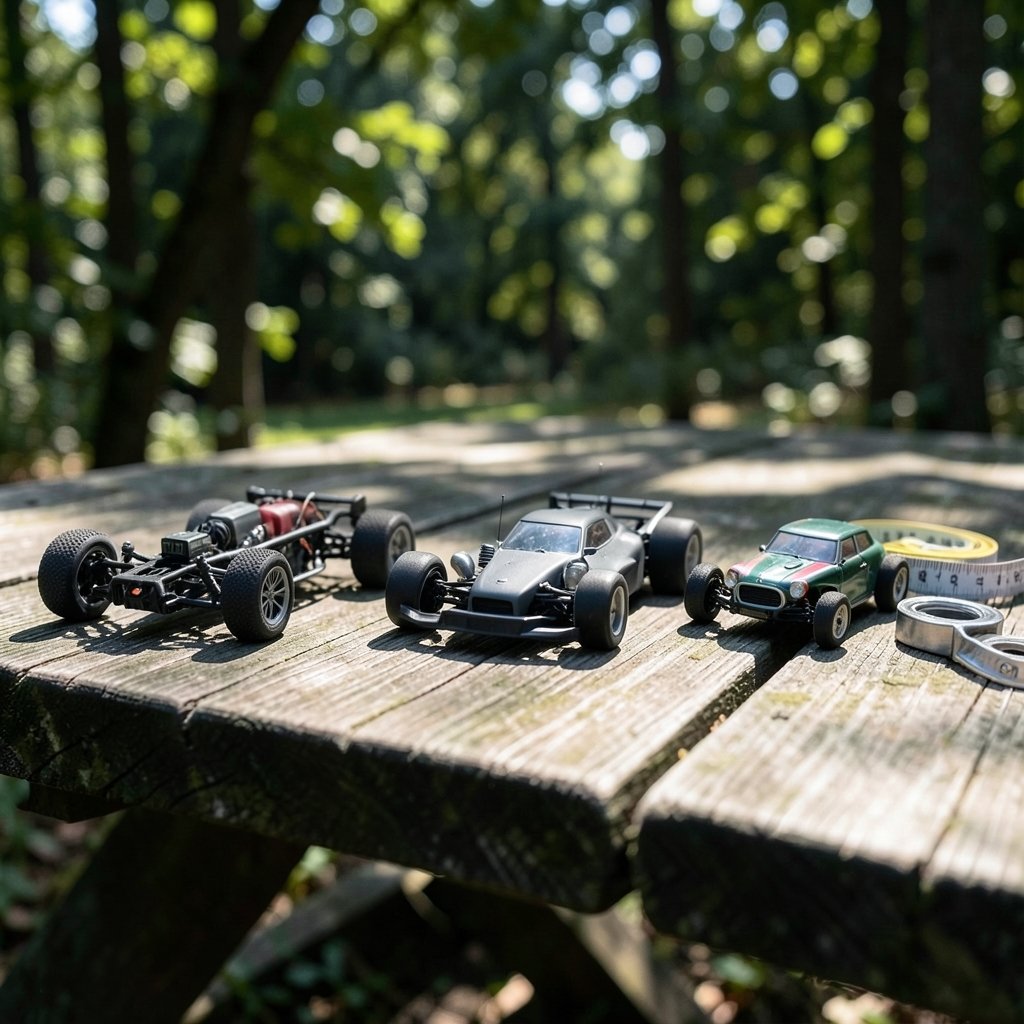
The market splits into a few clear categories. Each suits a different budget and commitment level.
| Type | Scale | Typical cost | Best for | Trade-off |
|---|---|---|---|---|
| Mini-Z / 1/28 RWD | 1/28 | $180–$350 | Indoor drifting, small spaces | Limited outdoor use |
| 1/10 RWD drift chassis | 1/10 | $250–$700 | Competition, realism | Needs a gyro and setup time |
| Countersteer AWD (CS) | 1/10 | $200–$500 | Learning, mixed surfaces | Less realistic than RWD |
| Entry brushed kits | 1/10 | $100–$180 | First taste of drifting | Weak electronics, few upgrades |
1/10 RWD is the competition standard. It is also the hardest to drive. A rear-drive drift car needs a steering gyro to catch slides, and the gyro does a lot of the work for you at first. Purists argue this makes the hobby too easy. In practice, a good gyro lets a beginner learn throttle control instead of fighting constant spins.
Countersteer AWD cars are the forgiving middle ground. The front wheels pull while the rear breaks loose, so the car self-corrects. Many drivers start here, then move to RWD once they can hold a figure-eight.
Mini-Z and 1/28 platforms deserve more credit than they get. A living-room-sized car that drifts across a coffee table teaches the same fundamentals at a fraction of the space and cost. For anyone in an apartment, this is the realistic entry point.
Surface and tire matching is where most beginners go wrong
The single most common mistake is buying a good chassis and then drifting on the wrong surface. Tire compound and floor type have to match, or the car either grips and spins or slides with no control.
Here is what actually works in practice:
- Smooth concrete or polished garage floor: hard rubber or ABS tires. Too soft a compound will grip and flip the car.
- Short-pile carpet: PVC or hard plastic tires. Carpet eats soft rubber.
- Asphalt or rough concrete: medium-hard rubber. Pure plastic wears out fast and throws the car sideways unpredictably.
- Interlocking foam mats: the most forgiving surface. Great for learning, though it hides bad technique.
A practical tip that saves money: buy one spare set of tires in a harder compound before you buy any motor or battery upgrade. Tire changes alter the car’s behavior more than a modest power bump ever will.
The other frequent error is over-powering a beginner chassis. A 10.5T brushless motor in a car with stock plastic steering will spin on every corner exit. Most experienced drifters run modest power and focus on gearing and suspension. Speed is not the goal. Control is the goal.
Gyros, radios, and the electronics that make drifting repeatable
A steering gyro is a small sensor that countersteers automatically when the rear steps out. It plugs between the receiver and steering servo. On RWD drift cars it is close to mandatory. On countersteer AWD cars it is optional and often switched off.
Settings matter. Too much gyro gain and the car feels robotic, correcting before you can react. Too little and it spins. A good starting point is 40 to 60 percent gain, adjusted up on low-grip surfaces and down on high-grip ones.
Radio choice is less glamorous but matters for consistency. A basic two-channel radio works. A radio with exponential steering and end-point adjustment lets you soften the initial steering response, which makes holding a slide far easier. That is a genuine quality-of-life upgrade, not a luxury. (Radio-controlled car)
Batteries deserve a note too. LiPo packs give consistent power through a run, while NiMH packs fade as they discharge. Consistent power makes it easier to learn throttle control, because the car behaves the same on lap one and lap ten.
Setup: the adjustments that change how a drift car feels
Setup is where the hobby gets deep, and where casual owners often stop. The four adjustments below deliver the biggest returns.
Camber. More negative front camber (around 3 to 5 degrees) increases front grip mid-slide. Rear camber stays closer to zero so the rear keeps sliding.
Toe. A little toe-out at the front sharpens turn-in. Rear toe-in adds stability and stops the car from snapping around.
Ride height and droop. Lower ride height lowers the center of gravity. Droop limits how far the suspension extends and controls weight transfer. Small changes here are felt immediately.
Diff and gearing. A locked or spool rear diff gives predictable, consistent slides. A ball diff allows tuning but needs maintenance.
A useful rule from the track: change one thing at a time and run a full battery before judging it. Drivers who change four settings at once usually cannot tell which one helped.
Scale classes, communities, and where the hobby is heading
The scene organizes around scale and drivetrain. 1/10 RWD dominates club competition. 1/28 classes thrive indoors, especially in Asia and Europe, where space is tight. Countersteer AWD remains popular as a stepping stone and in regions where RWD competition is thin.
Community matters more here than in most RC niches. Drift groups tend to be social, running “tandem” sessions where cars follow inches apart. That proximity demands consistent setups and predictable cars, which pushes the whole group toward better tuning. Newcomers who join a local club progress faster than solo drivers, mostly because they can copy proven setups instead of guessing.
The broader RC market has grown steadily as hobbyists age into disposable income and manufacturers push ready-to-run packages. For a wider view of how these cars fit into the hobby at large, Voozon Cars — Reviews, Comparisons & Car Guides covers platforms and buying angles beyond drifting alone.
There is also a philosophical divide worth knowing about. Some drivers treat RC drifting as a simulation of full-size drifting and chase scale realism: body kits, interior details, exhaust smoke units. Others treat it as its own discipline and optimize purely for control. Neither is wrong, but the two groups buy different cars. The simulation-minded crowd favors RWD chassis with detailed bodies. The control-focused crowd favors whatever holds a line most consistently. The cars built around experience angle captures why so many hobbyists care about feel over raw specs.
A realistic buying path for newcomers
The temptation is to buy the most capable car first. That usually backfires. A high-end RWD competition chassis punishes bad throttle habits and can make a beginner quit within a month. (NASA)
A better sequence:
- Start with a countersteer AWD kit or a 1/28 RWD car. Both are forgiving and cheap to run.
- Buy hard tires and a spare set. This is the real “drift upgrade.”
- Add a gyro only when moving to RWD. It is not needed earlier.
- Upgrade the radio before the motor. Steering feel beats power.
- Join a local group before buying a competition chassis. Their setups will save you months.
Budget realistically. A workable 1/10 drift setup with a decent radio, two batteries, a charger, and spare tires lands around $400 to $550. That is the honest number, not the $150 kit price. The kit is the beginning of the spend, not the end.
Common mistakes that stall progress
Beyond surface and tire mismatches, a few habits reliably slow people down.
Chasing power. More motor makes slides harder to control, not easier. Most club-level drifters run modest motors deliberately.
Ignoring tire wear. Worn tires change grip and throw off a setup that used to work. Rotate and replace them.
Skipping the gyro calibration. A mis-calibrated gyro fights the driver. Recalibrate after every significant setup change.
Drifting alone. Without feedback, bad habits become permanent. Even one experienced driver watching for ten minutes can fix a steering habit that would otherwise take months to unlearn.
Neglecting the body. Bodies do more than affect appearance. A heavy body raises the center of gravity and changes how the car transitions. Lightweight bodies are quicker to rotate.
Conclusion
RC drift cars reward patience more than spending. The physics are simple: steering lock, countersteer gearing, and hard tires create a slide, and a gyro plus careful setup make it repeatable. The trap is treating the hobby as a spending contest. Drivers who master a cheap countersteer car on foam mats will out-drive someone with a $1,500 build who never learned throttle control.
Start small, match your tires to your surface, change one setting at a time, and find a group to drift with. Those four habits matter more than any spec sheet. For anyone weighing platforms before committing, Voozon Cars — Reviews, Comparisons & Car Guides – Voozon — Discover, Review & Explore is a reasonable place to compare options side by side. The rest is seat time, and seat time is the part that actually makes a drift car fun.
Frequently Asked Questions
What is the best RC drift car for a complete beginner?
A countersteer AWD 1/10 kit or a 1/28 RWD car like a Mini-Z. Both are forgiving, cheap to run, and teach throttle control without constant spins. Avoid high-end RWD competition chassis until you can hold a figure-eight consistently.
Do RC drift cars need a gyro?
RWD drift cars almost always do, because the rear steps out faster than most drivers can react. Countersteer AWD cars usually do not. Gyro gain typically runs 40 to 60 percent, adjusted for surface grip.
How much does it actually cost to start RC drifting?
A realistic all-in budget for a 1/10 setup with a radio, two batteries, a charger, and spare tires is roughly $400 to $550. Entry kits cost less but usually need tires and a better radio within the first month.
Can you drift a normal RC car?
Yes, on the right surface with the right tires. Hard rubber, ABS, or PVC tires on smooth concrete will break traction on most hobby-grade cars. Steering lock and gearing will limit how well it holds a slide, but it is a cheap way to try the hobby.
What surface is best for RC drifting?
Smooth concrete, polished garage floors, and interlocking foam mats work best. Match tire compound to the surface: hard tires on smooth floors, PVC on carpet, medium-hard rubber on asphalt.
How long does it take to learn to drift an RC car?
Most people hold a basic slide within a few sessions on foam mats with a forgiving car. Consistent tandem driving takes months of practice. Joining a local group shortens the learning curve considerably.