
Pinewood Derby Cars: Engineering Guide for Kids 2026
 Abdul WadoodLast updated

Every year, roughly a million small wooden cars roll down aluminum tracks in gyms, church halls, and community centers across the United States. Most weigh less than a stick of butter. Most are shaped with a parent’s coping saw and sanded by a kid’s small hands. And every one of them is a rolling physics experiment.
The Pinewood Derby is one of the most enduring traditions in American youth scouting, and it has quietly become something bigger than a race. It is a design challenge, a lesson in friction and mass, and occasionally a cautionary tale about how seriously adults can take a children’s craft project. This guide covers where the derby came from, what the standard kit actually contains, how the physics of a fast car works, and the mistakes that sink most entries.
Where the Pinewood Derby Came From
The derby was created in 1953 by Don Murphy, a Cub Scout leader in Manhattan Beach, California. Murphy wanted a safer, smaller alternative to the Soap Box Derby for younger boys, who were often too small to handle a full-size gravity racer. The first official race is generally dated to May 15, 1953, in Manhattan Beach, though exact historical details vary between sources and are best checked against scouting archives. (Pinewood Derby)
The program is run by the Boy Scouts of America, now branded Scouting America, through its Cub Scout division. National guidance sets broad kit specifications, but here is the detail that trips up newcomers: local packs and councils routinely add their own rules. There is no single universal rulebook. A car that wins one pack’s race might be disqualified at another pack across town.
That local variation is the single most important thing to understand about pinewood derby cars. Before anyone touches sandpaper, read your pack’s rule sheet carefully.
What’s in the Standard Kit
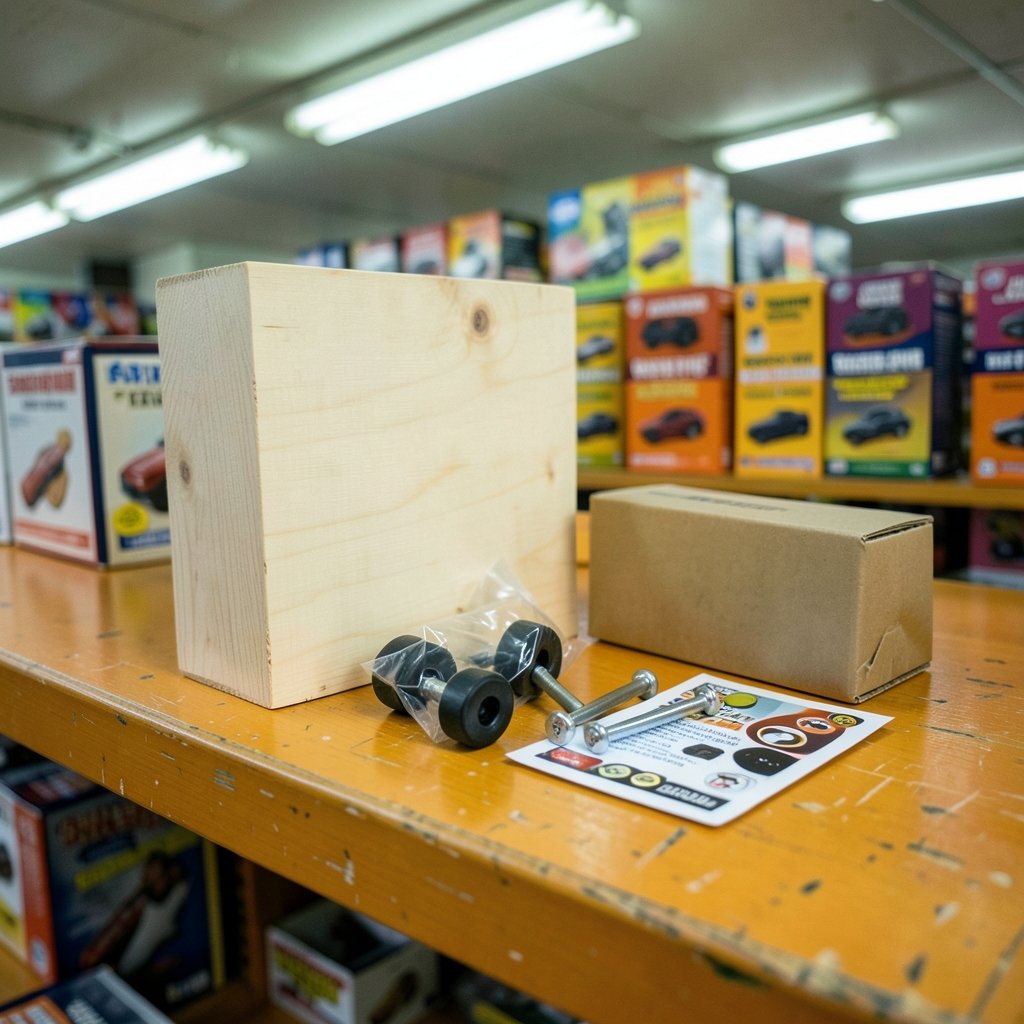
The classic kit is deliberately humble. It typically includes a block of pine roughly 7 by 1¾ by 1¼ inches, four plastic wheels, four nail-type axles, and decals. Dimensions and wheel designs have shifted over the decades, so “standard” depends on which era’s kit you’re holding. Older kits used noticeably different wheel profiles.
Common rules across most packs include:
| Rule | Typical Limit |
|---|---|
| Maximum weight | 5 ounces (about 141.7 grams) |
| Maximum length | Around 7 inches |
| Builder requirement | Scout builds it with limited adult help |
| Lubricant | Varies widely by pack; often restricted |
| Modifications | Wheels and axles frequently must remain stock |
Those numbers are common, not universal. Weight limits, length limits, and whether graphite is allowed all change from pack to pack. Some packs permit aftermarket axles; others inspect wheels under a magnifier and reject anything modified.
The Physics That Actually Decide Races
A pinewood derby car is a gravity-powered machine, and its speed comes down to a short list of variables. Understanding them is more useful than any store-bought gimmick.
Mass and Where You Put It
The five-ounce limit exists because mass matters. A heavier car accelerates faster down the ramp, since gravity pulls harder on more mass while air resistance stays roughly the same. The trick is placement: weight toward the rear and high on the car gives more stored energy at the start; weight low and centered improves stability. Most builders with practice put weight near the rear axle but keep the center of gravity low enough that the car does not wobble.
Friction Is the Real Enemy
Two contact points eat speed: the axle-to-wheel interface and the wheel-to-track interface. Polishing axles with fine abrasives, deburring the nail heads, and using a permitted dry lubricant can shave time. Smooth beats shiny — a mirror finish on an axle means little if the wheel bore is rough or the axle is bent.
Alignment and Rolling Straight
A car that drifts sideways rubs its wheel hubs against the track’s center rail and loses energy with every correction. Rolling the car down a flat table and watching which way it veers is a simple, free diagnostic. Small axle adjustments can fix a persistent drift. This is the step most families skip, and it is often worth more than an hour of sanding.
Aerodynamics: Less Than You Think
Aerodynamics matter, but at derby speeds they are a minor factor compared to friction and alignment. A wedge shape looks fast and is easy to build, but a well-aligned brick will beat a poorly aligned wedge nearly every time. Shape is the fun part; mechanical basics are the winning part.
Design Choices and What They Cost You
Builders face a genuine trade-off between looks and speed. Here is how the common approaches compare.
| Design approach | Speed | Build difficulty | Notes |
|---|---|---|---|
| Thin wedge | High | Low | Easy to cut, low frontal area, simple to weight |
| Flat slab with weights | High | Very low | Ugly but effective; great for first-timers |
| Detailed scale model | Moderate | High | Looks fantastic, often heavier than ideal |
| Extreme cutout (rail car) | Variable | High | Fragile; weight placement gets tricky |
| Open-class novelty | Low to moderate | Varies | Built for fun, not the podium |
The honest advice: build the car the kid wants, then optimize the parts that don’t show. A scout who designs a shark-shaped car and still polishes the axles will usually beat a scout who copied a “fastest design” video but never checked alignment.
For more on how vehicle design choices shape real-world performance, the reviews and comparisons at Voozon Cars offer a useful broader perspective on how engineering trade-offs play out in full-size machines.
Common Mistakes That Cost Races
First-hand experience across thousands of pack races surfaces the same errors again and again.
Weighing in at home on a kitchen scale. Bathroom and kitchen scales drift. Use a postal or digital scale accurate to 0.1 ounces, and weigh the car the night before the race, not the morning of.
Sanding the block but ignoring the axles. The block is the visible part; the axles are where friction lives. Spend at least as much time on the nails as on the wood.
Bending an axle and not noticing. A slightly bent axle makes a wheel wobble and drag. Roll each wheel on a flat surface and check for wobble before assembly.
Over-lubricating. More graphite is not better. Excess powder gums up the wheel bore. A small amount, worked in, outperforms a heavy dusting.
Building to the edge of the rules. Cars exactly at the weight limit sometimes fail the official scale. Leave a small margin, or bring removable weights and a tiny screwdriver to the race.
Forgetting the scout is supposed to build it. Packs increasingly inspect for adult-built cars, and more importantly, a car the kid made is the one they’ll remember.
There is also a subtler mistake: treating the derby as a pure speed contest. Many packs now run design awards alongside the race, which rewards creativity and keeps the event from becoming a proxy competition between parents. The cars built around experience — the ones with a story, a theme, or a genuinely odd shape — often matter more to the kids than the ones that finish first. That idea of design as experience is explored further in this piece on the cars built around experience.
A Practical Build Sequence That Works
For families doing this for the first time, a simple sequence beats a complicated one.
- Read the pack rule sheet and highlight every limit.
- Sketch three designs and pick one the scout can actually cut with help.
- Cut the profile, then sand progressively finer grits.
- Drill axle slots or holes square and true.
- Install axles, check alignment on a flat table, adjust as needed.
- Add weight incrementally, weighing after each addition.
- Polish axles and apply permitted lubricant last.
- Test-roll on a smooth floor and fix any drift.
- Pack the car in a padded box for transport.
Steps five through eight are where races are won. They are also the least glamorous, which is exactly why so many families skip them.
The Adult Side of the Derby
The Pinewood Derby has spawned an entire aftermarket: precision axles, tungsten weights, alignment tools, and open-class races for adults who never quite stopped wanting to build one. That ecosystem is a double-edged sword. Good tools make the mechanical basics accessible to any family. But an arms race of purchased parts can quietly push kids out of the driver’s seat of their own project.
Many packs have responded by splitting the event: a scout class with strict stock rules and an open class where anything goes. That structure preserves the fairness of the main race while letting the engineering enthusiasts scratch their itch. It is a sensible compromise, and packs that adopt it tend to report fewer disputes at the inspection table.
The broader lesson — that small design decisions compound into measurable performance differences — shows up everywhere from derby tracks to real vehicle engineering. A wider set of car reviews and comparisons at Voozon Cars covers how those same principles play out at full scale.
Conclusion
Pinewood derby cars are a rare thing: a children’s craft project that is also an honest engineering problem. The rules are simple, the materials are cheap, and the physics is real. Mass, friction, and alignment decide the race far more reliably than paint color or a fancy shape. The families who do well are rarely the ones with the most expensive parts; they are the ones who read the rule sheet, weighed the car on a decent scale, and spent twenty minutes on the axles.
And the deeper value sits outside the standings. A scout who learns that a small adjustment produces a measurable result has learned something that transfers to every machine they will ever touch. That is the point of the whole exercise, and it is why a block of pine has outlasted so many more elaborate youth programs.
Frequently Asked Questions
What is the maximum weight for a pinewood derby car?
Five ounces, or about 141.7 grams, is the most common limit. However, this is set by individual packs and councils rather than by a single national rulebook, so always confirm with your pack’s rule sheet before finalizing your car. Many experienced builders aim slightly under the limit to allow for scale variation at inspection.
How fast do pinewood derby cars go?
Speeds depend heavily on track design, but derby cars typically reach only modest speeds over a short course, usually finishing in a few seconds. The race is won by fractions of a second, which is why friction reduction and wheel alignment matter so much more than dramatic design choices.
Do you have to use the wheels from the kit?
In most packs, yes. Stock wheels and axles are frequently required, and some inspectors check for modifications under magnification. A minority of packs allow aftermarket wheels or axles in a separate open class. Check your local rules before buying anything.
Is graphite or silicone lubricant better?
It depends entirely on what your pack permits. Dry graphite is the traditional choice and is allowed at many races, while liquid lubricants are often banned because they attract debris and can affect the track. Whatever you use, apply it sparingly and work it into the wheel bore rather than coating the outside.
Can parents help build the car?
Yes, but within limits. Most packs expect the scout to do the main work, with adults handling tools that are unsafe for children, such as saws and drills. Packs increasingly look for evidence of adult-built cars, and the spirit of the event favors a car the kid genuinely shaped and sanded.
Why does my car drift to one side?
Drift almost always comes from axle misalignment or a bent axle. Roll the car slowly down a flat, smooth surface and watch which way it veers, then rotate or gently adjust the offending axle. Fixing drift is one of the highest-value tuning steps available, and it costs nothing but a few minutes.