
Luxury Background: Meaning, Origins & Brand Claims
 Abdul WadoodLast updated
What do people actually mean when they say someone has a “luxury background,” or when a product photo is praised for its luxury background? The phrase sounds precise, but it is not. English speakers use it in at least three loose ways, and mixing them up causes real confusion in conversation, in design briefs, and in marketing copy.
This article untangles those meanings. It looks at the word’s odd history, the social shorthand behind “old money” talk, the visual sense used in photography and interiors, and the legal rules that apply when a brand puts “luxury” on a label. By the end, readers should be able to hear the phrase and know which version they are dealing with.
A word that once meant vice
Start with the word itself. Luxury entered English through Old French luxurie, from Latin luxuria, meaning excess or extravagance. In its early English life, the word carried a negative charge. Luxury was something close to vice: indulgence, appetite run wild, a habit that softened character. The modern, positive sense of sumptuous living is a later shift.
That history matters because it explains a lingering ambivalence. Even today, describing someone as coming from a “luxury background” can sound admiring or faintly accusatory, depending on the speaker. The word never fully shed its old association with excess.
Three meanings, one phrase

Because there is no dictionary definition of “luxury background” as a compound, context does all the work. In practice, the phrase shows up in three distinct senses.
| Sense | Typical phrasing | What it actually refers to |
|---|---|---|
| Social origins | “She comes from a luxury background” | A wealthy upbringing, private schools, family connections |
| Visual backdrop | “Shoot it on a luxury background” | Styled sets: marble, velvet, gold, soft light |
| Brand heritage | “A luxury background spanning generations” | Marketing copy about a product’s pedigree |
The first sense is about people. The second is about pictures. The third is about products. They share a word and almost nothing else. A design brief that asks for a “luxury background” and a dinner-party remark about someone’s “luxury background” are not describing the same thing at all.
Social origins: what people are really signaling
When someone says a person has a luxury background, they usually mean money, and often more than money. The phrase bundles together private education, family property, holidays abroad, and the ease that comes from never having worried about a bill. It is shorthand, and like most shorthand it hides as much as it reveals.
The academic frame for this kind of talk is old. Thorstein Veblen’s 1899 book The Theory of the Leisure Class introduced the idea of conspicuous consumption: spending designed to display status rather than to satisfy need. Veblen’s account remains the standard starting point for anyone asking why luxury signals rank. The full text is in the public domain, and readers can explore Veblen’s theory of conspicuous consumption in The Theory of the Leisure Class directly.
Later research refined the picture. A 2010 study by Han, Nunes and Drèze in the Journal of Marketing found that wealthy consumers often prefer inconspicuous branding, choosing products whose logos are subtle or invisible. Status signaling, in other words, does not always shout. Sometimes the quietest object does the loudest work. That finding helps explain why “old money” style prizes worn leather and unmarked cashmere over visible monograms.
Old money versus new money
The distinction between old money and new money is folk sociology, not a measured category. No official body defines it, and sociologists rarely use the terms without quotation marks. It survives because it captures something people feel: that inherited wealth and self-made wealth carry different social meanings, different tastes, and different anxieties.
The French sociologist Pierre Bourdieu offered a more rigorous frame in Distinction (1979), arguing that taste itself functions as a marker of class. What someone finds beautiful, boring, or vulgar is not purely personal. It is learned, and it tracks upbringing. Read that way, a “luxury background” is less about money in the bank and more about acquired ease: knowing which fork, which wine, which silence.
Practical takeaway: when the phrase appears in conversation, listen for whether the speaker means money, manners, or both. The three are not the same, and conflating them is where snobbery and resentment both creep in.
The visual sense: staging a luxury backdrop
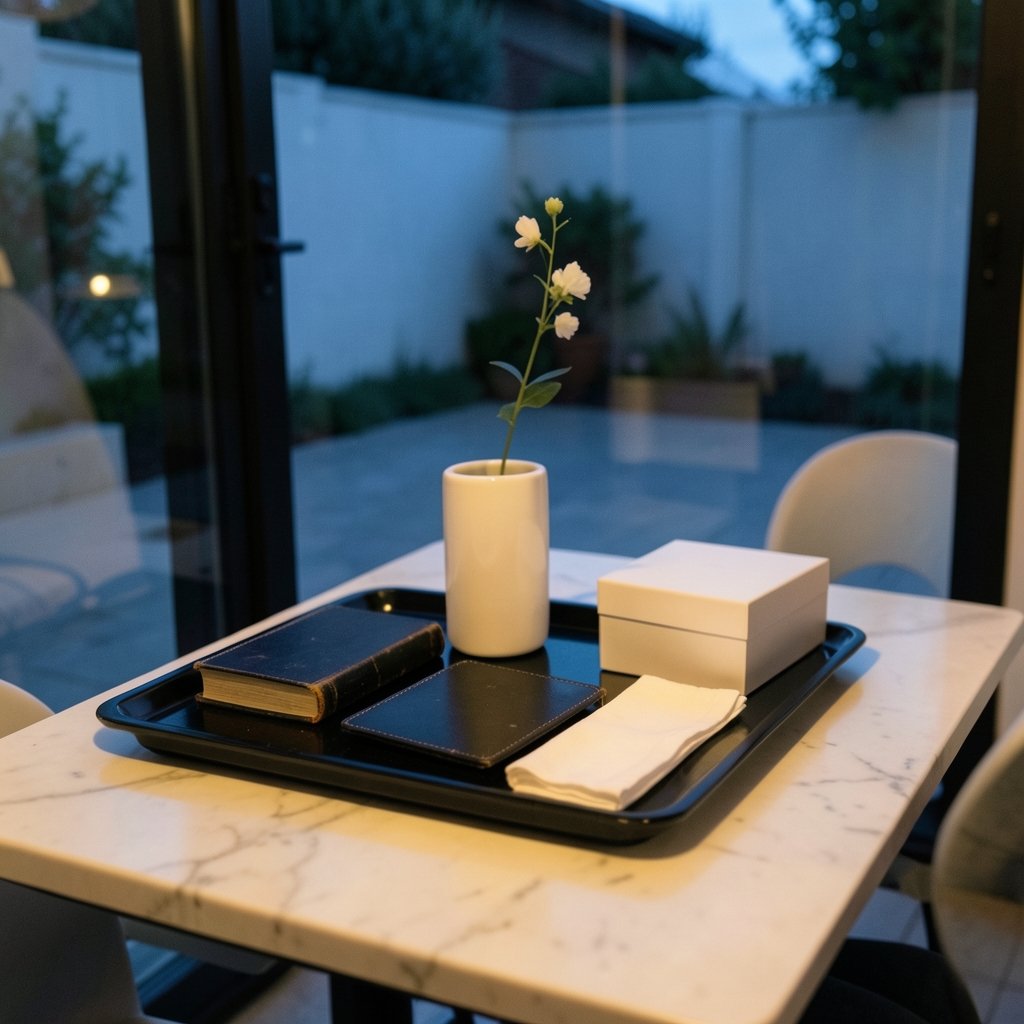
In photography, interiors, and branding, a luxury background is a styled surface or setting behind a subject. Think veined marble, deep velvet, brushed brass, muted plaster, and soft directional light. The backdrop is not the product, but it does much of the persuading.
There is no technical standard for this sense of the term. It is descriptive usage, not a specification. Still, certain conventions recur so often that they function as a visual grammar.
What actually works in practice
Designers and photographers who stage luxury backdrops tend to follow a few rules that are easy to state and hard to execute well.
- Choose one texture, not five. A marble surface with a velvet drape and a gold tray competes with itself. One dominant material reads as confidence; three read as clutter.
- Control the light before the props. Soft, directional light from one side creates depth. Flat overhead light makes even good marble look like a laminate sample.
- Keep the palette narrow. Warm neutrals, deep greens, and muted metals age well. Trend colors date a photograph within a season.
- Leave negative space. The subject needs room. A backdrop that fills every corner leaves the eye nowhere to rest.
- Match the backdrop to the story. A heritage watch suits dark wood and leather. A skincare product suits pale stone and linen. Borrowed grandeur looks borrowed.
Common mistakes
The most frequent error is over-styling: treating the backdrop as the star. The second is mismatched register, pairing a modest product with a set that promises a palace. Viewers notice the gap, and it reads as pretension rather than quality. The third is fake materials photographed too closely. Faux marble shot at high resolution looks like what it is.
There is also a subtler trap. Luxury backdrops borrowed from stock libraries make every brand look identical. A distinctive set, even a simple one, does more for perceived quality than a generic gold-and-marble scene. The same logic applies to how premium goods are chosen and presented more broadly; a thoughtful approach to conscious luxury and buying better rather than more tends to produce imagery that feels earned rather than rented. (Luxury goods)
Brand heritage: when “luxury” is a claim, not a compliment
The third sense is commercial. Brands describe their “luxury background” to signal craft, history, and price justification. Here the phrase stops being casual and starts being regulated.
In the United Kingdom, the Consumer Protection from Unfair Trading Regulations 2008 require marketing claims to be substantiated and not misleading. A claim implying a verifiable quality standard must survive scrutiny. The EU’s Unfair Commercial Practices Directive, adopted in 2005, sets a parallel framework across member states. In both regimes, “luxury” is not a free word. It is a claim that can be tested.
France goes further with haute couture, a legally protected designation. Only houses on the official list maintained under French law may use the term. The modern regulatory framework dates from a 1945 decree. The concept itself is usually traced to Charles Frederick Worth, who opened his Paris house in 1858 and is often called the father of haute couture.
This legal layer matters to readers because it separates heritage from hype. A brand with a genuine luxury background can usually point to something concrete: an atelier, a founding date, a craft technique, a supply chain. A brand without one tends to point at adjectives.
How to read a luxury claim
Shoppers can apply a simple test. Ask what the claim rests on.
| Claim type | Strong version | Weak version |
|---|---|---|
| Heritage | Named founder, dated archive, documented technique | “Decades of tradition” with no specifics |
| Materials | Named mill, fiber, or tannery | “Premium materials” |
| Making | Named workshop, visible process | “Crafted with care” |
| Scarcity | Limited production explained | “Exclusive” as a standalone word |
If the answer is a noun, the claim has substance. If the answer is an adjective, it does not.
Where the phrase goes wrong
Most confusion around “luxury background” comes from crossing the three senses. A few examples show how.
A recruiter describes a candidate as having a luxury background. The phrase is doing social work, not professional work, and it may be doing it unfairly. A designer asks for a luxury background and receives a photograph of a person in a blazer. A brand claims a luxury background and offers no evidence. (Trademarks)
The fix is simple: replace the phrase with the specific thing meant. Say “wealthy upbringing,” “styled marble backdrop,” or “founded in 1902, still family-owned.” Precision removes the ambiguity and, often, the awkwardness.
This habit connects to a wider shift in how premium goods are discussed. The distinction between quiet luxury and the old money aesthetic as two separate trends is a good example: the two are constantly merged in popular writing, yet they describe different things, one a design philosophy and one a social performance. Naming the difference is half the work.
Why the phrase persists
If “luxury background” is vague, why does it survive? Because it is useful. It compresses a cluster of associations into two words: money, taste, ease, history, quality. Speakers reach for it when they want the associations without the specifics.
It also persists because luxury itself is a moving target. Market estimates vary widely depending on definition, and analysts routinely caution that figures for personal luxury goods differ from figures for the total luxury market. The phrase inherits that fuzziness. It sounds exact and is not.
For readers who want to go deeper into how premium goods are made, chosen, and presented, related guides on eco-luxury lodges and how to spot genuine sustainability show the same principle at work: substance over adjectives, evidence over atmosphere.
Conclusion
“Luxury background” is not one thing. It is a social shorthand, a visual convention, and a marketing claim sharing a single phrase. The social sense describes upbringing and carries the weight of old class distinctions. The visual sense describes a staged backdrop and follows the practical rules of texture, light, and restraint. The commercial sense describes brand heritage and answers to consumer-protection law.
The most useful response to the phrase is a question: which one do you mean? Ask it of others, and ask it of yourself. Precision about luxury is not pedantry. It is the difference between recognizing quality and being sold a mood.
FAQ
What does “luxury background” mean?
It has no single definition. In everyday English it usually means one of three things: a wealthy upbringing, a styled visual backdrop used in photography and design, or a marketing claim about a brand’s heritage. Context decides which one is meant.
Is “luxury” a legally regulated word in advertising?
Not as a banned word, but claims must be truthful. Under UK consumer protection rules and the EU’s Unfair Commercial Practices Directive, a “luxury” claim that implies a verifiable quality standard must be substantiated and must not mislead. Some terms, such as haute couture in France, are protected designations with their own rules.
What makes a background look luxurious in photography?
Texture, light, and restraint. A single dominant material such as marble, velvet, or brushed metal, soft directional lighting, a narrow warm palette, and generous negative space do most of the work. Over-styling and fake materials are the most common failures.
Is “old money” a real sociological category?
No. It is a folk distinction used in popular writing, not a measured category. Sociologists prefer frameworks such as Bourdieu’s analysis of taste and class in Distinction. The phrase survives because it captures a felt difference between inherited and self-made wealth.
Why do wealthy consumers sometimes avoid visible logos?
Research on status signaling suggests that the wealthiest buyers often prefer subtle or invisible branding, a pattern sometimes called inconspicuous consumption. Visible logos can signal status to some audiences and insecurity to others, so quieter products often carry more social weight.
How can I tell a real luxury heritage claim from marketing talk?
Look for nouns, not adjectives. A genuine claim usually names a founder, a date, a workshop, a mill, or a technique. Vague phrases like “decades of tradition” or “premium materials” without specifics are a sign that the heritage is decorative rather than documented.