
LEGO Technic Cars: 2026 Buyer’s Guide & Tips
 Abdul WadoodLast updated

LEGO Technic launched in 1977 under the name “Expert Builder,” and it changed how people thought about the brick forever. Instead of studs and stacked plates, here came beams, pins, axles, and gears. Almost fifty years later, Technic cars are the line’s most popular category. They sit on shelves as display pieces, teach real mechanical principles, and sometimes cost more than a used bicycle. This guide breaks down what makes Technic cars different, how the range is structured, and how to choose one without regret.
What Makes a LEGO Technic Car Different From a Standard Set
A Technic car is built from a system that shares almost nothing with a classic LEGO set. The core parts are liftarms (beams with holes), connector pins, axles, and gear wheels. There are no studs on most exterior panels. The result looks engineering-like rather than toy-like, and the build process feels closer to assembling a kit than snapping bricks together. (LEGO Technic Theme)
That difference matters for buyers. A Technic set rewards patience and spatial thinking. Instructions are dense, often showing a single pin placement per step. Mistakes are common and usually invisible until three steps later, when a gearbox won’t turn. The payoff is a model with working functions: steering, suspension, differentials, and sometimes a functioning gearbox.
The building blocks of the system
| Component | Function | Typical mistake |
|---|---|---|
| Liftarm | Structural frame | Using the wrong length, forcing a twist |
| Connector pin | Joins beams | Pushing a friction pin where a frictionless one belongs |
| Axle | Transmits rotation | Cutting axles too short for a gear train |
| Gear wheel | Changes speed or torque | Meshing gears too tightly, causing binding |
| Differential | Splits power to wheels | Installing it backward, so wheels fight each other |
How the Technic Car Range Is Structured
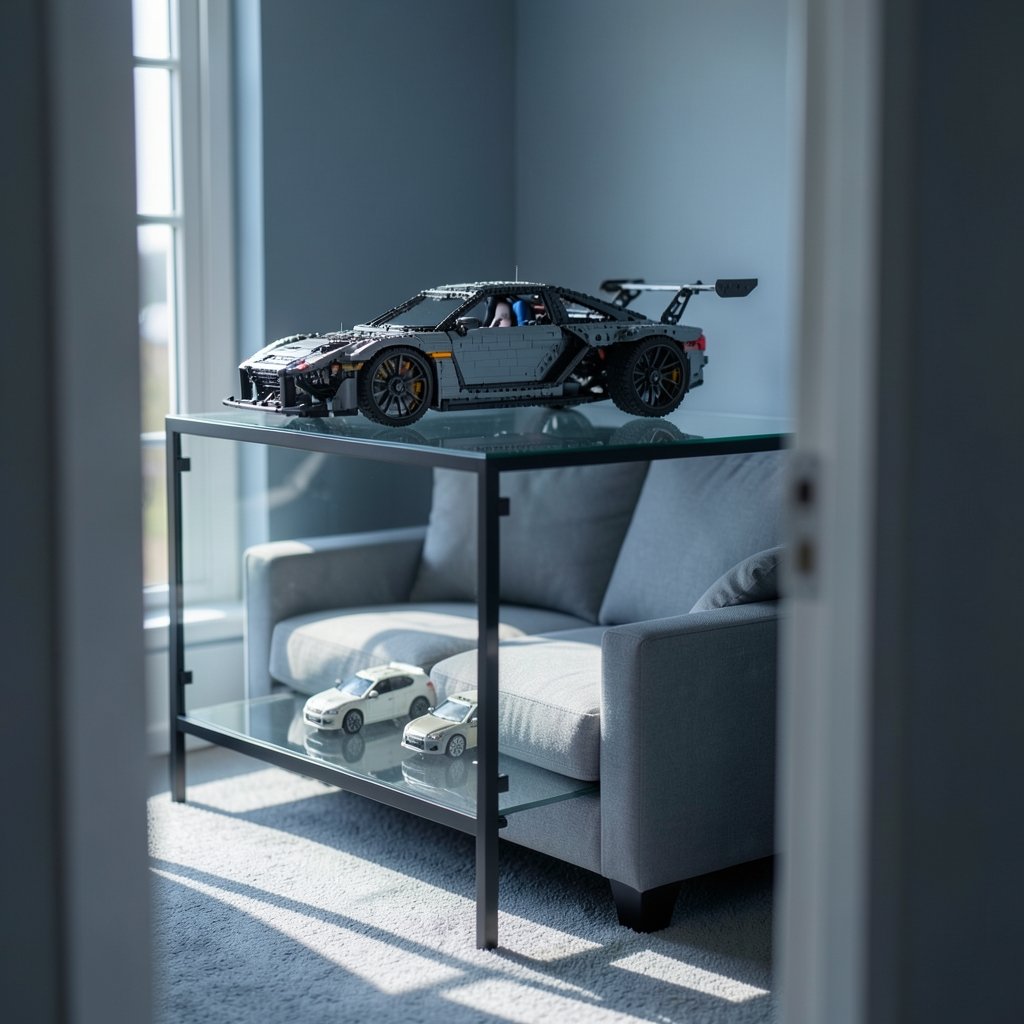
Technic cars fall into rough tiers, and knowing them prevents wasted money. Small sets (roughly 200 to 500 pieces) deliver a single function, like steering or a simple engine. Mid-range sets add suspension and opening panels. Flagship sets, often built in partnership with real manufacturers, pack in gearboxes, active aero, and thousands of pieces.
The licensed models are the headline act. Technic has produced cars badged by Ferrari, Lamborghini, McLaren, Porsche, Bugatti, and Mercedes, among others. These are 1:8 scale flagship builds aimed at adults, and they are the sets most likely to appear in a collector’s display cabinet rather than a toy box.
For a broader look at how these models compare against other vehicle-focused coverage, the Voozon Cars reviews and car guides are a useful starting point, and the site’s piece on the cars built around experience offers a different angle on why certain vehicles capture attention.
Small sets vs. flagship sets
| Factor | Entry-level Technic car | Flagship Technic car |
|---|---|---|
| Piece count | 200–600 | 1,500–3,900+ |
| Build time | 1–3 hours | 10–20+ hours |
| Working functions | 1–2 | 5–10 |
| Typical builder age | 8+ | 18+ |
| Display value | Low to moderate | High |
| Price band | Low | High |
The Flagship Models That Defined the Category
A few releases carry outsized weight in the community. The Porsche 911 GT3 RS (set 42056, released 2016) is widely credited with resetting expectations for what a Technic car could be: a large-scale, licensed model with a working PDK-style gearbox and a display-ready silhouette. The Bugatti Chiron (42083, 2018) followed with a W16 engine representation and a two-tone body that pushed color-matching complexity. The Lamborghini Sián FKP 37 (42115, 2020) added a striking lime-green palette and an eight-speed sequential gearbox. The McLaren Formula 1 car and various Ferrari builds continued the pattern.
These flagship sets are not toys in any practical sense. They are engineering puzzles with a shelf life measured in years, and many hold or gain value after retirement. That secondary-market behavior is worth understanding before anyone buys two of the same set as an “investment.”
For ongoing coverage of new releases and comparisons, Voozon Cars tracks the category alongside other vehicle reviews.
What Actually Works in Practice: Tips From the Build Table
First-hand builder experience points to a handful of habits that separate a smooth build from a frustrating one.
- Sort before you start. Empty every bag into a tray and group by part type. Flagship sets contain thousands of pins, and hunting for one black pin in a pile is the single biggest time sink.
- Check gear trains as you go. After installing any gear cluster, rotate the input by hand. If it binds, stop and fix it immediately. Retrofitting a gearbox after the body goes on is miserable.
- Follow the pin color code. Blue pins are friction pins, tan and gray pins are frictionless. Swapping them creates joints that either seize or wobble. This is the most common beginner error.
- Don’t overtighten axles. Axles should slide freely. If one needs force, the alignment is wrong somewhere upstream.
- Photograph each major subassembly. When instructions get ambiguous, a photo of your own progress beats re-reading a diagram.
- Keep spare parts separate. Leftover pieces are normal in small quantities. A pile of unused gears means something was skipped.
The most common mistake is rushing the chassis. The frame is unglamorous, but every function depends on it being square and true.
Display and dust
Technic models have open structures that collect dust in every hole. A soft brush and compressed air work better than a cloth, which snags on exposed axles. Display cases are expensive but preserve both the model and its resale value.
Cost, Value, and the Retirement Problem
Technic cars are priced by piece count and license. Flagship licensed models typically command a premium over unlicensed equivalents of similar size. When a set retires, the secondary market often pushes prices well above retail, sometimes doubling them within a couple of years.
That creates a genuine decision point. Buyers who want to build should buy while sets are in production. Buyers who want to display should consider whether the model will still appeal in five years. And buyers treating sets as investments should remember that re-releases, condition issues, and shifting collector taste can all erode returns. A sealed box is only worth what someone will pay for it.
Who Each Type of Technic Car Suits
- Kids aged 8–11: entry-level sets with one or two functions. Steering and a visible engine are enough.
- Teenagers: mid-range sets with suspension. These teach real mechanical cause and effect.
- Adults new to Technic: a mid-range licensed car, not a flagship. Learn the pin system on something smaller.
- Experienced builders: flagship 1:8 models, ideally with the gearbox.
- Display-focused collectors: flagship sets with strong silhouettes and limited production runs.
Common Myths Worth Correcting
Myth: Technic is just LEGO with holes. In reality, the two systems use incompatible connection methods. Very few parts cross over.
Myth: More pieces always means a better build. Piece count often reflects cosmetic detailing, not mechanical complexity. A 1,500-piece set with a full gearbox can be more interesting than a 3,000-piece set with static panels.
Myth: Flagship sets are for kids. The age ratings on flagship Technic cars are typically 18+, and the instructions assume adult patience.
Myth: Retired sets always go up. Some do. Plenty don’t. Popularity, condition, and re-release rumors all move prices.
Building Beyond the Instructions
The Technic community is unusually active. Builders publish alternative models, motorization guides, and custom bodies. Adding Power Functions or the newer powered-up motor system turns a static car into a remote-controlled one, though it requires planning during the build rather than after.
The most rewarding path for many builders is modification. Swapping wheels, adding lights, or reworking a gearbox ratio teaches more than any instruction booklet. It also voids nothing, since Technic is designed to be taken apart.
Conclusion
LEGO Technic cars occupy a strange, appealing space: part toy, part engineering lesson, part display object, part speculative asset. The category rewards buyers who understand the tiers, respect the pin system, and build slowly. Start with a mid-range model if Technic is new territory. Move to a flagship when the gear trains stop being intimidating. And whatever the set, sort the parts first. That single habit saves more frustration than any other piece of advice in this guide.
Frequently Asked Questions
What is the difference between LEGO Technic and regular LEGO?
Technic uses beams, pins, and axles instead of studded bricks. The two systems connect differently and share very few compatible parts. Technic models prioritize mechanical functions like steering and suspension over decorative building.
Are LEGO Technic cars suitable for children?
Entry-level Technic cars are rated for ages 8 and up and work well for kids with patience for detailed instructions. Flagship licensed models are typically rated 18+ because of build complexity, small parts, and price.
How long does it take to build a flagship Technic car?
Most builders report 10 to 20 hours for a flagship 1:8 scale model, spread across several sessions. Smaller sets take one to three hours. Sorting parts before starting cuts total build time noticeably.
Why do retired Technic sets cost so much?
Once a set leaves production, supply is fixed while demand often continues. Popular licensed models can trade well above original retail on the secondary market. Not every retired set appreciates, though, and condition matters enormously.
Can LEGO Technic cars be motorized?
Yes. Many sets are designed with space for motors, and the community publishes motorization guides. Adding power usually requires planning during the initial build, since retrofitting motors into a finished model is difficult.
What should a first-time Technic builder buy?
A mid-range licensed car in the 500 to 1,500 piece range is the safest starting point. It teaches the pin and axle system without the gearbox complexity of a flagship, and the cost of a mistake stays low.
Final Thoughts on Buying Smart
The practical takeaway is simple: match the set to the builder, not to the marketing. A flagship model bought for a ten-year-old usually ends up half-built in a drawer, and an entry-level set bought by an experienced adult often gets finished in an evening and shelved. Neither outcome is a tragedy, but both are avoidable with a little planning.
Watch the release calendar, too. New flagship announcements tend to push older sets toward retirement, and prices on the secondary market react quickly. Builders who know a set is leaving production can buy at retail instead of paying a premium later. Conversely, anyone tempted by a “rare” listing should check whether a re-release has been rumored, because speculation alone can inflate prices on models that later return to shelves.
Storage deserves a mention as well. Disassembled sets should be bagged by subassembly with the instructions, not dumped into a single bin. Rebuilding a flagship from a loose pile of 3,000 parts is a project in itself, and labeled bags turn a weekend of sorting into an afternoon. Keep the box flat if resale matters; crushed boxes cost real money.
Above all, Technic rewards curiosity. The builders who get the most from the hobby are rarely the ones with the largest collections. They are the ones who take a finished model apart to see why the gearbox works, who test a ratio change, who build something the instructions never described. The set is the starting point, not the destination. Buy the tier that fits, sort the parts, check the gears, and the rest follows.