
History of Van Cleef Alhambra Necklace: 1968 to Icon
 Abdul WadoodLast updated

In 1968, a year of student protests and cultural upheaval, a quiet revolution in jewelry design began. Van Cleef & Arpels introduced a necklace shaped like a four-leaf clover, edged with tiny gold beads and set with mother-of-pearl. It was called the Alhambra. No one at the time could have predicted that this simple, lucky shape would become one of the most recognizable pieces of fine jewelry in the world, worn by royals, film stars, and a new generation of self-purchasing women. More than five decades later, the Alhambra is not just a necklace. It is a cultural marker, a resale-market phenomenon, and the foundation of an entire product family.
A Lucky Shape Born in a Changing Era
The late 1960s were a turning point for jewelry. Formal, gem-heavy pieces were losing ground to something more relaxed. Women wanted jewels they could wear during the day, with a plain blouse or a cashmere sweater, not just at galas. Van Cleef & Arpels, a Paris house founded in 1906, responded with a design that felt almost casual by the standards of the time.
The motif was a quatrefoil, a four-lobed shape that resembles a four-leaf clover. The house’s own materials have long tied the shape to the clover, a universal symbol of good luck. The name, however, points somewhere else entirely: the Alhambra, the Moorish palace and fortress in Granada, Spain, famous for its interlacing arches and geometric tilework. Both inspirations are usually mentioned together, and sources differ on which came first. What matters for the design is that the result feels architectural and organic at once. The rounded lobes echo the palace’s arches; the clover association gives it warmth.
The beaded gold border, known as the perlée edge, was the finishing touch. That ring of tiny gold spheres frames each motif like a picture frame, catching light and giving the piece a texture that photographs remarkably well. The perlée treatment became a house signature in its own right, appearing on rings, bangles, and later collections. For a deeper look at how jewelry fastenings and clip mechanisms evolved alongside such designs, the history of hair clips and their materials offers a surprisingly useful parallel, since both fields solved the same problem: how to keep a beautiful object attached to a moving body.
The 1970s and 1980s: Building a Family
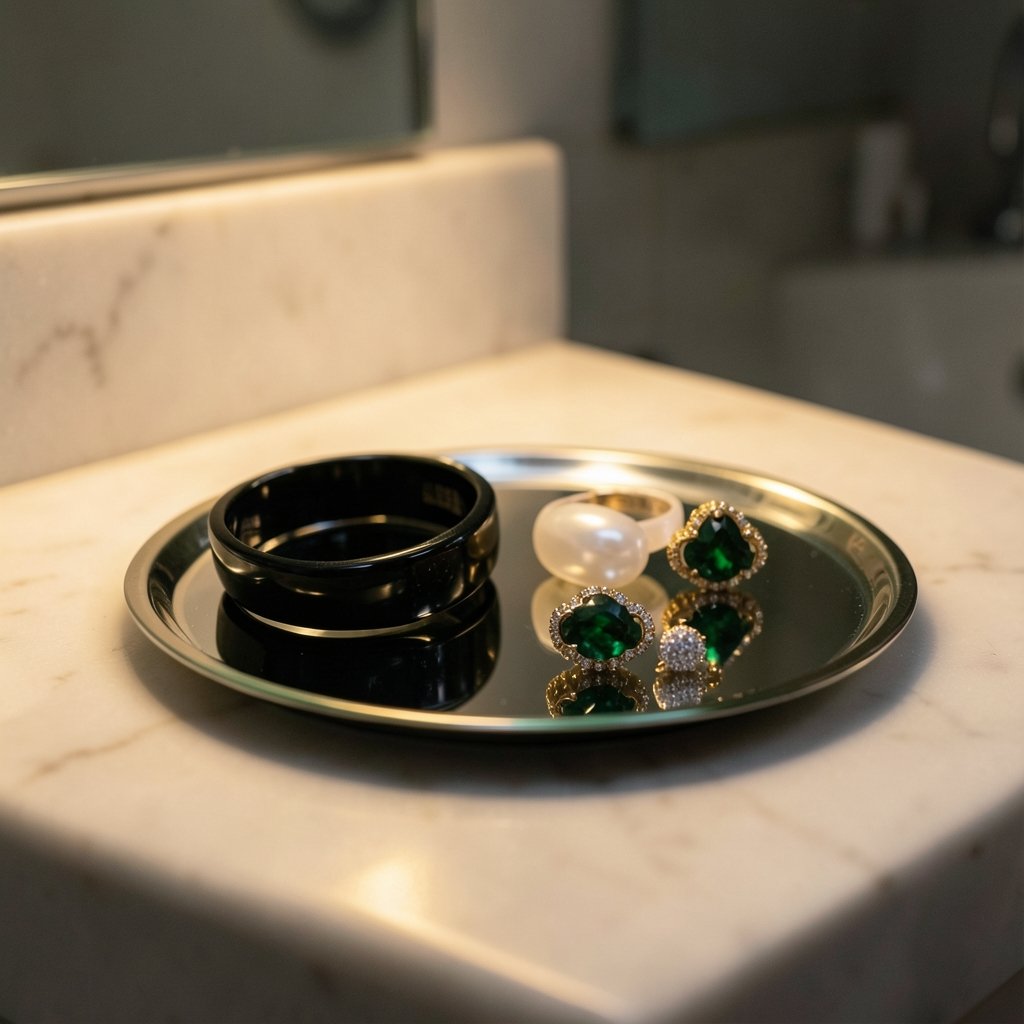
The first Alhambra pieces were necklaces, but the collection did not stay still. Through the 1970s and 1980s, the house expanded the line into bracelets, earrings, and rings. Sizes multiplied too. What began as a single proportion grew into distinct families, with smaller and larger motif sizes serving different tastes and budgets.
This was deliberate strategy. A recognizable motif is a business asset, and Van Cleef & Arpels treated the quatrefoil the way a fashion house treats a logo: consistent enough to be instantly identifiable, flexible enough to appear in dozens of variations. Materials became the variable. Mother-of-pearl gave a soft, luminous white. Onyx offered graphic black contrast. Malachite brought deep green banding, tiger’s eye a shifting golden shimmer, and carnelian a warm burnt orange. Later came diamonds, both as accents and as full pavé versions.
The practical effect, for anyone shopping today, is that two Alhambra necklaces can look quite different while sharing the same DNA. That variety is also a trap. Buyers who focus only on the motif sometimes overlook the stone, and stone quality varies enormously. Mother-of-pearl is soft and can dull or scratch with daily wear; malachite is sensitive to water and perfume; onyx and carnelian are far more forgiving. Knowing the stone matters more than knowing the size.
Why the Alhambra Became a Status Symbol
By the 2000s and 2010s, the Alhambra had crossed from jewelry into pop culture. It appeared on red carpets, in music videos, and on the necks of celebrities whose outfits were photographed millions of times. The necklace became shorthand for a certain kind of success: understated but unmistakable, expensive but not flashy in the traditional diamond sense.
Part of the appeal is legibility. A diamond solitaire is beautiful, but from across a room it reads as “sparkle.” An Alhambra reads as Alhambra. The shape is distinctive at a distance, which is exactly what a status symbol needs. Part of it is also accessibility. Because the collection spans a wide range of sizes and materials, there is an entry point at many price levels, from small single-motif pieces to long multi-motif necklaces. That range helped the design reach a broader audience without losing its luxury positioning. (Alhambra Collection)
The business context matters here. Van Cleef & Arpels has been part of Richemont, the Swiss luxury group, since 1999. That corporate backing gave the house resources for global retail expansion and marketing at a scale the family-owned firm could not have matched alone. The Alhambra benefited directly, becoming a fixture in airports, department stores, and flagship boutiques across Asia, Europe, and the Americas. For comparison, the way haircut terminology shifted from barber slang to salon branding shows how language and positioning can reshape an entire category, a dynamic explored in this guide to what hair cut names really mean.
Anniversary Editions and the Modern Collection
Around 2018, the house marked the collection’s 50th anniversary with special editions, a common move for heritage brands sitting on a signature motif. Anniversary pieces tend to be collectible, and they also serve a marketing purpose: they remind buyers that the design has history, not just popularity.
Today the Alhambra family includes several size and style groupings, from delicate everyday pieces to bold statement necklaces. The core formula has not changed since 1968: quatrefoil motif, perlée edge, hardstone or diamond center, gold chain. What has changed is the audience. Where the original buyer was likely a European or American woman of means, the modern customer is global, often younger, and frequently buying for herself rather than waiting for a gift.
The secondary market tells its own story. Alhambra pieces hold value unusually well for fashion-adjacent fine jewelry, and certain discontinued stone-and-size combinations trade at premiums. That resale strength is a signal: collectors treat the necklace as a durable asset, not a seasonal accessory.
What Actually Matters When Buying One
Practical experience with this category surfaces a handful of recurring issues. First, authenticity. The Alhambra is one of the most counterfeited jewelry designs in the world, and fakes range from obvious to disturbingly good. Buyers should insist on original paperwork, a service history where available, and independent authentication for any secondhand purchase.
Second, stone care. Mother-of-pearl and malachite are the two most common choices and also the two most fragile. Perfume, hairspray, chlorine, and even prolonged sun exposure can damage them. The fix is simple: jewelry on last, off first.
Third, sizing and proportion. A single-motif pendant suits daily wear; a ten-motif necklace makes a statement but can feel heavy. Try before buying if possible, and remember that motif size changes the whole look more than chain length does.
Fourth, the clasp and chain. These are mechanical parts that wear out. A loose clasp on a fine necklace is a lost necklace waiting to happen, and servicing is far cheaper than replacing.
Finally, resale expectations. Not every Alhambra piece appreciates. Common sizes in popular stones are liquid; unusual combinations can be slow to sell. Buyers who care about resale should stick to classic materials and sizes.
How the Design Compares Across Eras
| Era | Dominant style | Alhambra’s position |
|---|---|---|
| Late 1960s | Casual luxury emerging | Brand-new, lucky-charm novelty |
| 1970s–1980s | Gold-heavy, bold jewelry | Expanding into a full family |
| 1990s | Minimalism | Quiet classic, steady seller |
| 2000s–2010s | Logo-driven luxury | Global status symbol |
| 2020s | Investment-minded buying | Resale-strong heritage piece |
The pattern is clear. The Alhambra survived every shift because it never depended on a single trend. It was never the boldest piece in the room, and that restraint is precisely why it lasted.
The Editorial View
Luxury media has been consistent in treating the Alhambra as a case study in brand longevity. The necklace is routinely cited as an example of how a single motif, repeated with discipline, can outlast decades of changing taste. That editorial attention reinforces a feedback loop: coverage creates desirability, desirability creates coverage. For readers curious about how publications approach this kind of jewelry reporting, the editorial approach behind Voozon’s reviews explains the standards applied when assessing heritage pieces and their claims.
It is worth being honest about the limits of the story. The exact launch month in 1968 is not reliably documented in public sources, and the precise dates when each sub-line appeared are similarly murky. What is well established is the outline: a 1968 debut, a 1970s and 1980s expansion, a 1990s corporate change of ownership, and a 2000s global boom. Anyone claiming more precision than that is likely guessing.
Conclusion
The history of the Van Cleef Alhambra necklace is a story about restraint winning. A four-leaf clover shape, a beaded gold edge, and a rotating cast of hardstones: that is the entire formula, unchanged since 1968. It survived the bold gold of the 1980s, the minimalism of the 1990s, and the logo culture of the 2000s without ever redesigning itself. What changed was the world around it. Women started buying jewelry for themselves. Luxury went global. Resale markets turned accessories into assets. Through all of it, the Alhambra stayed legible, wearable, and just elusive enough to remain desirable. Whether that makes it a wise purchase or simply a beautiful one depends on the buyer. But as a piece of design history, its place is secure.
Frequently Asked Questions
When was the Van Cleef Alhambra necklace first created?
The Alhambra line debuted in 1968. It was introduced as a more casual, everyday luxury design at a time when formal jewelry was losing ground to wearable pieces. The exact launch month is not reliably documented.
What does the Alhambra name refer to?
The name references the Alhambra, the Moorish palace in Granada, Spain. The shape itself is a quatrefoil resembling a four-leaf clover, a luck symbol. Sources differ on which inspiration the house treats as primary, and both are usually mentioned together.
What is the perlée edge on an Alhambra piece?
Perlée refers to the beaded gold border that frames each quatrefoil motif. Those tiny gold spheres are a defining feature of the collection and a broader house signature, giving the pieces their distinctive texture and light-catching quality.
Which stones are used in Alhambra jewelry?
Common materials include mother-of-pearl, onyx, malachite, tiger’s eye, and carnelian, along with diamonds in accent and pavé versions. Mother-of-pearl and malachite are the most delicate and need protection from perfume, water, and chlorine.
Does the Alhambra hold its value?
Generally yes, better than most fashion-adjacent fine jewelry. Classic sizes in popular stones are the most liquid on the secondary market. Unusual stone-and-size combinations can be slower to sell, so resale strength depends heavily on the specific configuration.
Who owns Van Cleef & Arpels today?
The house has been part of Richemont, the Swiss luxury group, since 1999. That ownership gave the brand resources for global expansion, which helped the Alhambra reach markets far beyond its original European and American customer base.
That durability is the real lesson. Few jewelry designs survive five decades without a single meaningful redesign, and fewer still do so while remaining genuinely desirable rather than merely familiar. The Alhambra achieved both because its restraint was never an accident: every element, from the perlée edge to the hardstone center, was chosen to be recognizable at a glance and wearable every day. For collectors, that means the necklace rewards patience over impulse. Buy the stone you will actually wear, verify the piece before you commit, and treat servicing as routine rather than an afterthought. Do that, and a 1968 idea still earns its place in a modern jewelry box.