
Hair Cut vs Haircut: Spelling, Meaning & Style Guide 2026
 Abdul WadoodLast updated

Is it “haircut” or “hair cut”? The answer depends entirely on where the phrase sits in a sentence, and that small spelling choice is just the first of many surprises hiding inside a term most people use every week without a second thought. The same word describes a Saturday appointment, a billion-dollar banking rule, and a budget cut in a news headline. Getting it right matters whether you are booking a stylist, writing a memo, or reading a financial report.
The Spelling Question: Haircut vs. Hair Cut
The standard noun is one word: haircut. That is the form dictionaries list as the main entry, and it covers both the act of cutting (“she gave him a haircut”) and the resulting style (“a short haircut”). The two-word version, hair cut, shows up mainly as a verb phrase, usually with “get” or “have” in front of it: “he needs to get his hair cut before the interview.”
A simple test settles most cases. If you can swap in another noun and the sentence still works, you want the single word. “I like your haircut” becomes “I like your jacket,” so one word is correct. “I got my hair cut” cannot become “I got my jacket cut” without changing the meaning entirely, so the two-word form is right.
Three mistakes come up again and again in real writing:
- Splitting the noun. “She has a nice hair cut” reads as an error to most editors. Use “haircut” when it functions as a thing.
- Joining the verb phrase. “I need to haircut my hair” is not standard English. The verb is “cut,” and “hair” is its object.
- Hyphenating out of habit. “Hair-cut” appears in some older texts but is not the modern standard in either the US or the UK.
Style guides differ on small details, but on this point they agree: the noun is closed up. If you write professionally, treat “haircut” as the default and reserve “hair cut” for sentences where “cut” is clearly doing verb work.
Where the Word Came From
“Haircut” is a compound that settled into English during the 19th century, according to dictionary records. Before it, writers described the act rather than naming it, talking about trimming or cropping hair instead of giving it a single label.
The word’s rise tracks a shift in how people thought about grooming. Once haircuts became a service you bought rather than something done at home with a bowl and a pair of shears, the language needed a noun for the transaction. The word filled that gap and never left.
Worth noting: the exact date of first attestation is the kind of detail best confirmed against the full historical record rather than repeated from memory. Anyone citing a specific year should check a historical dictionary entry directly.
What Actually Happens in the Chair
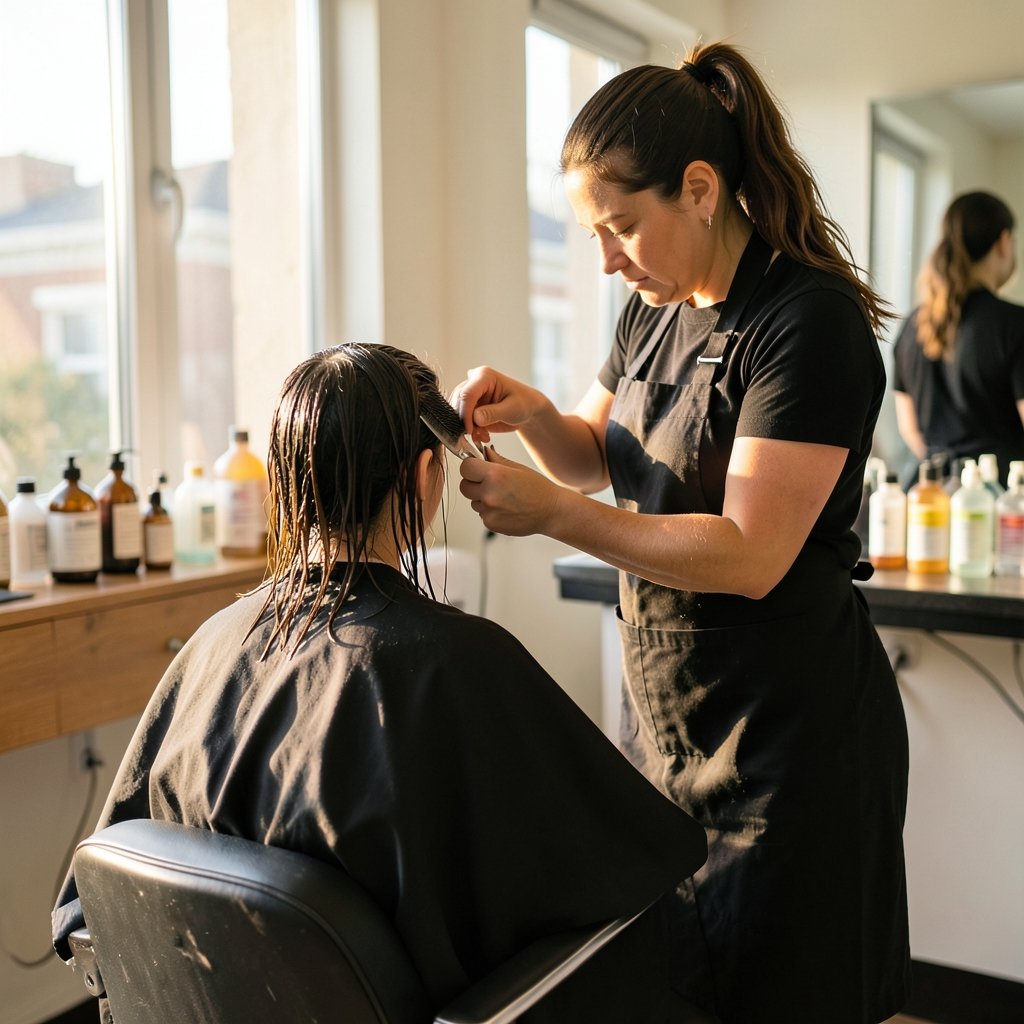
A haircut is a small act of engineering. Most of the outcome is decided before the scissors move, and the difference between a cut people love and one they tolerate usually comes down to communication rather than technique.
Bring Pictures, but Bring the Right Ones
Photos help, but only if they match your situation. A picture of a model with thick, straight hair tells a stylist very little about what will work on fine, curly hair. The practical move is to find images of people with a similar hair texture, density, and face shape. Two or three references beat a phone full of screenshots, because they let the stylist see the pattern in what you like. (Hair loss)
Say What You Mean by “Short”
“Just a trim” and “a little off the top” are among the most misunderstood phrases in the business. A trim can mean a quarter inch to one person and two inches to another. The fix is boring and effective: agree on a number. Most stylists will happily show you how much they plan to remove before they start.
Know the Difference Between Consultation and Cutting
A good appointment starts with a short conversation about routine, styling time, and how often you plan to come back. Someone who air-dries and never touches a product should not leave with a cut that only works after twenty minutes with a round brush. This is the single most common source of disappointment, and it is entirely preventable.
Common Mistakes That Cost Money
- Cutting curly hair dry without asking. Curly hair shrinks dramatically when dry, so a wet cut can end up far shorter than expected.
- Skipping the “what did you hate last time” question. Stylists cannot fix a problem they do not know about.
- Booking a brand-new stylist for a major change. Big transformations are better tested on a smaller scale first.
- Ignoring growth patterns. A cowlick will win every argument with a pair of scissors, so plan around it rather than against it.
How Often Should You Actually Go?
Frequency depends on length, texture, and how sharp you want the shape to stay. There is no universal rule, but there are useful ranges. (Hairstyle)
| Hair Type or Goal | Typical Interval | Why |
|---|---|---|
| Short, structured cuts | 3 to 5 weeks | Shape collapses quickly once sides grow out |
| Medium length | 6 to 8 weeks | Maintains outline without constant visits |
| Long hair, healthy ends | 8 to 12 weeks | Prevents split ends from traveling upward |
| Curly hair | 8 to 12 weeks | Curls need length to form properly |
| Growing it out | 10 to 14 weeks | Less frequent trimming preserves progress |
The honest answer is that maintenance schedule matters more than any chart. Someone with a high-visibility job and a tight fade needs a different rhythm than someone working from home in a beanie.
The Finance Meaning Nobody Expects
Here is where the word takes a hard turn. In banking and investing, a haircut is the discount applied to the value of an asset when it is used as collateral. If a bank lends against securities worth a million dollars, it might only count eight hundred thousand of that value, protecting itself against price swings. The difference is the haircut.
The term also appears in restructuring, where creditors agree to accept less than they are owed, and in everyday journalism, where a “haircut” means a cut to pay, budgets, or benefits. Same word, entirely different world. Context does all the work, which is why a sentence like “the deal involved a significant haircut” makes perfect sense to a bond trader and no sense to a barber.
Haircuts, Culture, and Rules
Hair length has carried meaning far beyond fashion. Military organizations use standardized cuts for hygiene and uniformity. Some religious traditions treat hair cutting as a ritual or a restriction. Schools and workplaces have enforced dress codes that reached down to the length of a fringe. The word itself stays neutral, but what a haircut signals has never been neutral.
There is also a quiet linguistic split worth knowing. British English says fringe; American English says bangs. Both describe the same section of hair, and neither is a synonym for haircut itself. Mixing them up in writing aimed at a specific audience is a small tell that the text was not localized.
Writing About Hair Without Getting It Wrong
For anyone producing content, product copy, or client emails, a few habits prevent most errors.
Use haircut as the noun and cut as the verb. Write “book a haircut,” not “book a hair cut.” Write “get your hair cut,” not “get your haircut done” unless you are deliberately aiming for casual speech. In headlines, the single word is almost always correct.
For the finance sense, add context on first use. “The lender applied a 20% haircut to the collateral” is clear. “There was a haircut” is not. Readers outside finance will otherwise picture scissors.
And for service businesses, spell out what is included. Ambiguity about whether a price covers washing, drying, or styling causes more complaints than the cut itself. Clear language is cheaper than a refund.
What Good Looks Like in Practice
A successful haircut has less to do with trends than with fit. The cut that works is the one that suits the hair type, the daily routine, and the amount of upkeep the person is genuinely willing to do. That last part is where most advice falls short. A style that demands daily styling is a bad choice for someone who wants to roll out of bed and go, no matter how good it looks in a photo.
Practical habits that consistently pay off:
- Arrive with dry, clean hair when possible so the stylist sees the real texture.
- Describe the routine honestly, including how much time you will actually spend.
- Ask what the cut will look like in three weeks, as well as on day one.
- Confirm the price and what it includes before the first snip.
- Speak up early if something feels wrong. Adjustments mid-cut are easy; fixes afterward are not.
None of this is complicated, but it is the difference between a routine errand and a recurring frustration.
Conclusion
“Hair cut” is a small phrase carrying a surprising amount of weight. Spelled as one word, it names a service, a style, and a routine appointment. Spelled as two, it describes the act itself. In finance, it means a protective discount. In journalism, it means a reduction. The through-line is simple: context decides everything, and clarity is always the better choice.
Whether the goal is a sharper fade, healthier ends, or a sentence that reads cleanly in a report, the same principle applies. Say precisely what is meant, agree on the details before the work starts, and check the facts before repeating them. That approach works equally well in a salon chair and on a spreadsheet, which is a strange thing to say about a word most people learn before they turn ten. Yet it holds up, and it is the reason this ordinary term keeps turning up in places no one expects.
Frequently Asked Questions
Is it “haircut” or “hair cut”?
Both exist, but they do different jobs. Haircut is the standard noun for the act or the style. Hair cut is correct when “cut” is a verb, as in “she got her hair cut.” If you can replace the word with another noun like “jacket,” use the single word.
Why does “haircut” mean something in finance?
In lending and investing, a haircut is the percentage discount applied to an asset’s value when it serves as collateral. It protects the lender if prices fall. The same word also describes a reduction in pay, budgets, or debt repayments, so the surrounding sentence always determines the meaning.
How often should someone get a haircut?
It depends on length and texture. Short structured cuts usually need attention every 3 to 5 weeks, medium lengths every 6 to 8 weeks, and long hair every 8 to 12 weeks. Curly hair often does best on a longer cycle because it needs length to form shape.
Does cutting hair make it grow back faster?
No. Hair grows from the follicle, and trimming the ends has no effect on growth rate at the root. What regular trims do accomplish is removing split ends before they travel up the strand, which keeps hair looking fuller and healthier over time.
What should someone bring to a first appointment?
Two or three photos of people with similar hair texture and face shape work better than a large folder of images. It also helps to describe the daily routine honestly, including how much styling time is realistic, and to agree on how much length will come off before the cutting starts.
Is “hair-cut” with a hyphen ever correct?
It appears in some older texts but is not standard in modern usage. Most style guides treat the noun as one closed word and the verb phrase as two separate words. Hyphenating it is the least common of the three forms and is best avoided in professional writing.