
How to Design a Restorative Bedroom for Better Sleep
 Abdul WadoodLast updated

Roughly one in three adults doesn’t get enough sleep on a regular basis, according to the Centers for Disease Control and Prevention. That’s a striking number, and it explains why so many people treat sleep as a problem to be solved with supplements, apps, and gadgets. But the room itself, the one space people spend a third of their lives in, often gets overlooked. A bedroom designed for restoration isn’t about buying the most expensive mattress or painting everything beige. It’s about controlling four things: noise, light, temperature, and air. Get those right and almost everything else falls into place. (Sleep hygiene)
Why the Bedroom Environment Matters More Than Willpower
Most sleep advice focuses on behavior: go to bed earlier, put the phone down, stop drinking coffee at 4 p.m. Useful, sure. But behavior is hard to change and easy to abandon. The physical environment works quietly in the background, night after night, without requiring discipline. (About Sleep Hygiene)
The World Health Organization has flagged environmental noise as a major public health issue in Europe, linking nighttime exposure to sleep disturbance and long-term health effects. Light does something similar. Even dim light exposure before bed can suppress melatonin, the hormone that signals the body it’s time to wind down. And temperature? The body needs its core temperature to drop slightly to fall asleep, which is why a stuffy, overheated room can leave someone lying awake for an hour.
The takeaway is simple: the room does half the work for you. Design it well and sleep becomes easier by default. Design it poorly and every night is a small battle. (Where Design Meets the Horizon)
Start With Noise: The Invisible Sleep Thief
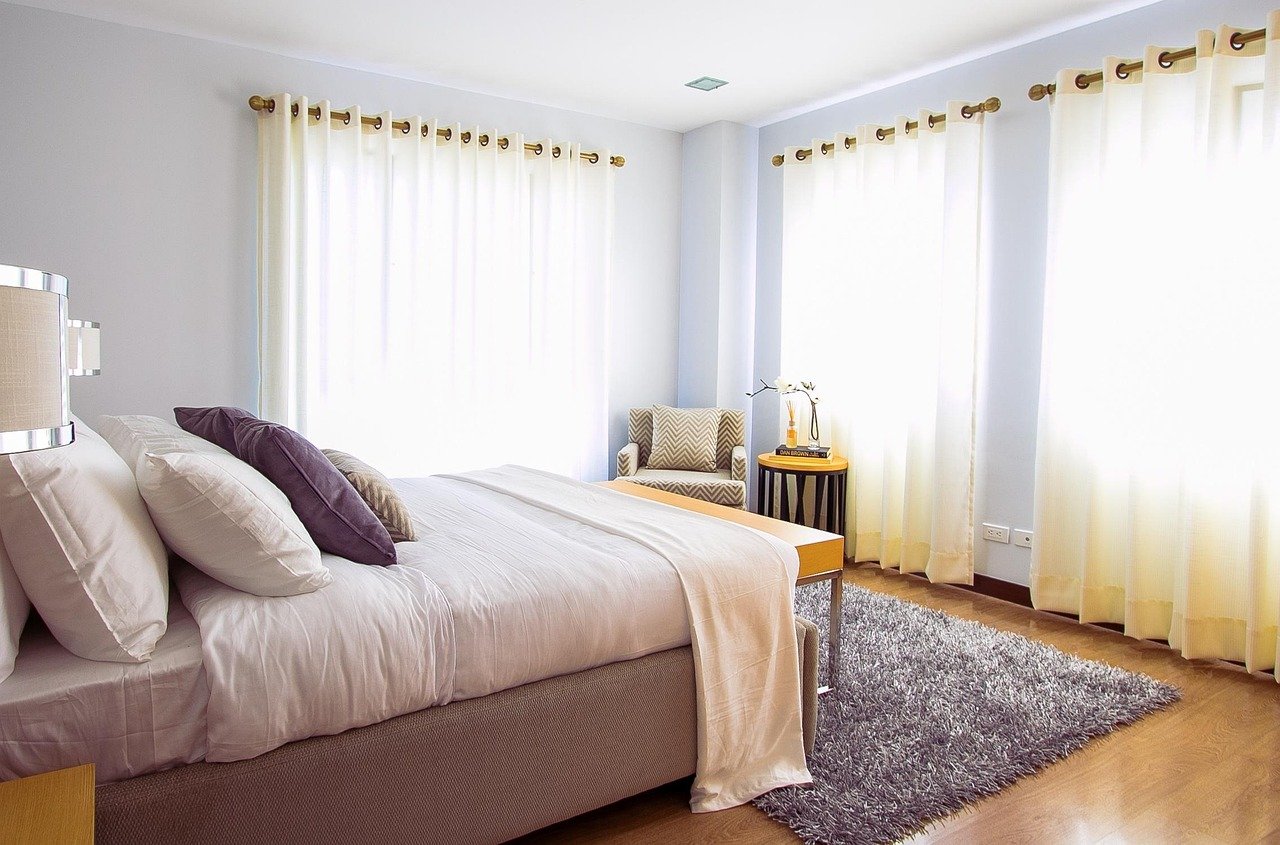
Noise is the most underestimated factor in bedroom design. A passing truck, a neighbor’s television, a dripping tap, a partner’s early alarm. None of these seem dramatic in isolation, but they fragment sleep in ways people don’t notice until they’re exhausted.
What actually works
- Seal the gaps first. Before buying anything, walk the room and find air leaks around the door frame, window sashes, and any vents. Acoustic sealant and door sweeps are cheap and surprisingly effective. Sound travels through air gaps far more readily than through solid walls.
- Address the source where possible. A rattling pipe or a loose window latch is a five-minute fix that removes a nightly irritant.
- Soften hard surfaces. Rugs, curtains, upholstered headboards, and bookshelves absorb sound and reduce echo. They won’t block a motorcycle outside, but they make the room feel calmer and cut down on reflected noise.
- Consider layered window treatments. A heavy curtain over a well-fitted window does more than a thin blind, especially when combined with proper sealing.
Common mistakes
People often buy a white noise machine before fixing an obvious rattle, or hang a single decorative rug in a room with bare floors and hard walls. The order matters: seal first, soften second, mask third. Masking noise with more noise should be the last resort, not the first move.
Light: Darkness Is a Design Decision
The body’s internal clock is highly sensitive to light, particularly the blue-rich light of morning and the bright screens people stare at until midnight. A restorative bedroom makes darkness the default and light the exception.
Practical steps
- Audit the room at night with the lights off. Stand in the doorway and look for glow: standby LEDs, chargers, a streetlight bleeding through the top of the curtain, the crack under the door.
- Fit blackout curtains properly. They need to overlap the window frame on all sides, ideally with a ceiling-mounted track or a generous return. A blackout fabric that hangs flat against the glass still leaks.
- Use low-level warm lighting for the last hour. Table lamps with warm bulbs, dimmers, and nothing overhead. Overhead light after dark tells the brain it’s midday.
- Cover or remove standby lights. A strip of electrical tape over a router LED takes ten seconds and is one of the most satisfying fixes in home design.
An eye mask is a reasonable backup for travel or for anyone who can’t control their curtains. It’s a patch, not a solution, but a patch that works is worth having.
Temperature and Air: The Two Factors People Get Wrong
Ask someone why they slept badly and they’ll usually blame stress. Ask them what their bedroom thermostat was set to and they’ll often shrug. Yet the thermal environment shapes sleep onset and how many times someone wakes during the night.
The temperature rule of thumb
Most sleep guidance points to a bedroom temperature somewhere in the mid-to-high 60s Fahrenheit (roughly 16 to 19°C). This isn’t a legal standard, just a widely used comfort range. What matters more is that the room is cool but not cold, and that the bedding can be adjusted. Layering a light duvet over a breathable cotton sheet gives more control than one heavy comforter.
Ventilation and CO₂
A closed bedroom with the door shut and no airflow accumulates carbon dioxide overnight. Some studies have linked elevated bedroom CO₂ to poorer sleep quality and next-morning grogginess, though the exact thresholds are still debated. The practical fix is unglamorous: crack a window, use a trickle vent, or run a fan to keep air moving. If the room feels stale in the morning, it probably is.
Humidity
Dry air irritates the nose and throat and can make breathing uncomfortable. A humidity level somewhere between 30 and 50 percent is a sensible target. In winter, a humidifier helps; in summer, a dehumidifier or air conditioning does the opposite job. Both are worth having in the right climate.
Clutter, Calm, and the Psychology of the Room
There’s a reason so many design guides circle back to tidiness. Research on clutter and stress has found associations between disordered spaces and elevated cortisol, though the causal direction isn’t fully settled. What’s clear from practice is that visual noise competes for attention. A bedroom full of laundry, paperwork, and exercise equipment doesn’t feel like a place to switch off. (Voozon Luxury)
The fix isn’t minimalism for its own sake. It’s giving everything a home:
- A lidded basket for clothes that aren’t dirty but aren’t clean
- A drawer or tray for phones, watches, and chargers
- Closed storage for anything that doesn’t need to be seen at 11 p.m.
- A dedicated spot for the things that pile up on the nightstand
Design details matter here in a way that’s easy to underestimate. The design details that define a driver’s car are about reducing friction and creating a sense of control, and a bedroom works on the same principle. Small, deliberate choices, from where the light switch sits to how the door closes, shape how the room feels. For anyone interested in how this plays out across other design disciplines, luxury design coverage offers a useful parallel. (Art, Design & Modern Trends)
Choosing Materials That Breathe
Bedding and surfaces do more than look good. They regulate moisture and heat.
| Material | Strengths | Watch out for |
|---|---|---|
| Cotton (percale) | Breathable, crisp, durable | Wrinkles easily |
| Linen | Excellent airflow, gets softer with washing | Expensive, creases |
| Bamboo viscose | Silky, moisture-wicking | Can pill over time |
| Microfiber | Cheap, smooth | Traps heat |
| Wool (blankets) | Temperature-regulating | Needs careful washing |
Natural fibers generally breathe better than synthetics, which matters for anyone who runs warm. Mattress choice matters too, but a firm mattress with a breathable cover and a washable protector covers most needs. Pillows are worth replacing more often than most people do; a flat, lumpy pillow undermines everything else.
Sound, Scent, and the Senses
Beyond noise, the other senses deserve a moment. Scent is powerful and personal. Lavender gets mentioned constantly, but the honest answer is that scent preferences vary enormously and the evidence for aromatherapy improving sleep is mixed. What works is a scent the sleeper associates with winding down, used consistently and lightly. Strong synthetic fragrances can irritate airways, which defeats the purpose.
Sound works similarly. Some people sleep better with a fan or a low hum; others need silence. There’s no universal answer, which is why testing for a week or two beats guessing. A simple approach: try a week with the window cracked, a week with a fan, and a week with nothing, and see which mornings feel best.
Layout and Function: One Room, One Job
The bedroom is the most overworked room in many homes. It becomes an office, a gym, a cinema, and a storage unit. Each added function brings its own light, noise, and mental associations.
Where space allows, keep the bed as the visual anchor and push work surfaces, screens, and exercise gear elsewhere. If a desk has to live in the bedroom, screen it off or cover it at night. The goal is a room that signals rest the moment someone walks in. This is the same principle behind designing a home that feels personal: the space should reflect how it’s actually used, not how a catalog says it should be.
A Realistic Checklist for a Weeknight Redesign
Not everyone can renovate. Most people can do this in a weekend:
- Seal gaps around the door and windows.
- Fit blackout curtains that overlap the frame.
- Cover standby LEDs with tape.
- Move the phone charger out of arm’s reach.
- Clear the nightstand to three items maximum.
- Wash the bedding and swap to breathable layers.
- Crack a window or set a vent for overnight airflow.
- Set the thermostat to the cool end of comfortable.
None of these steps is expensive. Together they change how the room performs.
Conclusion
A restorative bedroom isn’t a luxury purchase or a styling exercise. It’s a controlled environment built around four unglamorous variables: noise, light, temperature, and air. Seal the gaps, black out the light, keep the room cool and ventilated, and clear the visual clutter. Then let the room do its job. The best bedroom design is the one nobody notices, because it disappears into a good night’s sleep.
How much does it cost to make a bedroom more sleep-friendly?
Less than most people expect. Sealing gaps, covering LEDs, and rearranging furniture cost almost nothing. Blackout curtains, a door sweep, and breathable bedding are the main expenses, and they typically cost far less than a new mattress or a sleep-tracking device.
Is a completely dark bedroom necessary?
Not completely, but darker is generally better. Even small light sources can interfere with melatonin production and make it harder to fall asleep. Blackout curtains and covered LEDs get most rooms close enough, and an eye mask handles the rest.
What is the ideal bedroom temperature for sleep?
Most guidance points to roughly 16 to 19°C (the mid-to-high 60s Fahrenheit). This is a comfort range rather than a strict rule, so the right number is the one that lets someone fall asleep without feeling too warm or too cold. Layered bedding gives flexibility.
Does ventilation really matter for sleep quality?
Yes. A closed, stuffy room accumulates carbon dioxide overnight, and some research links elevated bedroom CO₂ to poorer sleep and morning grogginess. Cracking a window, using a trickle vent, or running a fan keeps air moving with minimal effort.
Should I use a white noise machine?
Only after fixing the obvious problems. Sealing gaps and softening hard surfaces address many noise issues directly. If background noise from outside is unavoidable, a fan or white noise machine can help mask it, but it shouldn’t be the first purchase.
How do I stop my bedroom from feeling like an office?
Separate the functions as much as possible. Move screens and work surfaces out, or screen them off at night. Keep the bed as the visual focus, store paperwork out of sight, and reserve the room for sleep and rest wherever space allows.