
Cars Movie Characters: Complete Guide to Radiator Springs
 Abdul WadoodLast updated

When Cars rolled into U.S. theaters on June 9, 2006, it did something unusual for an animated film: it turned a rusty tow truck into a fan favorite. Mater, voiced by Larry the Cable Guy, became the breakout star of a franchise that now spans three theatrical films, a Disney+ series, and two Planes spin-offs. That kind of character work is why the Cars movie characters still anchor merchandise aisles nearly two decades later. (Disney Official Site)
This guide breaks down who the main characters are, what drives them, and why the franchise’s casting and design choices worked so well. It also covers the real-world inspirations behind the fictional town of Radiator Springs and the practical details fans most often get wrong.
The Core Cast of the Original Cars (2006)
The first film is a classic underdog story dressed up in racing leather. Directed by John Lasseter, it follows a rookie race car who gets stranded in a forgotten town on Route 66 and learns that winning isn’t everything.
Lightning McQueen
Lightning McQueen, voiced by Owen Wilson, is the protagonist. He starts as an arrogant rookie chasing the Piston Cup and ends the film as a humbled racer who values friendship over trophies. His arc is the spine of the entire franchise, and it’s the reason the sequels have somewhere to go.
Mater
Mater is a rusty tow truck and the film’s deuteragonist. Voiced by Larry the Cable Guy, he’s the emotional heart of Radiator Springs. He’s also the character who got his own spin-off series, Cars on the Road, on Disney+ in 2022. In practice, Mater is the character kids quote most, and that’s not an accident: his dialogue is written to be repeatable.
Doc Hudson
Doc Hudson, voiced by Paul Newman, is the town’s judge and medic, and a former racing legend hiding a painful past. This was Newman’s final film role; the actor died on September 26, 2008. The performance is restrained and quietly funny, and it gives the film a gravitas that animated movies rarely earn.
Sally Carrera
Sally Carrera, voiced by Bonnie Hunt, is a Porsche 911 who left a fast legal career in California for a slower life in Radiator Springs. She’s McQueen’s love interest and, more importantly, the character who articulates the film’s thesis: that a place can matter more than a career.
The Radiator Springs Ensemble
The supporting cast does a lot of heavy lifting. Each resident is a specific car model with a specific personality, which is why the town feels lived-in rather than designed.
| Character | Vehicle Type | Voice Actor | Role in the Story |
|---|---|---|---|
| Lightning McQueen | Stock race car | Owen Wilson | Protagonist, rookie racer |
| Mater | Tow truck | Larry the Cable Guy | Best friend, comic relief |
| Doc Hudson | 1951 Hudson Hornet | Paul Newman | Mentor, former racer |
| Sally Carrera | Porsche 911 | Bonnie Hunt | Love interest, town attorney |
| Ramone | 1959 Chevrolet Impala lowrider | Cheech Marin | Body shop owner, custom painter |
| Flo | 1950s show car | Jenifer Lewis | Runs the local diner |
| Luigi | Fiat 500 | Tony Shalhoub | Tire shop owner, Ferrari obsessive |
| Guido | Forklift | Guido Quaroni | Luigi’s assistant, pit crew prodigy |
| Fillmore | VW Microbus | George Carlin | Organic fuel evangelist |
| Sarge | Willys Jeep | Paul Dooley | Military surplus dealer |
| Sheriff | 1949 Mercury Police Cruiser | Michael Wallis | Town law enforcement |
| Red | Fire truck | Joe Ranft | Shy fire engine |
| Lizzie | 1923 Ford Model T | Katherine Helmond | Elderly shop owner |
| Mack | Hauler truck | John Ratzenberger | McQueen’s transporter |
That table is also a useful reminder of how much of the film’s charm comes from casting: Cheech Marin as a lowrider, George Carlin as a counterculture van, Tony Shalhoub as an Italian tire salesman. The voices match the vehicles, and that match is the joke.
Why the Character Design Works So Well
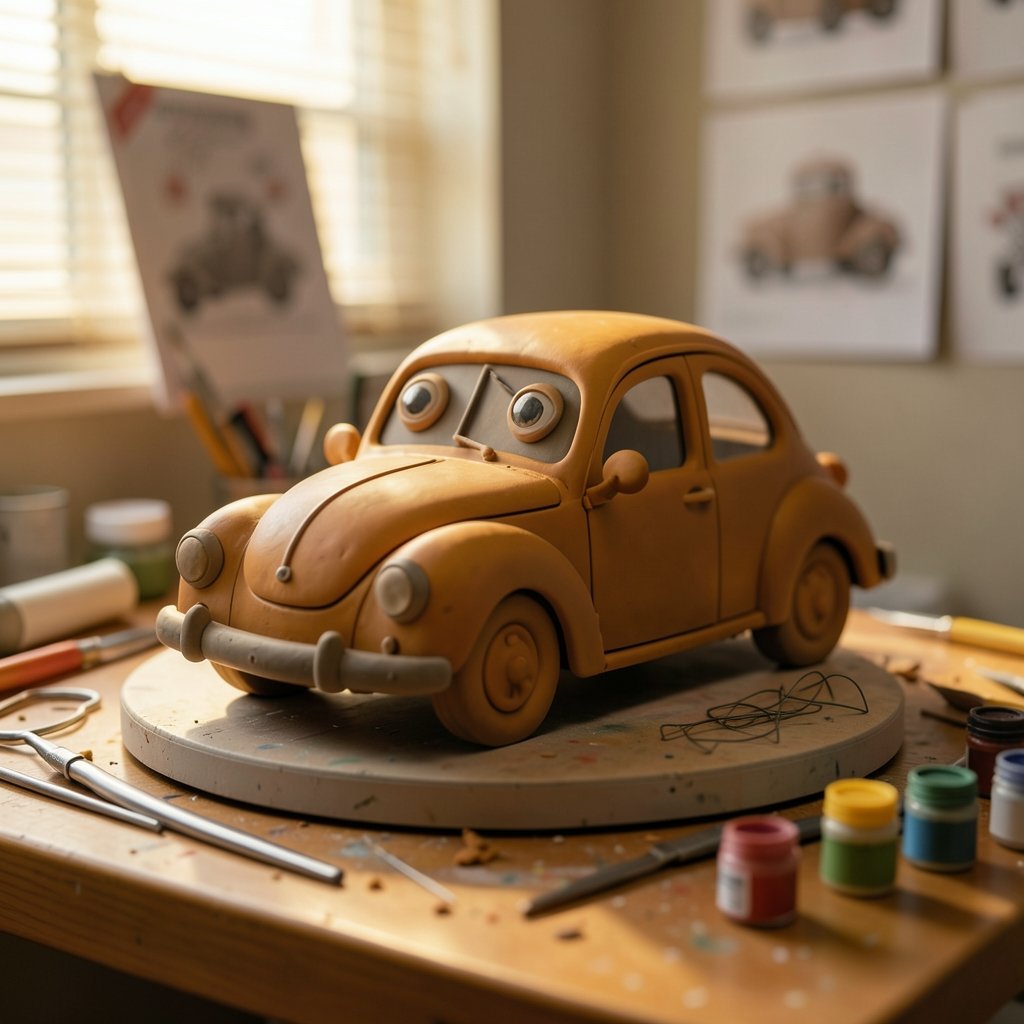
Pixar’s team made a decision early on that shaped everything: the cars have no hands, no visible drivers, and eyes placed in the windshield. That constraint forced the animators to solve problems creatively, and the solutions became the franchise’s visual signature.
The practical lesson for anyone studying character design is that limitations produce personality. Because the cars can’t gesture, they lean, swerve, and pop their tires. Because they can’t smile, the animators used bumper shapes and headlight angles. The result is a cast that reads instantly, even in silhouette.
For a deeper look at how the films build character through setting and story, the breakdown of the cars built around experience is worth reading alongside this guide.
The Real-World Inspirations Behind Radiator Springs
Radiator Springs is fictional, but it’s built from real American car culture. The town is a stand-in for the communities that Route 66 bypassed when Interstate 40 opened, and the film treats that history with genuine affection rather than nostalgia for its own sake.
The racing scenes draw on NASCAR conventions: the pack racing, the pit stops, the sponsor culture. The character of Doc Hudson references the real Hudson Hornet’s dominance in early 1950s stock car racing. And the film’s central theme, that progress can erase places worth saving, is a documented chapter of American infrastructure history.
If you want to compare how different animated and live-action car films handle character, the Voozon Cars reviews and comparisons hub collects side-by-side breakdowns that are useful for exactly this kind of analysis.
The Sequels and How the Cast Expands
Cars 2 (2011)
The second film pivots hard into spy territory. Mater becomes the protagonist, and the story sends the cast to Tokyo, Paris, and London for a World Grand Prix. New characters include Finn McMissile (Michael Caine), a British spy, and Holley Shiftwell (Emily Mortimer), a field agent.
The shift was divisive. Critics felt the franchise abandoned the small-town warmth that made the first film work, and the tonal jump from character drama to action comedy is the most common complaint. Still, the sequel expanded the world in ways that later projects leaned on.
Cars 3 (2017)
Directed by Brian Fee, the third film returns to racing and to McQueen’s interior life. It introduces Jackson Storm (Armie Hammer), a next-generation racer who represents automation and data-driven training, and Cruz Ramirez (Cristela Alonzo), a trainer who becomes a racer herself.
Cars 3 is the strongest of the sequels precisely because it treats McQueen’s decline as a real problem rather than a plot obstacle. It also gives the franchise its most satisfying ending: McQueen doesn’t win. He mentors.
Planes and Planes: Fire & Rescue
The Planes films (2013 and 2014) were produced by Disneytoon Studios and set in the same universe. They follow Dusty Crophopper, a crop duster who dreams of racing. They’re lighter and aimed at a younger audience, but they share the franchise’s core idea: a machine with a job discovers it can do more.
The Disney+ Era and Mater’s Spin-Off
Cars on the Road arrived on Disney+ in 2022 as a series of shorts following McQueen and Mater on a cross-country road trip. It’s the most relaxed entry in the franchise, and it works because it doesn’t need a plot. The characters are strong enough to carry loose, episodic storytelling.
That’s the real test of a character-driven franchise. When you can put two characters in a car and let them talk for twenty minutes, you’ve built something durable. For more franchise and vehicle coverage, the Voozon Cars guides cover related releases and comparisons in more depth. (Cars (franchise)))
Common Mistakes Fans Make About the Characters
A few details get muddled in fan discussions, and it’s worth correcting them plainly.
Mistake one: assuming Doc Hudson appears in later films. Paul Newman died in 2008, and the character was retired rather than recast. Doc appears in flashback and memory, but he isn’t voiced by a replacement in the theatrical sequels.
Mistake two: treating Mater as pure comic relief. He’s funny, but he’s also the character who delivers the franchise’s most quoted lines about friendship. Reducing him to a punchline misses why he became the breakout.
Mistake three: assuming the Planes films are Pixar productions. They were made by Disneytoon Studios, a different unit, which explains the different tone and animation budget.
Mistake four: expecting real car accuracy. The vehicles are stylized. A 1951 Hudson Hornet and a modern stock car don’t share proportions, and the films bend physics constantly. That’s a feature, not a flaw.
The practical takeaway: if you’re writing about these characters or building a fan resource, check the voice cast against a primary source before publishing. Cast lists are where errors spread fastest.
What the Franchise Gets Right About Character
The franchise’s biggest strength is that every character wants something specific. Luigi wants to sell a Ferrari tire. Fillmore wants people to stop burning gasoline. Sarge wants order. Those wants collide, and collision is comedy.
A second strength is restraint. The films rarely explain a character’s backstory in dialogue. Doc Hudson’s history is revealed through a newspaper clipping and a silent drive. That’s more effective than a monologue, and it’s a technique worth studying.
A third is consistency. McQueen’s voice, ego, and eventual humility stay recognizably his across three films and a series. The character grows without becoming someone else. That’s harder than it sounds, and it’s why the cast still resonates.
Conclusion
The Cars movie characters work because they’re specific. A tow truck with a dented bumper and a philosophy about life. A judge with a hidden racing career. A Porsche who chose a slower road. None of these are generic archetypes, and that specificity is why the franchise outlasted its lukewarm sequel reception and kept expanding into new formats.
For fans, the takeaway is simple: the films are best when they trust their characters to carry the story, not the spectacle. For anyone writing about them, the takeaway is equally simple: verify the cast, check the release dates, and don’t confuse the Pixar films with the Disneytoon spin-offs. The details matter, and the characters deserve the accuracy.
Frequently Asked Questions
Who are the main characters in the Cars movies?
The core cast is Lightning McQueen (Owen Wilson), Mater (Larry the Cable Guy), Doc Hudson (Paul Newman), and Sally Carrera (Bonnie Hunt). The Radiator Springs ensemble includes Luigi, Guido, Ramone, Flo, Fillmore, Sarge, Sheriff, Red, Lizzie, and Mack. Later films add Finn McMissile, Holley Shiftwell, Jackson Storm, and Cruz Ramirez.
Who voices Mater in the Cars movies?
Mater is voiced by comedian Larry the Cable Guy across the theatrical films and the Disney+ series Cars on the Road. The character became the franchise’s breakout star and its most quoted figure.
Was Doc Hudson Paul Newman’s last film role?
Yes. Paul Newman voiced Doc Hudson in the 2006 original, and it was his final film performance. Newman died on September 26, 2008. The character was retired rather than recast in later films.
What town is Radiator Springs based on?
Radiator Springs is fictional, but it’s modeled on real Route 66 communities that were bypassed when Interstate 40 opened. The film draws on the history of American roadside towns and on NASCAR racing culture for its competition scenes.
How many Cars movies are there?
There are three theatrical Pixar films: Cars (2006), Cars 2 (2011), and Cars 3 (2017). Two spin-off films, Planes (2013) and Planes: Fire & Rescue (2014), were produced by Disneytoon Studios. A Disney+ series, Cars on the Road, debuted in 2022.
Is Cars 2 about Mater?
Yes. Cars 2 shifts the protagonist role to Mater, who becomes entangled in an international spy plot while accompanying McQueen to a World Grand Prix. The film was divisive among critics for departing from the small-town tone of the original.