
Luxury Modern Kitchen Designs That Work in 2026
 Abdul WadoodLast updated
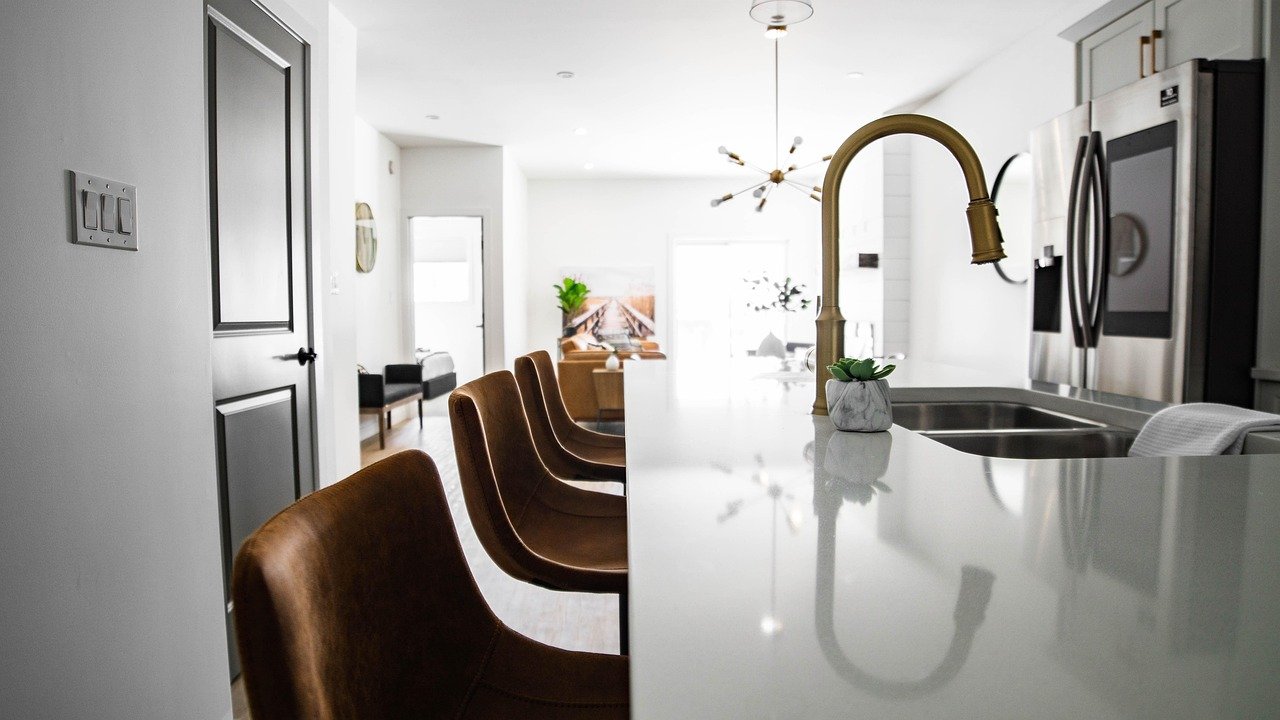
What makes a kitchen feel expensive: the marble, or the fact that you can open every drawer with one finger while holding a hot pan? Most people assume it’s the marble. They’re wrong, and the gap between what looks luxurious in a photo and what feels luxurious after two years of cooking is where nearly every costly renovation mistake lives.
This guide looks at luxury modern kitchen design as a working system rather than a mood board. It covers where the style came from, which choices hold up, which ones quietly fail, and how to tell real quality from expensive-looking shortcuts. (Defines modern luxury value meaning new status codes)
What “modern” really means in a luxury kitchen
The word gets used loosely, so it helps to know its roots. Modern kitchen design is a mid-century idea before it’s an aesthetic one. The Frankfurt Kitchen, designed by Margarete Schütte-Lihotzky and installed in Frankfurt housing from 1926, is widely credited as the first mass-produced fitted kitchen. Its logic was workflow efficiency: short walks, built-in storage, surfaces at working height. That efficiency argument still underpins every serious luxury kitchen today, even when the finishes are hand-picked stone. (Kitchen)
Modern luxury, in other words, isn’t a look. It’s a set of decisions about how a room performs. The visual language (flat fronts, integrated appliances, minimal hardware) follows from that.
Modern vs. contemporary vs. minimalist
These three get mixed up constantly, and the confusion costs people money.
| Style | Core idea | Typical signals | Common mistake |
|---|---|---|---|
| Modern | Function-first design lineage, clean geometry | Flat slab doors, integrated appliances, honest materials | Treating it as a color palette |
| Contemporary | What’s current right now, changes yearly | Mixed metals, warm neutrals, curved islands | Chasing trends that date fast |
| Minimalist | Reduction to essentials | Handleless fronts, hidden storage, few objects | Confusing empty with functional |
A kitchen can be modern without being minimalist, and contemporary without being modern. Knowing which one you actually want prevents the classic outcome: a room that photographs beautifully and frustrates everyone who cooks in it.
The planning rules that separate good kitchens from expensive ones
The work triangle is a guideline, not a law
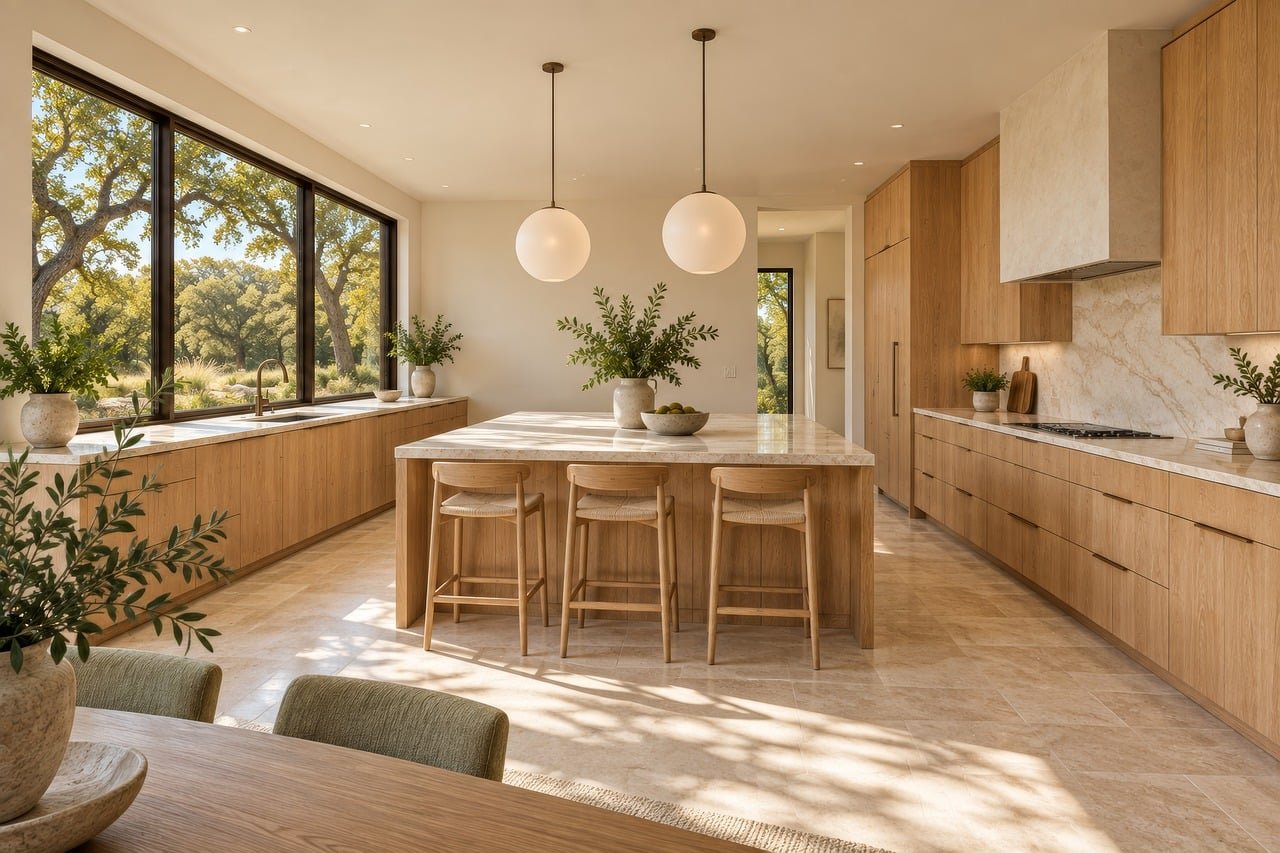
The work triangle connecting sink, stove, and refrigerator was developed in the 1940s at the University of Illinois Small Homes Council as a rule of thumb for efficient layouts. It has no legal force, and in large open-plan luxury kitchens it often breaks down: a triangle spanning eight meters isn’t efficient, it’s a hike. The better modern version is zones: prep, cooking, cleaning, and storage, each with its own tight cluster. Islands work best when they host one full zone rather than a bit of everything.
Accessibility and fair housing shape the layout
Luxury buyers increasingly plan for aging in place, and in multi-unit residential projects the law may require it. In the United States, the 2010 ADA Standards for Accessible Design set dimensional requirements such as clear floor space and reach ranges that apply to kitchens meant to be visitable. Separately, the Fair Housing Act’s design-and-construction requirements cover kitchens in most multifamily dwellings first occupied after March 13, 1991. Even in a single-family home, the practical version is simple: at least one work surface at a comfortable seated height, and drawers instead of deep base cabinets for daily items. It costs little at the planning stage and a fortune later.
Ventilation is a health decision
A luxury kitchen with a beautiful hood that vents nowhere is a common and costly error. Recirculating filters handle odors and grease reasonably but do not remove moisture or combustion byproducts. Residential mechanical codes generally require local exhaust for ranges, and recommended ventilation rates are published by the Home Ventilating Institute. If ducting to the exterior is impossible, plan for a recirculating system with a serious filter and accept the trade-off knowingly.
Materials: where luxury budgets are won and lost
Stone, engineered stone, and the silica question
Quartz countertops are engineered stone: crushed quartz bound with resin and pigment. That’s not a criticism, since engineered surfaces are consistent, non-porous, and easy to maintain. But the term is not a natural-stone designation, and buyers should ask exactly what they’re getting. Fabrication of quartz and other silica-bearing surfaces produces respirable crystalline silica dust, a recognized occupational hazard addressed by the OSHA silica standard. Ask your fabricator how they control dust, and prefer shops that cut wet or use enclosed equipment. It’s a fair question, and good fabricators welcome it.
Natural stone, by contrast, is porous and needs sealing. Marble etches when lemon juice lands on it. Neither is “better”; they fail differently.
| Surface | Strength | Weakness | Best for |
|---|---|---|---|
| Engineered quartz | Consistent, low maintenance | Heat sensitivity, seams visible on dark colors | Busy family kitchens |
| Marble | Unmatched depth and character | Etches and stains | Low-use prep areas, backsplashes |
| Granite | Heat tolerant, unique | Heavy, needs sealing | Statement islands |
| Sintered stone | Very hard, heat resistant | Brittle edges, fewer fabricators | Full-height backsplashes |
| Solid wood | Warm, repairable | Needs oiling, scratches | Butcher-block prep zones |
Cabinetry and the honesty test
The single biggest quality tell in any kitchen is the drawer, not the door. Open a drawer slowly: it should glide, close softly, and feel substantial when loaded. Ask what the box is made of, how the joints are cut, and what the load rating is. Full-extension, metal-sided drawer boxes with a high load rating cost more and are worth it. Particleboard boxes with stapled joints look identical from the outside and fail first at the corners.
For wood products, third-party certification is a useful filter. The Forest Stewardship Council certifies both forest management and chain of custody, so an FSC claim on cabinetry means the material can be traced through the supply chain. For indoor air quality, UL GREENGUARD certification covers low chemical emissions for products including cabinetry and furniture, which matters in tightly sealed modern homes.
Appliances and efficiency standards
Appliance efficiency standards in the US are updated periodically, and the current requirements shift over time. Check the US Department of Energy appliance and equipment standards program for the rules in force before specifying. Two practical notes: integrated appliances look seamless but constrain future replacement to the same dimensions, and panel-ready refrigerators need ventilation planned into the cabinetry, not added afterward.
Layout, light, and the details people notice
Lighting in layers
A luxury kitchen needs at least three lighting layers: ambient (ceiling), task (under-cabinet and over-island), and accent (inside cabinets, toe-kick). The Illuminating Engineering Society publishes recommended illuminance levels for residential spaces, which are consensus recommendations rather than law. In practice, aim for bright, even task light over work surfaces and dimmable everything else. The most common mistake is a single row of recessed lights that casts shadows exactly where you chop.
Storage that disappears
Handleless fronts, pocket doors, and appliance garages all serve one goal: fewer visual interruptions. The trap is that hidden storage only feels luxurious if it’s organized. Deep pull-out pantries with adjustable shelving beat clever concealed compartments that hold three items. Plan storage by category (dry goods, small appliances, everyday dishes) rather than by available wall space.
The quiet luxury question
Understated materials and restrained palettes have become a status signal in their own right, a shift explored in writing on the new language of modern luxury and how modern luxury value now gets defined through new status codes. In kitchens, that shows up as fewer statement pieces, better hardware, and stone with visible character rather than uniform pattern. It’s a more demanding aesthetic than maximalism, because there’s nowhere to hide a poor joint or a misaligned door.
The same restraint appears in interiors more broadly: quiet luxury interior design in understated rooms signals real quality through proportion and material rather than ornament. Kitchens are where that philosophy gets tested hardest, because the room has to work.
Practical tips and common mistakes
- Mock up the workflow before you commit. Tape the footprint on the floor and walk a full meal prep, from fridge to sink to stove. Most layout problems surface in ten minutes of pretending.
- Decide the ventilation route first. Ducting decisions constrain ceiling heights, cabinetry, and island placement. Settle it before finishes.
- Budget for the invisible. Good hinges, drawer runners, and a proper exhaust system cost real money and deliver most of the daily satisfaction.
- Reserve 10 to 15 percent contingency. Stone breaks, appliances get discontinued, and walls are never square.
- Test samples in your own light. A stone that looks warm in the showroom can read gray under north-facing windows.
- Plan for appliance replacement. Standardize cabinet openings where you can, and keep the spec sheet.
- Don’t over-glaze. Too many glossy surfaces show every fingerprint. Mix in matte and textured finishes.
The most frequent mistake overall is treating the kitchen as a visual project first. The second most frequent is skipping the lighting plan until the electrician is already on site.
Where the style is heading
Design lineage matters here. Houses like Givenchy, whose history runs from 1952 Paris couture to modern luxury, show how a fashion house translates restraint and precision into objects. That same logic now shapes kitchens: fewer, better elements, and materials that show their age gracefully. The parallel with Dior’s brand history and its shaping of modern luxury fashion is instructive too, because both houses built status on cut and proportion rather than decoration.
For kitchens, the practical translation is durable surfaces, repairable finishes, and layouts that adapt as households change. Organic modern design, which blends natural materials with clean lines, is a useful reference point for anyone who wants warmth without clutter. The through-line is longevity: a kitchen that still feels right in fifteen years was never really about the trend cycle.
Conclusion
Luxury modern kitchen design is a performance discipline dressed in beautiful materials. The Frankfurt Kitchen’s efficiency logic, the work triangle’s practical limits, accessibility standards, ventilation codes, and the honest feel of a well-made drawer all matter more than the stone sample you fall in love with first. Get the workflow, the light, and the hardware right, and the finishes will have something solid to sit on. Get those wrong, and no slab of marble will rescue the room.
Frequently asked questions
Is a quartz countertop considered luxury?
It can be, but the label is about execution rather than material category. Quartz is engineered stone, and high-end versions with tight tolerances and good edge detailing perform beautifully. What separates luxury from ordinary is fabrication quality, seam placement, and how the surface is integrated with the cabinetry.
How much space do you need for a luxury modern kitchen?
There’s no minimum, but efficiency matters more than square footage. A well-zoned kitchen of 15 to 20 square meters can outperform a poorly planned 40. The key is keeping each work zone tight and avoiding long walks between sink, stove, and refrigerator.
Do luxury kitchens need a work triangle?
Not strictly. The work triangle is a 1940s heuristic, not a requirement, and it becomes less useful in large open-plan layouts. Zones, where each task has its own clustered area, often work better in modern designs.
Is marble a bad choice for a busy kitchen?
It’s a trade-off, not a mistake. Marble etches when acids like lemon juice or vinegar sit on it, and it stains if unsealed. Many households use marble on islands or backsplashes and a harder engineered surface on the main prep areas.
How do I check if cabinetry is genuinely high quality?
Focus on the drawer, not the door. Ask about the drawer box material, joint construction, and load rating, and test a loaded drawer for smooth, soft-close travel. Full-extension metal drawer boxes with high load ratings are the clearest signal of quality.
What ventilation do modern kitchens actually need?
Plan for exterior-vented exhaust where possible, sized to the range and installed to local mechanical code. Recirculating hoods handle odors and grease but don’t remove moisture or combustion byproducts, so choose them only when ducting truly isn’t feasible.