
Quietest Luxury Cars: What Makes a Cabin Silent
 Abdul WadoodLast updated
A whisper is roughly 30 decibels. A normal conversation sits near 60. And at highway speed, the quietest luxury cars can pull their cabins down into the mid-to-high 50s dB(A) — meaning a passenger can hold a soft conversation at 70 mph without raising their voice. That single number explains why engineers spend millions chasing silence, and why “quiet” has become one of the most contested claims in the luxury market.
But here’s the catch: quietness is one of the hardest car qualities to compare honestly. Test methods differ, tires change everything, and a car that feels tomb-like on smooth asphalt can roar on coarse concrete. This guide breaks down what actually makes a luxury car quiet, which models consistently earn a place in the conversation, and the mistakes buyers make when they assume a badge guarantees silence.
Why Quiet Is an Engineering Problem, Not a Feature
Sound enters a cabin through four main paths: the engine and drivetrain, the tires and road surface, the wind rushing over the body, and vibration traveling through the car’s structure. Each path needs a different fix, which is why genuine quietness is expensive.
Above roughly 50 mph (80 km/h), tire and road noise usually dominate. Below that, engine noise and vibration matter more. This is a crucial point that many buyers miss: a car that’s serene in a 30 mph test drive can turn noisy the moment it merges onto a highway. Wind noise becomes the third player at higher speeds, driven by mirror shape, door seals, and how well the body gaps are sealed. (Noise-induced hearing loss)
The engineering toolkit is well established across the industry:
- Acoustic laminated glass on side windows, which sandwiches a sound-absorbing layer between glass panes
- Active noise cancellation (ANC) that uses the audio system’s speakers to cancel low-frequency drone
- Thicker carpeting, dash insulation, and sound-deadening mats in the floor and firewall
- Sealed body gaps and multi-layer door seals to block wind intrusion
- Active engine mounts that isolate vibration before it reaches the chassis
None of these are exotic. The difference between a quiet car and a loud one is usually how thoroughly and how consistently a manufacturer applies them — including on the base trim, not just the flagship.
How Quietness Is Actually Measured
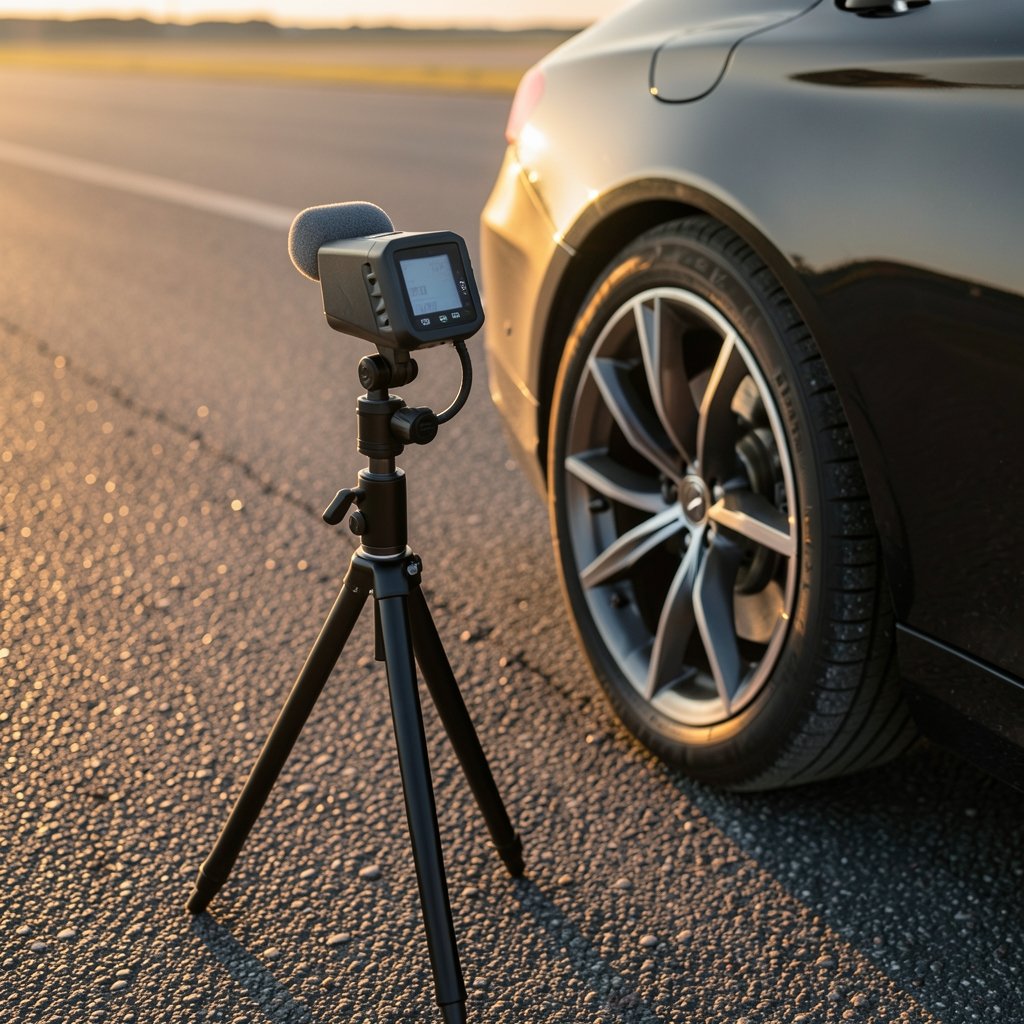
Interior noise is expressed in dB(A), a decibel scale weighted to how human hearing perceives sound. Because the scale is logarithmic, a few decibels represent a meaningful real-world difference. Dropping from 65 to 60 dB(A) isn’t a 5% improvement — it’s a substantial reduction in perceived loudness. (Deafness and hearing loss)
The problem is comparability. Publications like Germany’s ADAC and Auto Motor und Sport, and America’s Car and Driver, each run their own protocols. They test at different speeds, on different road surfaces, with different tires, and with microphones in different positions. There are formal standards — ISO 362 covers pass-by noise, and SAE publishes interior-noise test practices — but consumer comparisons rarely apply them identically.
The practical consequence: a dB(A) figure is only meaningful next to another figure measured the same way. A 58 dB(A) result from one magazine and a 62 dB(A) result from another may describe cars that are effectively equal, or may not. Treat any cross-publication “quietest car” ranking as a rough signal, not a verdict.
The Models That Keep Appearing at the Top
Certain cars show up again and again in quietness discussions, and the pattern is instructive. The Mercedes-Benz S-Class and its electric sibling, the EQS, are perennial references, as are the BMW 7 Series and i7. Lexus built much of its reputation on the hushed LS sedan and LX SUV. At the very top of the price ladder sit the Rolls-Royce Ghost and Phantom and the Bentley Flying Spur. The Genesis G90 has earned a place as a value-conscious alternative, and electric flagships like the Lucid Air join the conversation on the strength of having no engine at all.
| Model | Type | Reputation for quiet | Typical strength |
|---|---|---|---|
| Mercedes-Benz S-Class | Combustion sedan | Very high | Broad insulation, ANC, acoustic glass |
| Mercedes-Benz EQS | Electric sedan | Very high | No engine noise, sealed body |
| BMW 7 Series / i7 | Sedan (both) | Very high | Thick glazing, active isolation |
| Lexus LS | Combustion sedan | High | Engine refinement, isolation |
| Rolls-Royce Ghost | Ultra-luxury sedan | Exceptional | Mass, double glazing, bespoke damping |
| Bentley Flying Spur | Ultra-luxury sedan | Exceptional | Heavy insulation, smooth drivetrain |
| Genesis G90 | Luxury sedan | High | Strong value, generous sound deadening |
| Lucid Air | Electric sedan | High | Silent drivetrain, low wind noise |
Notice what the table doesn’t say. It doesn’t rank them, because no single test ranks them fairly. It also doesn’t claim any of them is the quietest — that title shifts with every model-year refresh and every tire change.
The Electric Car Myth
There’s a widespread assumption that electric cars are automatically quieter. They aren’t. Removing the engine removes one noise source, but it also removes the masking effect that engine sound provides. Without it, wind and tire noise become far more noticeable — and at highway speed, some EVs actually trail the best combustion flagships.
This surprises buyers who expect a silent experience. An electric luxury sedan may be eerily quiet in city traffic and then reveal pronounced road roar on a coarse highway surface. The lesson: electric does not equal quiet. It changes which noises you hear, and it raises the bar for wind and tire suppression.
This is part of a broader shift in how luxury is defined. Where prestige once meant engine smoothness and leather, it increasingly means calm, filtered, controlled experience — a theme worth exploring in any serious look at the new language of modern luxury. Quietness is one of the clearest expressions of that shift, because it’s felt every second rather than seen.
Practical Tips for Judging Quietness Yourself
Showroom impressions are unreliable. Here’s what actually works when you’re evaluating a car:
- Drive the exact route you’ll drive daily. City streets flatter almost every luxury car. Insist on highway speeds for at least ten minutes.
- Test on multiple surfaces. Smooth asphalt hides tire noise. Find a stretch of coarse or grooved pavement — that’s where differences appear.
- Check the tires, not just the car. Tire choice can swing cabin noise by several decibels. Ask what’s fitted and whether a quieter touring tire is available.
- Turn the audio off completely. Dealers often demo with music playing. Silence reveals wind leaks, rattles, and tire drone.
- Sit in the back seat too. Insulation is sometimes thinner toward the rear, and rear passengers often hear more road noise.
- Listen at a steady cruise, not under acceleration. Constant-speed noise is what you’ll live with on long trips.
Common Mistakes Buyers Make
The biggest error is assuming the badge guarantees silence. Trim levels matter enormously — base models sometimes skip acoustic glass or extra insulation that higher trims include. A second mistake is judging a car by its engine refinement alone; a silky engine means little if tire roar dominates. A third is trusting a single review’s dB(A) number without checking the test conditions. And a fourth is overlooking wheel size: larger wheels with thinner tire sidewalls often transmit more road noise, so the sportiest-looking spec can be the loudest.
What Quietness Costs — and Where It’s Heading
Silence is heavy. Sound deadening adds mass, and mass costs fuel and range. That tension is central to how manufacturers approach the problem, and it connects directly to broader questions about the future of luxury living, where calm, privacy, and sensory control are becoming the real currency of premium products.
Active noise cancellation is the escape route. Instead of adding kilograms of insulation, engineers can use microphones and speakers to cancel unwanted frequencies electronically. It’s cheaper, lighter, and tunable — and it’s spreading down the price ladder. Expect ANC to become standard in mid-luxury cars within a few model cycles, narrowing the gap between a $60,000 sedan and a $200,000 flagship.
The other shift is structural. Electric platforms let designers seal bodies more aggressively and shape them for lower wind noise, because there’s no exhaust or engine bay to ventilate. That gives EVs a real advantage in wind and drivetrain noise — provided the manufacturer takes tire and road noise seriously. The best electric flagships do; the mediocre ones don’t, and the difference is obvious within seconds on a highway.
For buyers who care about the complete sensory package, quietness rarely stands alone. It pairs with ride quality, seat comfort, and material refinement — the same qualities that define the best luxury resorts for your next getaway in the travel world. Calm is the common thread, whether you’re in a cabin at 70 mph or a suite at sea level.
How to Shortlist the Right Car for You
Rather than chasing a single “quietest” title, build a shortlist around your actual driving. If most of your miles are highway, prioritize cars with strong tire-noise suppression and acoustic side glass. If you drive mostly in town, engine refinement and low-speed isolation matter more. If you’re going electric, test the highway specifically — that’s where the absence of engine masking exposes weaknesses.
It also helps to look at how the industry frames the driving experience itself. The best modern cars are increasingly designed around feel rather than raw specification, a philosophy explored in this look at the cars built around experience. Quietness is a textbook example: it’s not a number on a spec sheet but a quality you notice — or miss — every single day.
Conclusion
The quietest luxury cars aren’t defined by a single badge or a single decibel figure. They’re the ones that apply insulation, acoustic glass, active cancellation, and careful tire specification consistently across the whole car — and that hold up at highway speed on coarse pavement, not just in a showroom. The Mercedes S-Class and EQS, BMW 7 Series and i7, Lexus LS, Rolls-Royce Ghost, Bentley Flying Spur, Genesis G90, and Lucid Air all earn their place in the conversation, but for different reasons and with different weaknesses.
The smartest approach is to stop asking “which car is quietest?” and start asking “which car is quietest for the way I drive?” Test at speed, test on bad surfaces, check the tires, and listen with the stereo off. Do that, and the answer becomes obvious in minutes — no dB(A) chart required.
FAQ
Are electric cars quieter than gas luxury cars?
Not automatically. EVs eliminate engine noise, but they also remove the sound that masks wind and tire noise. At highway speed, some EVs are actually louder than the best combustion flagships because road roar becomes more noticeable. The quietest EVs invest heavily in acoustic glass, sealed bodies, and low-noise tires.
What is a good dB(A) level for a luxury car cabin?
There’s no universal benchmark because test methods vary. As a rough guide, mainstream luxury sedans often land in the mid-60s dB(A) at highway speed, while the quietest large flagships can dip toward the high 50s. Only compare figures measured under identical conditions.
Does active noise cancellation really work?
Yes, for low-frequency sounds like engine drone and tire hum. ANC uses microphones and speakers to cancel specific frequencies electronically. It’s effective but not a substitute for physical insulation against wind and higher-frequency noise. It’s also lighter and cheaper than adding sound-deadening material.
Why do bigger wheels make a car louder?
Larger wheels typically come with thinner tire sidewalls, which absorb less road vibration and transmit more noise into the cabin. A car specified with large sport wheels can be noticeably louder than the same model on smaller wheels with taller tires. If quietness matters, choose the smaller wheel option.
Do base trims have the same insulation as top trims?
Often not. Acoustic laminated glass, extra sound deadening, and active noise cancellation sometimes appear only on higher trims or as part of option packages. Always check the specific trim’s equipment list rather than assuming the model’s reputation applies across the range.
How can I test a car’s quietness on a test drive?
Drive at highway speed for at least ten minutes, include a stretch of coarse pavement, turn the audio off completely, and sit in the back seat as well as the front. Check which tires are fitted. Steady-speed cruising noise matters more than how the car sounds under acceleration.